Can Hong Kong Uncork Trading Of Wine in China?


HONG KONG -- As the global wine industry converges here this week to crack open the mainland Chinese market, this city is touting its prospects as a regional nexus for trade in wine.
On Wednesday, Hong Kong officially zeroed out its taxes on wine, and on Saturday morning the city will host a US$6.5 million auction of vintages, billed as the largest ever in Asia. Local importers, meanwhile, are scrambling to secure warehouse space for more bottles or, in some cases, build their own cellars.
"We already have the world-class infrastructure, logistics, financial and communication systems required and, more importantly, the discerning palate and ample appetite to become a wine trading and distribution center in Asia," said Henry Tang, Hong Kong's chief secretary, Tuesday at the opening of Vinexpo, a wine exhibition that splits its annual gatherings between the French region of Bordeaux and cities such as New York and Hong Kong. There are 692 exhibitors from 32 countries at the Hong Kong expo this year.
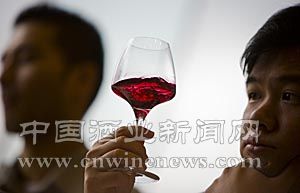 Reuters
Does it have what it takes? A man examines a glass of wine from Spain during a tasting at Vinexpo Asia-Pacific in Hong Kong on Wednesday.
Kevin Tang (no relation to Henry Tang), managing director of Hong Kong-based distributor Concord Wines, is wasting no time taking advantage of the new playing field.
He already has more than 70,000 bottles of wine stored in Hong Kong for the local market, but within six months, he says, he will build his own temperature- and humidity-controlled cellar right by Hong Kong's main port -- a move he says would cut costs and allow his company to "shift to a regional business." Restaurants, clubhouses and hotels in Hong Kong have been his main market, but Mr. Tang says 30% of his sales will come from neighbors like Taiwan, South Korea, Singapore and mainland China by the end of the year.
"Having the wine here really cuts down the shipping time," says Mr. Tang's sales manager, Francis Luk. "Before, if someone ordered a wine from France, it would take two months to get here. From here, we can fill an order in a few days."
A number of importers and merchants scouring Vinexpo shrugged their shoulders at the new measures. Hong Kong, while affluent, is a small market next to juicier prizes like mainland China, where conference organizer Vinexpo Overseas expects 13% growth a year in wine consumption over the next five years. China is the 10th-largest wine-consuming nation in the world, according to a 2008 study conducted partly by Vinexpo, accounting for 62.7% of all the wine consumed -- or 658 million bottles -- in Asia in 2006.
"If I'm trying to get into the China market, why would I ship my wine to Hong Kong and pay for storage here when I could just go straight to the destination?" says Ken Chan of Phi Cargo Services, a Hong Kong shipping company that works with wine importers. The company has operations in mainland China.
"I think everyone likes to position Hong Kong as a springboard into China, but the reality is, if you want to do business in China, you have to do business in China -- there is no substitute," says Simon Tam, a winemaker who has run popular wine-education programs in Hong Kong for nearly two decades.
And Hong Kong, while moving to slash taxes, still lacks the high-tech storage facilities that have made London and New York top-flight wine destinations. "You can't just say, 'I'm the wine hub,' and that's it," says Robert Beynat, chief executive of Vinexpo Overseas.
Still, in an interview this week, Mr. Beynat praised Hong Kong as "a natural hub" for the industry in Asia. "It's right in the middle of the map, whether you're talking about Singapore, Beijing, Shanghai or Tokyo," he says. Among Hong Kong's other advantages, he says: an abundance of tycoons, world-class hotels, wine knowledge and now, a tax-free environment.
Tom Sherwood, marketing manager at the Hong Kong office of British wine merchants Farr Vintners, says there was a "huge, huge spike" in orders after the government's decision to end the wine tax, keeping his staff in the office until after midnight for two weeks.
"It's the concentration of the companies, the talent, the people working in the industry," Mr. Sherwood says. "If they're based here, this is where the business is going to be done. Hong Kong is next to the mainland and to Macau, in a convenient central location, with a strong history as a shipping port, and now the tax situation.... If you want to sell, or if you want to buy, you're going to have to come to Hong Kong."
Winemaker Mr. Tam acknowledges the obstacles but sees a key role for Hong Kong as a tastemaker and example for China and the rest of Asia.
"I can envision in three years Hong Kong being a dream place for the industry, with a lot of personalities and authorities and knowledge," he says. "That's a model for China to perhaps tear apart and reconfigure."