Lawmakers hear Valley's plea on water


Residents tell legislators that a shortage would be disastrous, plan caravan to Sacramento.
|
KURT HEGRE / THE FRESNO BEE |
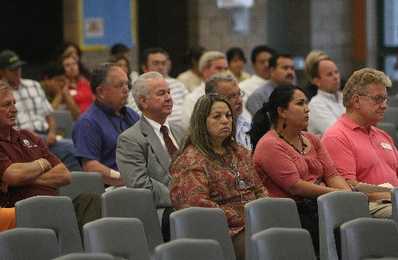
That promise -- along with talk of a need for a comprehensive solution to water needs -- was among testimony given Tuesday at Mendota High School before four members of the California Assembly. The central San Joaquin Valley's water shortage has caused many growers to abandon their crops and hundreds of farmworkers to lose their jobs.
The hearing, which drew about 100 people including officials from several cities outside the Westlands Water District, was led by Assembly Member Juan Arambula, D-Fresno.
Other Assembly members included Anthony Portantino, D-La Canada-Flintridge; Jose Solorio, D-Santa Ana; and Sally Lieber, D-Mountain View. They said the issue cannot be ignored.
"Each of us came from several hours away," Lieber said. "Juan is a good convincer."
The Assembly panel heard Riverdale farm labor contractor Piedad Ayala talk of plans for the caravan to the capital with "four or five buses." Ayala headed a similar action in 1990 because of a drought and consequent job losses.
"This problem is not affecting just farmers or farmworkers but also the consumer," Ayala said. "We're seeing ground turned into desert, seeing food in the supermarkets that is imported."
He said eliminating locally grown food is a dangerous trend -- that "the farmers here have to keep records" on pesticides and fertilizers they use.
Farmworker Jesus Borba with J&J Farms said he is concerned about the food he buys at the supermarket -- and for the future of the region.
"Help us maintain our family," he said through a translator.
Another J&J employee, Jose Luis Hernandez, lamented the condition of the fruits and vegetables he sees. "It's not as beautiful as before. There is less," he said.
Several told the panel that a long-term solution to water needs must be sought, and they backed Gov. Schwarzenegger's call for additional storage and an improved delivery system.
"We have to act to salvage the Delta. If it goes bad, 22 million Californians will be without water," said Mario Santoyo, assistant general manager of the Friant Water Users Authority, which represents east Valley growers.
"The time to study and study and study is over," he said. "It's time to take action."
Orange Cove Mayor Victor Lopez said Mendota "can kiss the title of Cantaloupe Capital of the World goodbye" unless a solution is found.
Fighting back tears, family advocate Rocio Madrigal said, "Bring the water back; it hurts the children most of all. If you had a good lunch, think of those families and those fathers."
Miguel Arias, president of the board for Mendota Unified School District, talked of strains on the district because some jobless families displaced by crisis are moving to Mendota for its low-income housing.
"It's hard for the children to learn when their stomachs growl with hunger," Arias said. "And the stomachs of their family members growl with hunger as well."
Arias said his farmworker parents ask him, "Why must people go hungry before the government acts?"
"It is a question I can not answer," Arias said.
Fresno County grower John Diener explained that he and other growers planted crops that required less water -- including winter wheat and safflower -- because they expected water cutbacks. But those crops are much less labor intensive.
|
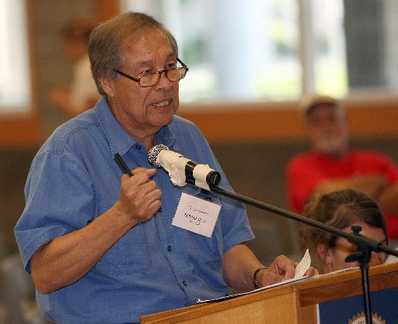
Robert Silva, the mayor of Mendota, tells Assembly Member Juan Arambula about his constituents' suffering. |
"I know that the state already has budget problems," Diener said.
"But what will happen when we take the water away and there is less volume of business and less of a tax base?"
Diener is president of the Mendota Beet Growers Cooperative that is trying to keep open the Spreckels plant in Mendota where 240 jobs are at stake.
Last month, Arambula introduced Assembly Bill 1107, which would extend unemployment benefits to agricultural workers who have lost their jobs due to the water shortage and drought in the Central Valley.
The proposed bill would extend unemployment benefits through the end of the year.
Before the 90-minute hearing, Arambula visited Vaquero Farms, where some cotton has been abandoned, to see first-hand the toll the drought is taking.
He also talked with grower George Pappas, who described cutbacks he has made in planting of cotton and melons.
Mendota Mayor Robert Silva accompanied Arambula on the tour.
At the hearing, Silva talked of a rise in shoplifting and theft of medicine.
"It's a tragic situation out there," he said. "We have discussed this issue over and over. The lesson to you folks in Sacramento is to get it done."
Amarpreet "Ruby" Dhaliwal, mayor of San Joaquin, said the average farmworker makes less than $10,000 -- if jobs are available.
"We live in a nation of abundance," he said, "and it's incomprehensible that people can actually starve. But it's possible on the west side."