South Napa Wineries Thirst for Water


Boundary agreement won't increase water, but wineries get creative
|
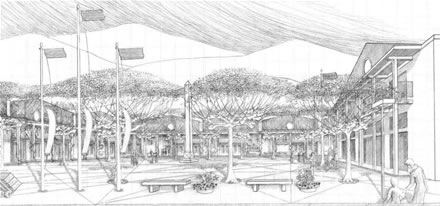
Tony Cartlidge has put his Les Garagistes wine village on hold, because of American Canyon's strict limitations on water use. |
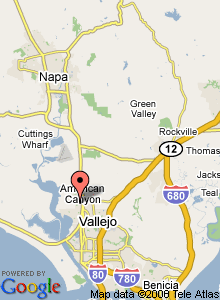
American Canyon, Calif. -- A long-disputed agreement between Napa County and the city of American Canyon has been resolved, but water restrictions still pose significant challenges for owners of wineries hoping to locate in South Napa County.
An agreement approved this week by Napa County Supervisors and the American Canyon City Council sets the city's sphere of influence, defining its future growth and effectually removing service restrictions, but it doesn't change the usage limitation.
|
REGION: WEST American Canyon |
Recently, Tony Cartlidge of Cartlidge & Brown Winery reported that his Les Garagistes Napa wine village project is on hold because of water restrictions. He is considering ways to accommodate the project in the company's existing winery.
Last year, the city denied water-service requests for several projects in the area of the small Napa County Airport, including wine-related projects by Rombauer Vineyards, Harlan Estate and Zapolski & Rudd. City officials said they were reluctant to extend water service to unincorporated areas around the airport that are outside the city's sphere of influence until American Canyon is allowed to share in the economic growth of the area.
The problem arose because water in the area is supplied by the City of American Canyon, which restricts all industrial users to 650 gallons of water per day per acre of property. This water usage includes recycled water from the Napa water treatment plant.
American Canyon Public Works Director Robert Weil says the restriction was set by a city ordinance passed in 2000, and it applies to users in and outside city limits. Weil says the city does have processes that can deal with the limits. One is to mitigate the water usage by including unused land or space that doesn't use water, like storage, in a proposed project.
Since then, some of the companies have found ways to deal with the restrictions.
Weil notes that the proposed Montalcino Resort bought an extra 21 acres to gain additional water credits, and the Napa Gateway project negotiated a cap for the whole project by which individual users may exceed the limits if others are under the limit (or land is fallow). He notes that a Beringer project bought land next door to get the water credits, and it remains basically unused.
Users also are encouraged to conserve and minimize water use, and to replace lush landscaping with more efficient xeriscaping. Rombauer Vineyards was able to work within historic water usage in an existing building.
Weil also notes that the city is unlikely to be able to change the limits. "We've done our water planning on all vacant industrial land, and we're still short." He adds that it's doubtful that the city will find a new source of additional water.
He notes, however, that one user, Bin to Bottle custom-crush facility, has shown creativity in meeting the restrictions. It operates a facility in an existing building that formerly contained a brewery, and is able to use the historic water consumption there.
|
Bin to Bottle custom-crush has adopted creative strategies to deal with water restrictions. |
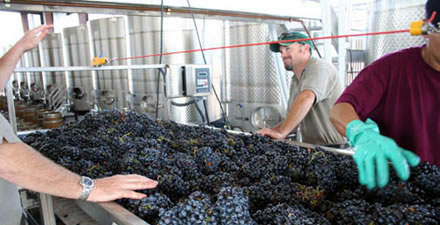
The facility has proposed a new facility for barrel storage next door. Co-owner John Wilkinson says that wineries traditionally required seven gallons of water to produce one gallon of wine, though many wineries are reducing that number (Trinchero says it uses less than 1.5 gallons of water per gallon of wine, for example.). Most of the water has been used for cleaning.
Wilkinson says the custom-crush facility uses an efficient, state-of-the-art barrel washer to minimize usage. It also proposes doing most of the cleaning in the existing facility, not the new one.
Bin to Bottle also carefully trains staff, with particular attention to the temporary workers at harvest who may not understand the company culture. "I've seen workers chase grapes with water streams instead of just sweeping them," he says.
Bin to Bottle installed a sophisticated individual water treatment system that settles out solids and uses biological removal of the organic material that creates heavy demand in wastewater plants, so-called biochemical oxygen demand or BOD. The system involves five 5,000-gallon underground tanks and was a significant expense.
Ironically, Bin to Bottle can't use the cleaned wastewater, which would be suitable for irrigation but not cleaning. "We produce far too much for our landscaping, 1,500 to 2,000 gallons per day," Wilkinson says.
Does American Canyon's Weil feel that other wineries could set up in th e area? He believes they can, noting that the city has presented options to John Hawkins of Les Garagistes, but hasn't yet gotten a proposal back.