Vineyard Sustainability Now Certified


Central Coast pilot project audits vineyard and management practice
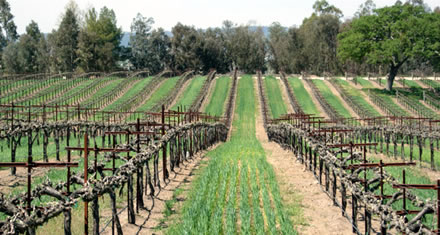
Robert Hall Vineyard, a participant in the Pilot Program, actively promotes green practices like the use of cover crops on its website.
Paso Robles, Calif. -- The Central Coast Vineyard Team (CCVT) has expanded its long-time commitment to sustainable growing practices and launched a pilot program enabling vineyards to certify their sustainability via a third-party audit. One dozen California Central Coast vineyards are participating in the pilot program this year. Audits have begun, and certification decisions are expected in late August.
According to program coordinator Jill Whitacre, "If all goes well, we'll see a bottle of wine made with 'Certified Sustainably Grown' fruit enter the marketplace in 2009." Vineyards from 3.5 to 1,200 acres have enrolled in the pilot program. "Some are doing specific blocks; others are doing the whole ranch," Whitacre told Wines & Vines.
The audits, which take about one day to complete, are conducted by F.J. "Chip" Sundstrum, who earned an undergraduate degree in plant science at the University of California, Davis, and a doctorate in horticulture at Virginia Polytechnic Institute and State University. His consulting company, FJS Consulting, provides organic and sustainability consultation and audits, and helps develop precision agricultural decision support tools. Once he has audited a grower candidate, his findings will be presented for peer review and approval from a committee representing government and academic experts, which will ultimately certify the grower for the current vintage.
Dana Merrill, president of Mesa Vineyard Management and co-owner of Pomar Junction Vineyard in Templeton, Calif., was among the first to be audited. "I don't know that it was difficult," he said. "It was the first time, and our manager spent the best part of a day with the certifier." Merrill is starting the certification process slowly, in one vineyard Mesa manages for Castoro Vineyards and another at his family-owned Pomar.
"It's a little tighter than doing your best with the Positive Points System," developed by CCVT in 1996, Merrill said. He noted that, in the candidate vineyards, he had to cease applying a favored pre-emergent herbicide, which is included on the certification program's "prohibited" list. Farmers like Simizine, he explained, because it's cheaper than alternatives, but it's prohibited because it can get into ground water.
"There aren't a lot of things like that," Merrill said. "I didn't personally believe it was a big threat, but this is a way to encourage changes in behavior. I want that stamp. Now it's more tangible, more definitive; it's a yes or a no."
Merrill commented, "The Positive Points worked great for us. We were really charting our self-improvement. But in talking with consumers, it's nice to have a certified standard. This is process-based. We're able to build off that." He said that he hopes to bottle Pomar's 2008 Viognier with a "certified sustainable" label next year.
The CCVT program (vineyardteam.org/certified_sustainable/) was developed over a period of years. The draft standards for Certified Sustainable Winegrapes include:
Conservation and Enhancement of Biological Diversity
Vineyard Acquisition/Establishment and Management
Soil Conservation and Water Quality
Water Conservation
Energy Conservation and Efficiency
Air Quality
Social Equity
Pest Management
Continuing Education
Wine Quality
The draft standards include 41 requirements, all of which must be completed and documented for a total of 500 points. Another 156 management enhancements are assigned point values that total another 500 points: 250 management enhancement points are required for certification.
Robert Hall Winery in Paso Robles had its entire 214-acre vineyard audited. Winemaker Dan Brady said he's confident the vineyard will be certified, although "We don't yet have a final-final."
Hall, which actively promotes its green standards on its website, "Did not change any vineyard practices," for the pilot program, Brady said, adding, "I'm sure we will adopt new practices as they make sense. A lot of what's involved in the program is best practices. We're finding it a great tool to review our current practices. Will some new things come out? It's too soon to tell. We'll determine what changes to make from the input we get," he said.
|
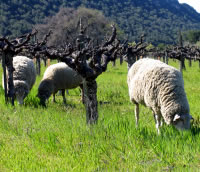
Saucelito Canyon employs sheep to replace tilling or herbicides in its 12-acre vineyard. |
Paraiso Vineyards, in the Santa Lucia Highlands, is also certifying its entire 250-acres of vineyards. Although the certification is not officially complete, marketing director Dave Muret knows how many points the operation received, and the total is more than sufficient. He looks forward to bottling Paraiso's 2008 Riesling as Certified Sustainably Grown.
Muret said that although the vineyard team spent some stressful hours with the auditor, "Anything important, we had already covered." He said that certification is awarded on a year-by-year basis, but he expects sub sequent vintage certification to be much simpler. Muret, who is working with CCVT's Whitacre on marketing the new concept, said, "Our first round of education will be primarily to the trade: the gatekeepers, the restaurateurs, so that they can explain it to their customers."
He praised CCVT's persistent toil in building the program. "They spent 10 years putting teeth in this thing," he said. "It's very concrete, a livable, working project."
Whitacre noted that participants in the pilot program have generally been ahead of the curve in terms of green practices. "These folks had to be very patient, but these are growers who had been doing this for years. Some might need to change some of their documentation, and how to verify their practices."
She emphasized that although CCVT has spent much time and effort developing the program, "This is not a regional certification program; not a CCVT certification." Whitacre said the vineyard team is in the process of developing marketing plans for the program. "We're excited we can now talk about it," she said.
The ongoing, surprisingly vituperative dialogue about green standards, as demonstrated in controversy engendered by the first International Green Wine Competition this spring (see, "New Judging for 'Green' Wines" and "Sustainability Goes to Market"), and frequently discussed by columnist Cliff Ohmart (be sure to read his Vineyard View in our September 2008 issue) illustrates the need for recognizable standards for every entity aspiring to greener practices. The Lodi Woodbridge Winegrape Commission, for which Ohmart is research/IPM director, began a third-party certification program through Protected Harvest in 2005, according to program manager Stuart Spencer.
The "Triple Bottom Line" embodied by the term "sustainable," encourages businesses to improve environmentally, economically, and by contributing to social equity. "Its not just about agriculture," Whitacre said. "It's not just the environment and the economy. It's also about the consumer. Without people, where would we be?"