Sales Strategies for Cool Climate Wines


Long Island conference hears marketing advice from international experts
|
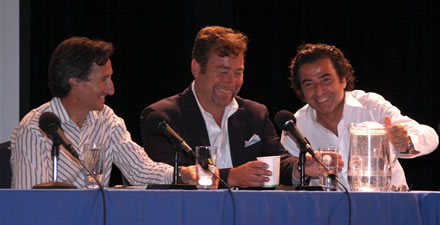
Jacques Lurton of Bordeaux, Steve Clifton from California's Central Coast, and Pascal Jolivet of the Loire Valley discussed balance, style and the global marketplace. |
Southampton, N.Y. -- On the sunny South Fork of eastern Long Island on August 5 and 6, roughly 240 vintners, growers, retailers, restaurateurs, sommeliers and consumers gathered for a two-day symposium entitled "The Art of Balance: Cool Climate/Maritime Wines in a Global Context." The conference was hosted by Stony Brook Southampton's Center for Wine, Food and Culture in cooperation with the Long Island Wine Council and with funding from the New York Wine & Grape Foundation.
Featuring a global line-up of speakers from winemaking regions in Italy, Germany, Spain, France, the Finger Lakes, Australia, Long Island and California, the symposium cast a spotlight on several issues, including the challenges posed by both cooler climates and maritime breezes, the struggle to define and capture the elusive notion of terroir, and the Long Island industry's own ambivalence about whether or not it should pursue a reputation for world-class wines by seeking distribution beyond the New York metropolitan market.
The Grand Tasting, which was open to consumers and took place on Tuesday evening, Aug. 12, following the lectures, drew roughly 400 people and featured wines from at least 30 producers paired with dishes from 16 local chefs and purveyors.
"To keep agriculture going, you have to have people support each other in a community, not only an economy," said Louisa Hargrave, the director of the Center for Wine, Food and Culture, who conceived of the conference three years ago and began enlisting support from local producers last year. "Most of these producers are so busy working all the time that they don't get to see each other."
The event marked the 20th anniversary of "Maritime Climate Wine Growing: Bringing Bordeaux to Long Island," the first groundbreaking conference of its kind, which was staged in nearby Riverhead in the summer of 1988 and drew participants from Château Margaux, Château Pichon-Lalande, and the Institut Technique de la Vigne et du Vin.
Louisa Hargrave, director of the Stony Brook Center for Wine, Food and Culture, opens the conference."I remembered what a dynamic experience occurred 20 years ago, and I wanted to do it again," Hargrave said. "Our strategy was to try to define Long Island wines in terms of their cool climate and to make a connection with other cool-climate wines that people already understand and appreciate. At the same time, we wanted to emphasize that Long Island wines are about drinkability, not bigness."
On Tuesday, following a string of presentations on climate, soil types, yeast strains and the global market by Alessio Dorigo of Dorigo in Friuil Venezia-Giulia; Gunter Kunstler of Weingut Kunstler in the Rheingau; Katia Alvarez of Martin Codax in Rias Baixas; and Thomas Laszlo of Heron Hill in the Finger Lakes, restaurateur and sommelier Paul Grieco, whose New York restaurants Hearth, Insieme, and Terroir could be said to showcase wines that are local and sometimes lesser known, led a lively panel discussion entitled "The Art of Authenticity or Just Wine Gobbledigoop?"
With a forearm faux-tatooed with the word "Riesling," and clad in a t-shirt stenciled "Summer of Riesling 2008," Grieco, an acknowledged lover of Kabinety and Spätlese, told winemaker Gunter Kunstler that he was "flummoxed" by the proliferation of dry Riesling when he visited Germany last summer.
Thomas Laszlo, winemaker at Heron Hill, Finger Lakes."Which is the better expression of terroir, a fully dry wine or one with residual sugar?" Grieco asked. Kunstler, somewhat cagily, replied that the grape is very "flexible" and added that "If Riesling is not masked with sweetness, then (one has) a pure sense of the soil."
When asked by Grieco whether "'masking' was a negative comment, Kunstler confirmed that it was, and said that in 20 years of making wine he had seen wines get better every year, and that the demands of the market would play a role in whether he decided to move away from residual sugar.
On the same panel, winemaker Alessio Dorigo observed, "Modern winemaking did all it could to destroy the idea of terroir because of the global palate," and added that he was not of the same ilk as the old-school producers in his region who experiment with field blends and prolonged skin contact. "Post-modern winemaking is trying to get its hands on terroir again," he said.
Day two's topics included balance, style and the global marketplace, and featured talks by Steve Clifton of Brewer-Clifton in the Santa Rita Hills on California's Central Coast; Pascal Jolivet of the Loire Valley; Eric Fry of the Lenz Winery on Long Island's North Fork; and Jacques Lurton of La Martinette in Bordeaux and the Islander Vineyard in Australia.
Eric Fry, of Lenz Winery, Peconic, N.Y.Kurt Eckert, import brand manager for Mt. Kisco, N.Y.-based Polaner Selections and moderator the discussion "Counter Currents: The Re-Emergence & Appreciation of Cool Climate/Maritime Wine in the global Marketplace," posed the question of how producers might go about marketing their wines within the complex three-tier distribution system.
"I come to you here as a representative of the dark side," Eckert said. "I work in the aspect of the business not yet addressed in-depth, which is selling the stuff."
Eckert proffered a lexicon of favorable terms that might be used to promote wines from Long Island, incl uding words like "subtlety," "discreet," "purity," and "authenticity" that he said would counter the less motivational terminology in common use such as "less alcohol" and "less color."
Invoking the power of pop culture to influence wine trends, Eckert referred to the movie "Sideways," saying "Maybe we didn't like it, but it makes Pinot Noir fly out the door."
Plumbing the depths a little further, Eckert asked how winemakers should go about crafting a message that communicates the appeal of their wines. Steve Clifton recalled in vivid detail the day he left Santa Barbara for San Francisco in a Dodge pick-up loaded with cases.
"I made a list of the top 10 restaurants in Northern California that I wanted to be in," Clifton said. And, when the first sommelier he met asked the much-anticipated question of where else the wines were already featured, Clifton said, "I just read off the other restaurants on the list." By the end of the day, he had landed eight of the 10 and "didn't have to lie anymore."
Clifton said that the key is an adjustment in mental attitude-that vintners must show their wines with assuredness. Since he began in 1996, he has increased his production from 240 cases to 8,000 last year. His wines are now available in several markets across the country.
"So if you want to be world-class do you have to be distributed around the world?" Eckert asked.
Clifton seemed to agree, but Eric Fry, who has been the winemaker at Lenz since 1989, said, "It you get hooked into that system, then growth is addictive.
"We don't need to be in a restaurant in L.A." Fry said. "We don't have the production. A lot of us are taking the guerilla approach-direct to the consumer. It's the neat little stuff that catches their attention."
The question will no doubt be debated as Long Island wineries and growers determine how to spend the $200,000 they recently obtained from New York State to promote their wines.