B.C. Winemaker Researches Barrels


Organized on-site trials yield practical, empirical knowledge
|
Winemaker Mike Bartier among his barrels at Golden Mile Cellars |
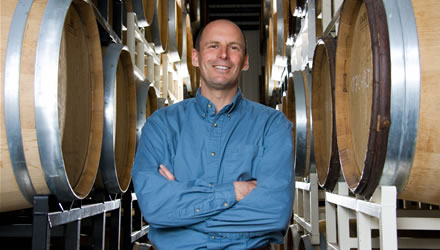
Oliver, B.C. -- An informal research project by a British Columbia winemaker is highlighting the contribution barrels make to the flavor profile of well-known varietal wines.
Michael Bartier, winemaker at Golden Mile Cellars in Oliver, B.C., began his effort to document the impact of different barrel styles on Golden Mile's wines in 2005. The project, he says, will help him refine the style of wines Golden Mile produces.
Golden Mile sources its grapes from the South Okanagan, from both vineyards on the mineral-rich soil surrounding the winery on the west side of the valley and the sun-baked vineyards along the Black Sage Road on the east side. It also sources some Pinot Noir from growers in the neighboring Similkameen Valley.
Bartier, an Okanagan native who worked at several local wineries before joining Golden Mile in 2004, aims to identify the particular flavor characteristics that barrels contribute to wine, as well as how these are expressed at each stage of the aging process.
"I'm trying to find out what I can consistently expect for textures and flavors to come from a certain barrel type, and I'm trying to find out which of these are appropriate to which grape varieties," he explains. "So I might find a barrel type that gives me a real leathery, earthy character, which may be very appropriate to Pinot Noir, but which isn't so appropriate to Merlot."
Bartier is tracking variables including the grain of the wood, stave thickness, toasting and the cooperage producing each barrel. Tastings are done midway through the aging and at the end of the process.
The leathery character he finds complements Pinot Noir? The effect of a Dargaud & Jaeglé barrel with a medium-heavy toast and a Les Bertranges forest grain. "I'm in love with that character on Pinot Noir; it is absolutely appropriate to the grape variety," he says. "Consequently, over the last four years I've moved my barrel program on Pinot Noir heavily over to that barrel."
Bartier has close to 300 lots on the go at the moment, using 50 types of barrels. Spider graphs of the results have highlighted trends within barrel types and identified similarities among wines made using the same barrels.
One of Bartier's most surprising findings to date regards the effect of stave thickness on fruit character and tannin perception. Thin staves appear to have a marked effect on the perception of tannins during the aging process. While the intensity of fruit characteristics are known to diminish during a wine's time in the barrel, the process is 20% faster in barrels with thin staves (20mm) than in those with regular 27mm staves.
"It's almost hyberbolic, in that the tannin perception will start dropping quicker with the thin staves," he says. As the fruit character of the wine gives way to what he terms a caramelization of the wine, the tannins become more perceptible.
"They become quite hard," he says. "My suspicion is that it's because you don't have that intensity of fruit anymore to carry the tannins."
Having over-barreled some wines in identifying this trend, Bartier plans to use the information he's gathered to determine an appropriate aging time for Golden Mile's wines.
Golden Mile, with an annual production of just 15,000 cases, is too small to have a separate set of trial barrels, so Bartier knows he has to make the best wine every time because eventually it's going to be sold. This fact helps root the research in daily experience and the business of making saleable wines.
Bartier told Wines & Vines that he doesn't plan to publish his work in any formal sense, but he is happy to discuss the results with other winemakers.
David Enns of Laughing Stock Vineyards in Naramata, is one such colleague. Enns has conducted his own barrel trials, some in collaboration with Bartier, but he says the research is well beyond what most small winemakers are willing to do. Being able to understand the effects barrels have on wines made from local fruit is important in raising the caliber of local wines, Enns says.
"The only way to do that is to run it through different barrels, different processes, different styles and see what you get," he says. The approach Bartier has taken to his research is the right one, and one Enns also follows. "You need to set up some kind of empirical program, establish a process that's somewhat scientific. And Michael's done that," Enns concludes.