Show me wine


A Missouri wine country tour offers pleasures for the eyes and the palate
I had to cancel plans with friends when I realized they conflicted with a wine tour in Missouri earlier this summer.
"A wine tour?" one friend said. "Gee, hard work. I love Napa."
"It's in Missouri," I said.
Her face changed. "Aw, I'm sorry. Can you get out of it?"
|
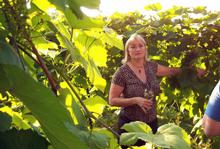
A wine tour of Missouri vineyards offers lush green vistas, such as the Crown Valley Winery in Ste. Genevieve, where the vines stretch for 600 acres. |
|
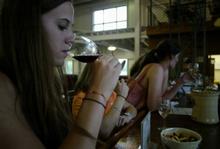
Jessica Kmitta, 22, of St. Louis, tastes the wine at Crown Valley Winery in Ste. Genevieve, Mo., on their limo tour of area wineries. |
|
In 1980, Augusta, Mo., was named the first designated wine district in the United States. Mount Pleasant Winery (above) is one of the wineries that led the movement to receive the designation. |

Only once did I wish I'd managed, and that was because I was spending the night in the Bates Motel -- more to come on that. Otherwise, it was a wonderful trip. It was some of the most lush, most beautiful, greenest countryside I've ever seen, the food was very good and some of the wines I tasted were plainly delightful.
The trip officially began with lunch in St. Charles, a charming town a little north of St. Louis. From there we loaded up in a 12-passenger van and made the harrowing drive along the weinstrasse, or wine road, to Hermann, about 80 miles west of St. Louis.
Seriously, this road (Hwy. 94) is as hilly and twisting as it gets. It's white-knuckle time.
But the drive seems worth it when you spot Hermann from across the river. Because of the ruined economy after Prohibition, the townspeople couldn't afford to modernize the buildings and the town stands today much as it did at the turn of the 20th century.
The streets of Hermann literally ran red in 1920 when barrel after barrel of wine was destroyed by federal agents enforcing Prohibition laws. But locals still say they were figuratively red with blood as the livelihoods of the German immigrants who settled the town were destroyed with each cellar that was raided.
At the time Missouri was one of the largest wine-producing regions in the country and Prohibition forced out-of-work wine makers to forge new lives.
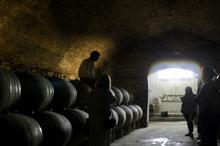
At Stone Hill Winery, wine cellars were converted to mushroom cellars and remained so until the 1960s, when the owner decided he wanted to turn Stone Hill into a winery again. Aging, he needed someone to do it for him, so he chose to give Jim Held the opportunity to reopen the winery.
"My father was a pig farmer and we lived in a house with outdoor plumbing," said Patty Held-Uthlaut. "When he was offered the chance to move his family to the second floor of a big house, he took it."
Each season Held was able to buy a bit of the winery from his profits, and eventually all the cellars were his. Today the Held family still runs Stone Hill, which is both the oldest and the largest producing of the 50-plus wineries in the state.
Not all are German-influenced, but nearly all of the Hermann-area wineries are.
German immigrants in Philadelphia, feeling that their children were being assimilated into American culture, formed the German Settlement Society of Philadelphia in the 1830s and set about the business of finding a place where they could live, prosper and remain true to their German ways.
The word is that the scouts heading west stopped at Hermann when they spotted the Missouri River winding through its verdant valley. Take a look down the sloping vineyard at OakGlenn Vineyards and Winery and it's easy to see how it would feel like home to someone missing the Rhine Valley.
When the settlers, having purchased land sight-unseen, came expecting suitable farming land, they found mostly hilly terrain perfect for grapes but not much else. But it was theirs, and they made the best of it. In 1845 Hermann was incorporated, named after a German leader who led the victory over the Romans in the 1st-century Battle of the Teutoburg Forest.
The first winery on the tour was at Adam Puchta Winery, which has remained in the same family since it started in 1855, when Adam Puchta returned from the California Gold Rush with some jingle in his pocket and began cultivating vineyards on his land.
|
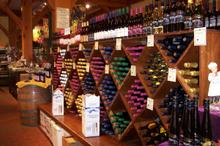
The Stone Hill Winery gift shop sells wine-related items. |
|
Patty Held-Uthlaut explains that the spring freeze wiped out most of the 2007 season's yield. |
The family made wine until Prohibition, when the grapevines were pulled and the suitable acreage was converted to cropland. The farm stayed in the family, but it was nearly 70 years before they re-entered the commercial wine-making business (the family had continued throughout to make wine for personal use from a few surviving vines).
In 1990, Tim Puchta and his father, Randolph, direct descendants of Adam, began selling and shipping the wine once again.
Like other wine growers in the area and throughout most of the state, they'll see little of this year's crop because of the Easter freeze.
"It's farming," Tim Puchta said. "You just have to take it in stride and do what you gotta do."
Grapevines produce three yields: Primary, secondary and tertiary. The majority of the harvest comes from the first grapes, which was virtually destroyed in the freeze. The vines that had secondary buds when the freeze came lost those, too. It's still unknown how much damage the vines themselves sustained.
The second stop on the first day is at Stone Hill, where we hear the Helds' story and dine at the German restaurant on-site.
That night the group is parceled out to small hotels around town and another woman and I let ourselves in to a three-story inn where it's apparent no one else is there. No desk clerk, no guests. No one.
Too bad for me that I've seen about a million haunted hotel movies. Too bad there's only a handle lock on the door. And it's really too bad that after finally drifting off, I awake to hear a man say:
"Ready or not, here I come...!"
It's followed by laughter that can only be described as Jack Nicholson evil.
Too bad there's no phone in the room, and too bad that the only weapon I can find is a wimpy corkscrew, because I am convinced that I'm going to have to make a stand against a possessed killer. And forget about the other woman in the hotel with me -- look here, any fool knows it's every gal for herself when the supernatural comes knockin'.
After about, I don't know, an hour or so of the laughing and loud but muffled conversation -- and something sort of like screaming -- I hear a car start.
Oops. My bad. Turns out there was a parking lot under my window. I think I overheard late-night revelers. Perhaps amorous ones.
I'm bleary-eyed the next morning but nonetheless ready for another day of touring. We start at Hermannhof Winery, a major player in the town's rollicking Oktoberfest, which is held the first four weekends of October, move on to OakGlenn, which offers a gorgeous view of the valley and a lovely award-winning white port. Then it's on to Rbller Vineyard in New Haven, to Washington, Mo., for lunch and a tour of the town, then back to St. Louis.
That night we have dinner at Copia, an urban winery. The house wine is made by Les Bourgeois Winery and Vineyards in Rocheport, Mo., and is stored at the restaurant in large stainless vats. You can also choose from more than 200 bottles of wine from the restaurant's retail store, purchase it and then pay only an $8 corkage fee with dinner.
The next day it's lunch, tour and tasting at Mount Pleasant Winery in Augusta, a small town that was named the first designated wine district in the U.S. in 1980. We go to Montelle Winery, then Sugar Creek in Defiance. Unexpectedly ahead of schedule and already in Defiance, we take a detour to Daniel Boone's home.
Dinner is at Annie Gunn's in Chesterfield, where the wine list tops 800.
"Is that the largest in the state?" I asked wine director Glenn Bardgett.
"Not even in the city," he told me.
Even though St. Louis is home to Anheuser-Busch, they like their wine there, too.
In March, Annie Gunn chef Lou Rook III was invited to cook at the James Beard House and he served three Stone Hill wines: A 2002 blanc de blanc sparkler, a 2005 late harvest vignoles, and a cream sherry.
"I served some Coppola wines, too, because people expect something they know, but there's plenty of good wine from Missouri," Rook said.
And for the cheese course, Rook surprised the guests with Missouri's most famous export:
He put buckets of cold Budweisers on the tables.
--Jennifer Biggs: 529-5223