Midwestern Vineyards Face Special Threats


|
Attendees visited Fahrmeier Farms near Lexington, Mo., to learn about trellis systems. |
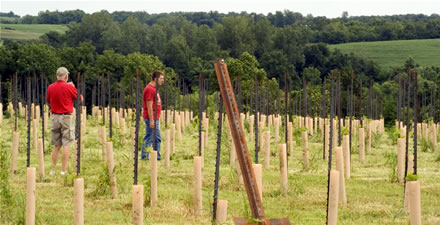
Northwest Missouri -- Midwest grapegrowers are almost certain to experience the threat of herbicide drift at some time during their growing season. Herbicides are used to control weeds, and some are selective for specific weeds. Grapes are especially sensitive to several herbicides common to agronomic crops, pasture, rangeland, forestry and non-crop areas.
Herbicide drift occurs when herbicide is applied on one crop and air-borne chemical particles are blown into neighboring acreage, injuring adjacent plants. Drift can also occur when the herbicide activates (vapor drift). If injury is severe enough or occurs repeatedly, it can reduce yields and result in poor fruit quality--occasionally even killing vines.
"As we've studied our vineyards (at four different sites), we've documented instances of herbicide drift," Dr. Paul Domoto, professor of horticulture at Iowa State University, told attendees at a recent Multi-State Viticulture Field Day. Hosted by the University of Missouri at two northwest Missouri vineyards, the event drew about 150 industry members and academics, who toured Fahrmeier Farms near Lexington and Baltimore Bend Winery at Waverly, and heard presentations given by professors and researchers from the University of Missouri, Iowa State University, and University of Nebraska-Lincoln.
"Usually, the growing season is well underway before herbicide drift becomes a problem," Domoto observed. "However, we were surprised to note that we had herbicide drift damage at one of our sites very early last year. Because corn prices have been so high, the Roundup Ready variety (of corn) was apparently in short supply, and our neighboring farmer used a different type of herbicide on his field. We saw more herbicide drift damage than we've ever seen with that instance. As vintners, we need to remember that this kind of threat could change from year to year. As I understand it, there will be a new herbicide-ready corn variety coming out, which could mean a new threat to grapevines."
Herbicide injury to grapevines can negatively affect the vine for several years after the damage occurs, Domoto said. Negative effects include reduced vigor, increased susceptibility to disease, reduced yield and fruit quality, and shortened life for the vine(s). The biggest threat to grapevines comes from growth-regulator herbicides, 2,4-D and dicamba, which mimic auxins, plant hormones that regulate growth and development. Applications as small as one-hundredth of the recommended label rate have been reported to damage grapes.
Herbicide drift can easily affect grapes within a half-mile of the application site, and as far as two miles away from the site. While growth-regulator herbicides are most commonly used in agronomic settings, they are also applied to turf by railroads, utilities, highway departments and municipalities.
Injury symptoms usually appear within 48 hours of the drift incident. Leaf symptoms include fan-shaped leaves with sharp points at leaf margins, downward bending of leaves, leaf strapping with deep sinuses, and leaf puckering with constricted veins. Injury from fall herbicide applications will affect vine roots.