China's thirst for wine is rising


|
GettyA stallholder shows a glass of wine at the first Hong Kong International Wine Fair in Hong Kong on August 15, 2008, where some 240 exhibitors showcased their products. |
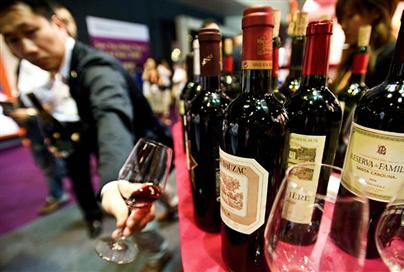
HONG KONG -- China's thirst for the grape has come a long way since the eighth-century poet Li Bai -- the "Immortal of Wine" -- penned "Drinking Alone by Moonlight." In his most celebrated work, Li Bai recalls enjoying "a cup of wine, under the flowering trees." These days, it would be a tough task to find a solitary spot in most crowded Chinese cities to sink a cooling glass of Chardonnay.
Indeed, you'd have no shortage of takers to share a tipple. As 21st century China has undergone the most rapid urbanization in history, the country's nouveau riche are taking to wine like never before.
Today, China is the world's ninth-largest wine market by volume and the sixth-largest wine producer. From a base of almost nothing a few years ago, the country boasts more than 400 commercially viable domestic wineries. Meanwhile, the value of wine imports to China is expected to reach US$870-million by 2017, up almost fivefold from US$184-million in 2007.
With such huge growth projected - the size of Asia's wine market, including China, is expected to increase by up to 20% per year for the next five years, compared to less than 1% in the rest of the world - it is not surprising many foreign vintners, including a bunch of adventurous Canadians, are jostling for a drop of the market.
"We in Canada are a pond compared to an ocean like China," says Paul Lizak, the wiry president of Legends Estate Winery, a family-run vineyard based in Beamsville, Ont., east of Hamilton. "With its population and growing interest in wines we feel the timing is right [to sell wine here]."
Mr. Lizak was one of almost 19,000 winemakers, buyers, investors and drinkers from 55 countries who swirled, swilled and spat their way through Hong Kong's first international wine fair last week - the city scrapped the import tax on wine and beer in February as it vies with Singapore and other Asian transport hubs to become the regional capital for the wine trade.
At a Canadian wine tasting session for 30 or so local sommeliers and wine critics - three ice wines, an ice cider, a pinot, chardonnay and gewürztraminer were introduced by the Canadian consul - Mr. Lizak said he had already sold some wine and was headed to the mainland for further reconnaissance.
Still, while Canadian ice wine has made a name for itself in China, the reputation of Canadian table wines lags far behind. Canadian labels are notable by their absence on most good wine lists here.
Despite the obvious attraction of selling into China - huge population, rising middle class, and a thirst for luxury goods - there are hurdles to overcome.
"The consumer is not fully knowledgeable about how to drink wines," Mr. Lizak says, echoing the thoughts of a number of exhibitors at the Hong Kong wine fair.
Bridget Guiney of Greedy Sheep winery in Western Australia tells stories about wealthy Chinese buyers diluting US$500 wines with a splash of Coke. Also, they prefer reds, because red is an auspicious colour. Ms. Guiney says in 2006, red wines accounted for about 70% of the Chinese market, compared to about 50% in most developed markets. "But they prefer sweet whites that are easier to drink. That's why we brought our rosé."
Mr. Lizak is not fussed by the lack of sophistication in China's enormous wine market. Twenty-five years ago, when Canadians were first getting into the wine scene, the most popular varieties were bigger, bolder wines, too.
But the Canadian market developed into a more complex one in recent years and "China is no different then in our market in Canada. Over the last few years we have also come a long way to enjoy and understand wine drinking in Canada," says Mr. Lizak.
Other challenges are not so easy to overcome. For starters, shipping costs that have risen dramatically thanks to soaring oil prices make it almost impossible to compete on price with Chinese producers who can rattle out a bottle for less than US$1.
Forging reliable agreements with distributors willing to transport and market product is not straightforward either given language barriers and legal differences, as well as the physical size of China. Large international grocers such as Carrefour Group and Wal-Mart are making inroads and would offer a familiar partner, but there's competition to seal their business from China's domestic winemakers and other foreign players from more globally recognized wine producing regions such as Australia, New Zealand, South America or Europe.
A glut of fake wines makes things even harder. Canadian ice wine, which enjoys a disproportionately high profile thanks to the local taste for sweet wines, has been the victim of a well-organized faking industry that swallowed an estimated 60% of the total ice wine business in China last year. Meanwhile, wine aficionados can tell an abundance of stories about Chinese counterfeiters who recycle empty bottles carrying expensive labels by filling them with cheap local wine that is passed off as the real deal.
The way to overcome these hurdles may be to ignore China's mass market altogether. The paradox for small wine producers such as those in Canada is that China is attractive not because of its mass market demographics, but because of the rapidly growing niche market at the top end of the price spectrum.
China's booming affluent classes already see expensive foreign wine as a symbol of their rising power. Ordering a bottle of Chateau Margaux 1995 in a glitzy Shanghai restaurant signals to other diners that you are both cosmopolitan and rich.
Indeed, while London and New York remain the world's top wine centres, some estimates say 40% of the global demand for high-end wine comes from buyers in Hong Kong and China.
"When people in China discover a new cellar in Italy, it's insane," says Gregory Brossard, a dapper Frenchman, from Platinum Wine, a Hong Kong-based wine broker. Platinum's clients are buyers with "a lot of money" in Hong Kong and on the mainland, who splash out large sums to purchase private collections of expensive wine as "a status recognition asset," says Mr. Brossard. Sample starter portfolios go for as much as HK$261,000 (US$32,000)
It is these buyers Canadian wineries can target, says Norman Hardie, owner of Norman Hardie Winery of Hillier, Ont., about two hours east of Toronto. Mr. Hardie, who was in Hong Kong to generate interest for his old-world Pinots, says to tap that market, you first have to be the best in your domestic market or sophisticated buyers won't buy in regardless.
For Canadians there's also the issue of "brand loyalty" some Chinese consumers have for wines from Italy, France and other traditional wine producers, says Mr. Hardie, who has been making wine since only 2004. "I'm not scared to drop Four Seasons' name," he adds, referring to a previous job as sommelier and restaurant manager at the luxury hotel chain whose brand is already established in Asia.
In Hong Kong, Mr. Hardie, sold some wine but had not met the right ‘face' to promote his wine in China. In the end, he says, China is just another gamble in what can be a tough industry.
"When we planted our vines in Prince Edward County, everyone said it was too cold and we'd never grow wine. But we rolled the dice because all the principles were there." Many of Canada's winemakers can ignore the world's biggest market and the rise of an enormous wealthy class. But, he adds, "If you want to be at the top, you have to push the limits."