From Casablanca to Bio-Bio, Chile Boasts Ripe, Fruity Whites


|
White wine grapes grow at the Amayna Vineyards in Chile on Aug. 4, 2008. The Garces Silver familyÔÇÖs Amayna Chardonnay 2005 ($20) is a limited run of only 1.543 cases. There are 28,468 hectares of white wine grapes planted in Chile, which is 24.4 percent of all vines planted in the country. Source: Amayna Vineyards via Bloomberg News |
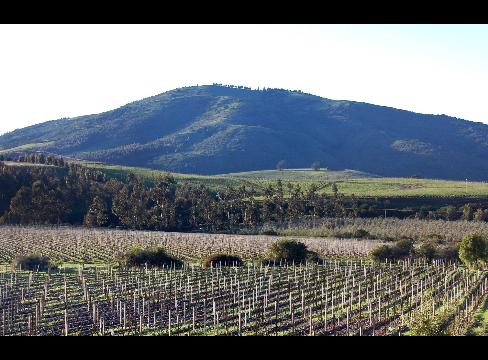
Of course, white wines have a lot of catching up to do in Chile, where the Spanish introduced red-wine grapes, mainly pais, during the colonial period. Indeed, red European varietals like cabernet sauvignon and carmenere were only really planted there in the 1980s, and only in the last decade has modern technology allowed vintners to boost white wine quality.
Overall, Chile's wine industry is booming. In 2007, it ranked fourth in bottled-wine market share, with 8 percent of the U.S. market, according to Gomberg-Fredrikson Report. Imports of Chilean wine increased 13 percent by volume in 2007 and by 24 percent in value to $207 million. Currently, Chile is the only one of the top 10 wine-producing countries showing an overall increase in imports to the U.S. (up 2 percent).
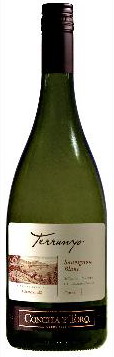
A bottle of Concha y Toro Terrunyo Sauvignon Blanc Vineyard Selection (Block 28) is shown in this photo taken on Aug. 11, 2005. Concha, founded in 1883, is the largest wine producer in Chile, with sales in excess of 6 million cases annually. Source: Concha y Toro via Bloomberg News |
The two main white Chilean varietals are sauvignon blanc (8,697 hectares) and chardonnay (8,548 hectares), with viognier beginning to make some gains. Shamefully, it was not until the 1990s that Chilean vintners admitted that a lot of what they said was sauvignon blanc was actually the unrelated, inferior sauvignonasse, also called sauvignon vert. Those days are, apparently, long gone.
Ripe Fruit
Chile's vineyard regions spread up and down the Pacific coast, whose winds cool the white grapevines in the morning and evening, from Casablanca in the north to Bio-Bio in the south. The soils seem to favor the kind of fruit ripeness preferred these days in white wines, especially sauvignon blanc, which I found the most desirable of the dozen examples of Chilean whites I tried in a recent tasting.
I expected to find the wines -- all from recent vintages -- refreshing and bright as an aperitif. Because some reach a minimum of 13.5 percent alcohol, they go very well with food, which included a salad of avocado, chickpeas and peppers.
Mellow Chardonnay
|
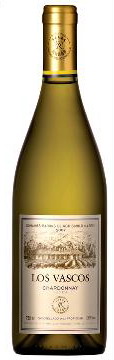
A bottle of Los Vascos 2007 Chardonnay is shown in this undated handout photo. The winery, located in Chile's Colchagua Valley, has a connection to Domaines Barons de Rothschild (Lafite). Source: Los Vascos via Bloomberg News |
By far the largest wine producer in Chile, with sales of more than 6 million cases annually, is Concha y Toro, founded in 1883. (It now has a 50-50 agreement with France's Baron Philippe de Rothschild SA to make Grand Cru-class red wines like those from Chateau Mouton-Rothschild.)
Concha y Toro's 2006 Terrunyo Sauvignon Blanc Vineyard Selection (Block 28) ($22-$25) was a striking example of how far Chilean whites have come. The seductive tropical fruit is definitely there, but this is no fruit punch. Its balance of acid, flinty notes and creamy smoothness on the finish make it uniquely Chilean, without the cloying sweetness of so many New Zealand sauvignon blancs or the acrid grassiness of lesser Sancerres.
The 2007 Punto Nino Sauvignon Blanc, from the Casablanca Valley, is a great buy at $15, a brisk and refreshing wine to go with tapas like shrimp, sardines and cheeses. It has a pretty floral bouquet and just enough fruit, minerals and crisp acid to keep it on the dinner table.
Casa Marin's 2007 Laurel Sauvignon Blanc ($22) also has a fine, passion-flower nose, but it was far too fruity and a tad too sweet to enjoy with most foods aside from a nibble of country bread with an olive tapenade.
Rothschild Connection
The Garces Silver family's 2005 Amayna chardonnay ($20) is a limited run of only 1,543 cases, and it shows the benefits of oak and age without crossing the line into muscularity. At 14 percent alcohol, it's a bold white wine, and I sensed that it is at its peak right now and probably won't gain further maturity. Drink it with the last lobsters of summer.
From Sept. 18 to Sept. 30 the trade organization Wines of Chile will join with Gourmet magazine to present the third annual Salud! Chilean Wine Fest in New York. Thirty restaurants and 10 retailers will showcase Chilean wines, some with complementary tastings. Participating restaurants include A Voce, Blue Fin, Porcao Churrascaria, the Modern and Spice Market. For more information, see http://www.winesofchile.org.