Vineyard harvest workshop offers timely tips


|
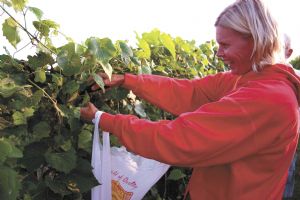
Kathy Behrens, of Carroll, tends 1,217 grapevines with her husband, Mark, at their farm south of town. During a recent workshop, Behrens helped gather samples of the grapes that are being raised on 3,300 vines at the six-acre Santa Maria Vineyard in Willey. |
“It’s important to keep an eye on how your grapes are doing this time of year,” said Sebastian Donner, a wine analysis laboratory supervisor at the Iowa State University, who spoke at a recent grape growing workshop at the Santa Maria Vineyard in central Carroll County.
“Also, talk to the person buying your grapes to find out their expectations for acidity, Brix, pH and other parameters,” Donner added.
Use proper berry sampling procedures
Accurate measurements start with a good berry sampling procedure. “I’ve been getting a lot of reports from vineyards and wineries reporting their Brix levels,” said Mike White, the ISU Extension viticulture field specialist. “Some seem realistic, while others seem unrealistically high, making me believe that their berry sampling procedures may need improvement.”
White explained that a correct sampling procedure should take into account sun-exposed clusters, shaded clusters, berries from the top, middle and tip of cluster (berries at the tip of the cluster ripen last), berries from either side of the row, berries from different parts of the canopy, and berries from primary, secondary or third clusters on the cane.
Avoid sampling from vines at the end of the row, said White, who suggested the following procedure:
n Start sampling three weeks prior to harvest, and sample every four to five days, shortening this interval as harvest approaches. For the most accurate results, sample at the same time of the day.
n Randomly select 20 vines. Then randomly select one berry each from the middle of five randomly selected clusters on each of the vines.
n Place the 100-berry samples in a plastic zipper-lock bag and hand crush. Then sample the juice poured from the bag.
Measuring acidity levels
Grapes grown in warmer climates have lower acidity levels than grapes grown in cooler climates, so high acidity levels are one of the biggest challenges in Iowa’s vineyards, White said. To measure titratable acidity, follow these steps from ISU:
n Fill a burette (a vertical, cylindrical piece of laboratory glassware with a volumetric graduation on its full length and a precision tap) with 0.10 N sodium hydroxide solution.
n Combine 100 millilters of distilled water and exactly 5.0 millileters of the sample in a 250-millileter beaker.
n Record the intial reading of the NaOH level in the burette.
n Titrate the sample with NaOH in the burette, using either an indicator or pH meter to determine the endpoint. If using the indicator, add five drops of phenolphthalein indicator, and tritrate with NaOH until the solution turns pale pink. If you use a pH meter, place the probe from a calibrated pH meter in the solution in the beaker, and titrate with NaOH until the meter indicates a pH of 8.20.
n Record the final reading of the NaOH level in the burette.
n Subtract the initial reading from the final reading, and multiply by 1.5.
n The final number represents the titratable acidity in grams per liter of tartaric acid.
Proper tools help measure pH and Brix
While acidity levels can pose issues for grape growers, pH is one of a winemaker’s biggest challenges, White said. Although winemakers can try to compensate for less-than-ideal acidity levels and Brix, it’s difficult to produce quality wine from grapes with an improper pH level.
White urges grape growers to invest in a good pH meter kit, which can be purchased for approximately $100 to $125. Also buy the solutions to calibrate the pH meter, including the neutral solution and the 4.01 pH solution. White recommends calibrating the meter every time before the equipment is used, since the process is simple and will yield the most accurate results.
To measure Brix, quality refractometers are worth the price, White said. Avoid the $49 bargain basement tools, because they don’t work very well. A better choice is a temperature-compensating refractometer, which can be purchased for about $100 to $115.
If you’d like to submit your samples for testing at ISU’s wine analysis laboratory, log onto www.extension.iastate.edu/Wine/lab.htm for sampling and shipping instructions.
For more information on Iowa’s wine and grape industry, log onto the Iowa Wine Growers Association homepage at www.iowawinegrowers.com, or the ISU Viticulture homepage at http://viticulture.hort.iastate.edu/.