Australian wine company does not want Lockeford ‘dancing vines’


• Central Valley winery must rename its wines
• ‘We’re selling below market value’
|
Sheri Watts, wife of owner Craig Watts, counts the cases of Dancing Vines wine at the Watts Winery. (Photo by Les Mahler) |
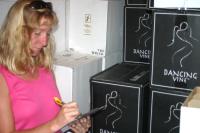
It’s not that there’s been a run on Watts’ Dancing Vine wines. Instead, in what could be called a war over words or a modern-day David and Goliath story, with David losing, Mr. Watts must get rid of most of his Dancing Vine labeled wines by Sunday.
“That was the agreement reached a year ago,” says Mr. Watts’ wife, Sheri Watts. And while the agreement was reached in 2007, the war over words began when Craig Watts tried to trademark Dancing Vine in 2004.
In what is a classic David and Goliath story, Watts Winery, which annually sells about 4,000 to 6,000 cases of wine, butted heads with Constellation Wine Group a unit of Constellation Brands Inc. (NYSE: STZ) of Fairport, N.Y., and owner of Hardy Wine Company Limited, Australia.
The international alcoholic beverage and wine group claimed it had the trademark rights to vine and vines under Hardy’s Waltzing Vines label, which Constellation says was done in January 2004 – never mind that Watts was using vine, not vines.
Vine is too close to vines, says Mike Martin, Constellation’s vice president for corporate communications.
“It’s about intellectual property rights,” says Ron Fondiller, general counsel for Constellation wine group, in an interview from New York on Monday morning. It’s also about “ensuring the integrity of the trademark,” he says.
Plus, there’s always a chance that after having built the name-brand around Waltzing Vines, someone could ask a merchant for Waltzing Vines and mistakenly be sold a Dancing Vine, Mr. Martin says.
“The trademark has to be protected globally,” he says. That’s why Watts agreed to stop selling Dancing Vine, Mr. Martin says, even though Waltzing Vines wine isn’t sold in California or the United States.
“Even if it’s not sold in the United States, it’s still a protection of a trademark,” Mr. Fondiller says, “whether we sell one bottle or 1,000.”
As for stopping the battle because of a Constellation’s claim it had the trademark, Mr. Watts says he abandoned the fight when it got to be too cost prohibitive. “It was going to cost us around $20,000 and we couldn’t afford that,” he says. Constellation could afford it, he says. “They kept coming out with everything legal.”
With only 150 or so cases of the Dancing Vine label left, Mr. Martin says it’s not worth pursuing anymore.
And although he’s sold most of his Dancing Vine wine, Mr. Watts says it’s come at a steep price.
Instead of getting $150,000 for 1,000 cases of Dancing Vine, he’s had to sell the chardonnay at $69,000 for the same 1,000 cases, he says.
“We’re selling below market value,” Mr. Watts says. “We lost half our market.”
As for the cabernet, Mr. Watts says he might try a different label. “I’m looking for another label and try again.”