Ladies of Spain: Winemakers Are Breaking the Gender Barrier


In a profession long dominated by men and a country with a tradition of machismo, Spanish women are suddenly making a name for themselves as winemakers.
"When I started making wine 18 years ago the only job for women at the bodega was doing the paperwork," says Cristina Mantilla, 44 years old, who makes both red and white wines for ten different wineries. "Now, women are starting to wake up."
Enrollment of women in Spain's university winemaking programs has increased nearly 40% since 2000. Women are already a force to be reckoned with in northwestern Spain, in an area of Galicia called Rías Baixas that is famous for its crisp, lively white wines -- and for being hospitable to new ideas. In 1990 only a few women winemakers were at work in Rías Baixas; now they run over half of the region's 198 wineries.
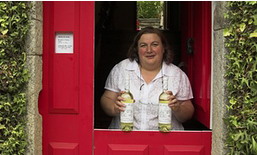 |
Ms. Luca de Tena is one of several women winemakers in Rías Baixas who are being heralded by international critics and, perhaps more importantly, by domestic aficionados for creating innovative white wines as they break down gender stereotypes.
Their specialty is Albariño, a popular, moderately priced white wine heavy on fruity undertones. Its adaptability to a variety of different styles makes it the perfect pairing for dishes from seafood to poultry, and also a versatile template for experimental winemaking. The women of Rías Baixas have taken a grape known for producing simple, summertime table wines and made increasingly complex wines from it -- by experimenting with different soil types, using unique maceration processes and blending Albariño with other grape varietals.
"Some in the industry try to insult us by saying the Albariño is a wine only for women," says Luisa Freire Plana, a winemaker at Bodega Santiago Ruiz. "But I think it's a wine that is too complex for some men."
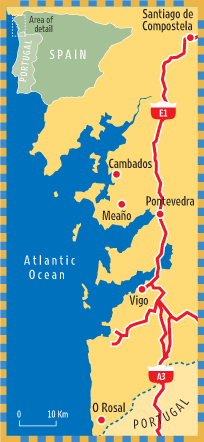
Rías Baixas is one of the youngest Denominacions de Origen in Spain, having received the official wine quality classification in 1988. It's the only Spanish appellation that produces solely white wine. For the last two decades, enterprising young winemakers, many of them female, have used this remote stretch of rural coast where Spain meets the Atlantic as a kind of viticultural proving ground. They've also built a growing international identity for Spanish white wine. In a country known mainly for its muscular reds, like Rioja and Ribera del Duero, creating a niche for the Albariño has been a long fight for equality. And that's just for the grapes.
 |
Why have women winemakers succeeded in Rías Baixas? Some of them say it begins with the region's history of hardship and poverty. For generations, men have left Galicia to earn a living at sea, in the factories of Barcelona or abroad, leaving women to tend farms and small vineyards.
"Women had power to direct the family and the home during the absence of men," says Ms. Mantilla. "From that they achieved an importance in the society that our generation is making good use of."
Galicia, with its rough Atlantic coastline, has a wet and gray climate. Winemakers train vines to grow slowly up tall trellises to keep them clear of the damp ground and expose the grapes to more sun and drying winds.
The basic production process of Albariño wines is the same at most of the region's wineries, with grapes harvested by hand and fermented in stainless steel vats instead of oak barrels. Still, the best Albariños are distinguished by individual character and unique nose. "The aromatic character of Rías Baixas wines comes from cold soaking the grape skins after they're crushed," says winemaker Lucía Carballeira, describing a technique rarely used to make other Spanish wines. "Each viticulturalist guards her maceration secrets."
Such attention to the process has given Rías Baixas wines a reputation for detailed craftsmanship that is notable, considering that other wines made from the same grape, such as Portugal's Vinho Verde, are considered simple. "The winemakers of the Rías Baixas have opened up the Albariño, finding surprising new aromas and developing more complex mouths," says Jordi Mallorqui, owner of a wine store in Barcelona.
Even with a growing international following, Rías Baixas wineries remain mostly small-scale operations, even as much of Spain's wine industry moves toward large-scale production. (The ratio of vineyards to bodegas in Rías Baixas is 33-to-1; in Rioja there are 93 growers for every one winery. Some 20 million liters of Albariño were bottled in 2006 -- double the output from 2003 but still less than 10% of Rioja's output.) Says Martin Codax viticulturalist Katia Álvarez, "We have real wines here, ones with a clear place of origin and a unique identity."
Here, a look at five of the most acclaimed female winemakers in the Rías Baixas region -- and their most notable Albariños.
Cristina Mantilla
|
Photos by Gerard Hancock |
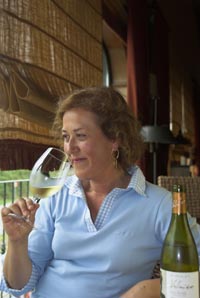
The most prolific of the Rías Baixas viticulturists, Ms. Mantilla makes wines for at least ten wineries each year, including Bodegas del Palacio de Fefinanes, Maior de Mendoza, Adegas Valmiñor and Pazo San Mauro. Along with her husband, Emilio Rodriguez Canas, also a celebrated winemaker, the two constitute the region's oenological power couple.
She became interested in wine simply as an enthusiastic consumer of it. "I thought that if I learned how to make it, I would enjoy it even more," she says.
After earning a master's in viticulture in Madrid, Ms. Mantilla came to Rías Baixas in 1990, starting out in a small winery. She was one of the first women on the winemaking scene in the region but found the environment in Galicia accepting even in the early days of its status as a Denominación de Origen.
In recent years the Albariño grape has been planted in California and Australia, among other places. Ms. Mantilla also travels frequently, serving as an ambassador for Rías Baixas and working to broaden the wine's base. "We have learned a lot about the grape and the fermentation and it's important to share that knowledge," she says.
Signature wine: Valmiñor, �11
A brilliant yellow Albariño from Adegas Valmiñor that is drier and less fruity than the standard bearers of the D.O. A strong fresh grape nose translates to hints of apple and balsamic on the palette with a light touch.
Adegas Valmiñor, O Rosal
www.adegasvalminor.com
Alexa Luca de Tena
|
Alexia Luca de Tena |
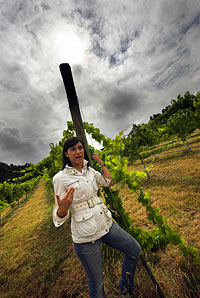
Just two and a half years ago, Ms. Luca de Tena left her family's winery to start her own, Bodegas Agnusdei. "It is difficult starting a new business, especially because some of the older generation don't think it's right for a woman to do it," she says. "But soon there will be more women making wine in the rest of Spain. We are talented and capable."
She says she believes the youthful exuberance of the winemakers pairs well with the local thinking. "The mind of the Galicians is very traditional, except with wine," she says. "They are always looking for fresh ideas and new ways to make white wine."
Signature wine: Agnusdei, �10
A straw-colored Albariño, but with a complex nose of mature fruits, aniseed and herbs. Like many of the whites from Rías Baixas, this wine confronts tasters with a fruity, full body.
Bodegas Agnusdei, Meaño
vinumterrae.com
Katia Álvarez
|
Katia Álvarez |
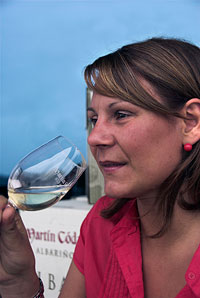
"This is a very young denomincaion de origen and there is much to be discovered with these grapes," she says. Her immediate challenge at the Martin Codax bodega is to extend the shelf life of the Albariño, which is best enjoyed very young. She's experimenting with oak barrel fermentation, instead of the traditional steel vats.
Signature wine: Martin Codax, �12
This striking wine has a straw green color and a potent nose blending citrus and fresh herbs. The mouth is acidic, but crisp with traces of ripe lemon.
Martin Codax, Cambados
www.martincodax.com
Lucía Carballeira
|
Lucía Carballeira |
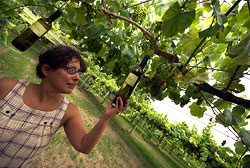
Like most other entry level winemakers, she had to begin at the bottom of the barrel: cleaning out the massive fermenting vats and tending to the vineyard. But she rose through the ranks quickly, and by late 2003 she was managing the Condes de Albarei winery.
"I only know the whites of the Rías Baixas," she says, referring to her resume. "And I am only starting to know them."
Ms. Carballeira says there is little competition among the winemakers in the region, making it a great learning environment. "Other famous wine areas of Spain can be more about pride than the product," she says. "Here it is different. This is a region of good grapes and hard workers."
Signature wine: Condes de Albarei, �11
Unlike many of the bolder wines from the region, this Albariño has a gentle, lingering mouth. But a sniff of the glass reveals a crisp, fruity nose that borders on perfume.
Condes de Albarei, Cambados
www.condesdealbarei.com
Luisa Freire Plana
|
Luisa Freire Plana |
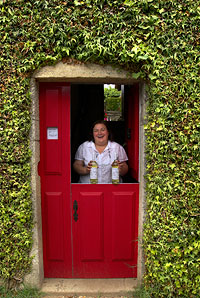
With no career path to follow after graduating from university, Ms. Freire Plana looked to her interests, one of which was enjoying white wines, for inspiration. "It's something I love," she says, "so why not try making it?"
Fortunately for her, winemaking is in her blood. "My grandfather made very basic wines on his farm," she says. The wines she makes now for Bodega Santiago Ruiz are anything but simple, and often blend the Albariño grape with other varietals indigenous to the area, such as the Loureiro, Treixadura and Caino Blanco.
Signature wine: Santiago Ruiz, �16
From the remote O Rosal subregion of the already remote Rias Baixas, comes this standout Albariño with a powerful nose of tropical fruits, especially fresh melons. The taste follows suit, relying heavily on fruit flavors but still very dry.
Bodega Santiago Ruiz, O Rosal
www.bodegasantiagoruiz.com