A grave waste, or fertiliser?


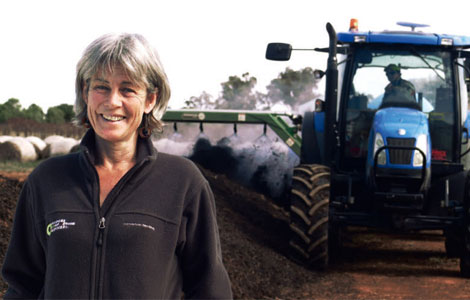
Nurturing the land … Jane Wilson believes adding compost to soil helps it better withstand drought.Photo: Peter Scott
A winemaker tells John Newton how she learnt to put life back into her soil.
Use your nose. That is the advice of the winemaker and compost queen Jane Wilson to the home composter. "If I walk into the winery in the morning and something doesn't smell right, it's the first thing I have to fix that day. It's the same with compost. If it doesn't smell sweet, something's wrong."
It is something this home composter had already learnt in his backyard bin. I had even figured out what the ideal smell was: the sweet smell of rotting vegetation on the rainforest floor.
Wilson and Turner have gone into partnership with Mudgee Shire Council, which will supply all the organic material it collects, and they will hand back compost. "They'll use it on trials in their parks and gardens and playing fields," Wilson says. "And that means less water use."
Once it becomes clear that there are no waste materials, only potential fertilisers, all sorts of possibilities arise. Bruce Christie is the chief veterinary officer with the NSW Department of Primary Industries. In 2002 he finished a review of carcass disposal techniques, one of which was composting.
"We were looking at the possibilities of disasters like the foot-and-mouth outbreak in the United Kingdom in 2001," Christie says. "At that time there were mass burnings of animals and plumes of smoke over the countryside. Or you can just dig a pit and bury them, which raises all sorts of health and safety issues: who's going to do it?"
Last year Christie's colleague, Kevin Cooper, led a team that began compost trials, adding organic materials like woodchips and straw to a pit where dead animals were placed. A total of 16 cattle were grouped in pairs and every three weeks for six months two of them were exhumed. After of three weeks, the bones of the first animals to be examined looked steam-cleaned.
After six months - "during which time there had been no offensive smell", Christie says - "we had good compost that could be used either as landfill or, depending on sensibilities, for agricultural compost".
Following the line that there are no waste materials, only potential fertiliser, consider this: on the ABC's Science Show in May, Professor Roger Short of the University of Melbourne said that when a human body was cremated it produced 160 kilograms of carbon dioxide, which was released into the overburdened atmosphere.
What if, instead of going to a crematorium, we were sent to a compostorium, to continue being useful after death?
Now there is something to ponder as you're turning your kitchen compost in the morning.
Wilson and Turner have gone into partnership with Mudgee Shire Council, which will supply all the organic material it collects, and they will hand back compost. "They'll use it on trials in their parks and gardens and playing fields," Wilson says. "And that means less water use."
Once it becomes clear that there are no waste materials, only potential fertilisers, all sorts of possibilities arise. Bruce Christie is the chief veterinary officer with the NSW Department of Primary Industries. In 2002 he finished a review of carcass disposal techniques, one of which was composting.
"We were looking at the possibilities of disasters like the foot-and-mouth outbreak in the United Kingdom in 2001," Christie says. "At that time there were mass burnings of animals and plumes of smoke over the countryside. Or you can just dig a pit and bury them, which raises all sorts of health and safety issues: who's going to do it?"
Last year Christie's colleague, Kevin Cooper, led a team that began compost trials, adding organic materials like woodchips and straw to a pit where dead animals were placed. A total of 16 cattle were grouped in pairs and every three weeks for six months two of them were exhumed. After of three weeks, the bones of the first animals to be examined looked steam-cleaned.
After six months - "during which time there had been no offensive smell", Christie says - "we had good compost that could be used either as landfill or, depending on sensibilities, for agricultural compost".
Following the line that there are no waste materials, only potential fertiliser, consider this: on the ABC's Science Show in May, Professor Roger Short of the University of Melbourne said that when a human body was cremated it produced 160 kilograms of carbon dioxide, which was released into the overburdened atmosphere.
What if, instead of going to a crematorium, we were sent to a compostorium, to continue being useful after death?
Now there is something to ponder as you're turning your kitchen compost in the morning.