Maryland Vintners Win USDA Grants


Awards allow rural businesses to grow, promote and create jobs
|
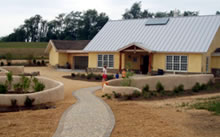
Elk Run Vineyards received a grant to build sales and marketing strength. |

The USDA awards these grants to farm owners to expand their agricultural businesses. Last year, it awarded $19.5 million in these grants.
This year, Elk Run Vineyards in Mount Airy, Md., received $263,000, which will enable it to meet retail and wholesale demands and improve and develop its marketing strategies, including hiring sales and marketing staff. It was the winery's third grant, says Neill Bassford, assistant winemaker and vineyard manager. The 5,000-case winery produces wines from vinifera grapes 30 miles south of Mason, Md.
Bassford says the winery applied for the grant after hearing of the success of neighbor Black Ankle Vineyard, which got a grant for $195,000 in 2006. Sarah O'Herron, the winemaker at Black Ankle, says they learned of the program from their lender, Mid Atlantic Farm Credit.
O'Herron and her husband Ed Boyce bought the property in 2002, and planted grapes in 2003 and 2004. Their first real harvest was in 2006, and they decided to add value to their vineyard by making wine. "There's no way to do traditional farming here," O'Herron says. "The grant has been a huge help," she adds.
They used their grant, which just expired, to hire a winemaking consultant to help improve the wines. It was also applied to new labels and bottling.
Another local winery, Sugarloaf, applied for and received a grant after hearing of Black Ankle's success.
This year, Terrapin Station Winery of Elkton, was awarded $49,872 to hire a full-time winemaker, develop a web presence and promote its environmentally friendly packaging.
Likewise, Cascia Vineyards of Stevensville received $99,856 that will be used to create a winery on the farm.
Maryland does seem to have received a disproportionate number of grants, admits Kevin Atticks of the Maryland Wineries Association. "We're thrilled about it," he says. "We've been actively encouraging our members to apply for the grants, and we're hoping that this is the start of something big."
Still a challenging place to make wine--and not just because of the weather--Maryland is becoming a little more friendly to wine businesses. "Maryland is getting on board," Neill Bassford says. The state is now home to 34 wineries that sold nearly $13 million in wine last year.
The USDA grants were established to try to help rural economies as well as make farming economic. Part of the objective is to create more jobs to keep people in rural areas.
According to a case study on the USDA website, Stonebridge Vineyards Inc. is an established eight-acre vineyard in Pawnee City, Neb., owned by Mike and Sharon Schilling. The Schillings wanted to open a winery to sell their grape production and increase tourism in their rural hometown. However, the financial obstacles involved with developing and marketing a successful winery business were overwhelming, and they sought assistance from USDA Rural Development.
|
Black Ankle Vineyard used its 2006 USDA grant to improve the quality of its wines and upgrade its labels. |
WineAmerica, which has 850 winery members, has been actively promoting the grants to members, says Bill Nelson, its executive director. "We've been quite successful with value-added grants," he says, noting that there were actually fewer this year than last. Last year, at least nine other American wineries received the grants, as did the Oregon Wine Board.
Nelson told Wines & Vines that the grants became available after the 2002 Farm Bill was implemented. Before that, they were primarily for co-ops, but now individual wineries and marketing groups are eligible; the Wine Institute and Yakima Valley association have also received funds. He notes that grants must be matched.
According to the USDA, funds can be used for planning and for working capital.
Planning is a defined program of economic activities to determine the viability of a potential value-added venture, including feasibility studies, marketing plans, business plans and legal evaluations. A maximum of $100,000 is available for a planning grant.
Working capital funds are used to operate the venture and pay the normal expenses associated with the operation of the venture. A maximum of $300,000 is available for a working capital grant.
The funds cannot be used to
Plan, repair, rehabilitate, acquire or construct a facility;
Purchase, rent or install processing equipment;
Pay for the preparation of the grant activity;
Pay expenses not directly related to the funded venture;
Pay costs incurred prior to receiving the grant;
Fund political and lobbying activities;
Fund activities prohibited by 7 CFR parts 3015 and 3019;
Pay any expenses related to agricultural production.
You can get more information about the grants and applying for them at rurdev.usda.gov, or if you're a member, from WineAmerica, wineamerica.org.