Grape-Juice State Michigan Makes Rieslings Fit for Hemingway


Sept. 15 (Bloomberg) -- Ernest Hemingway once wrote, ``Wine is one of the most civilized things in the world and one of the natural things of the world that has been brought to the greatest perfection.'' Still, he wasn't talking about the wines of northern Michigan, where he spent his boyhood summers.
Back then, before World War I, the best-known Michigan beverage was Welch's grape juice, which Dr. Thomas Welch called the first ``unfermented wine,'' for use in church services.
If Hemingway could go back to Michigan today he would find a flourishing wine industry, with 56 vineyards spread over 1,800 acres throughout the state -- a 60 percent increase in the last decade -- and, with 425,000 cases of wine annually, 13th in the nation for wine production.
Some of that is still made from native, out-of-fashion labrusca grapes like Concord. Yet since the 1970s, more and more French-American hybrids such as vignoles and chambourcin and European varietals like chardonnay, merlot and, especially, riesling are now planted throughout the stunningly beautiful northern part of the state, around Traverse City, the Leelanau Peninsula and the Old Mission Peninsula. This is where the winter climate is somewhat more temperate than elsewhere in the state.
I recently spent a week in the region, astonished by the size of Lake Michigan and enchanted by the numerous lakes, bays, rivers and streams, where Hemingway's hero Nick Adams lived and fished, around Charlevoix, Petoskey and Horton Bay. The first two, as well as Traverse City, are now largely gentrified, with gourmet delis proudly selling the local wines. Indeed, I only wish wine shops in New York, Texas and Virginia had more of that pride in promoting their own wine industries.
Local Bottles
At every restaurant I visited, from the superb, high-end Tapawingo in Ellsworth to quaint taverns like Chandler's in Petoskey, there were always Michigan bottlings on the wine list.
New wineries have taken some odd names, like Left Foot Charley, Karma Vista, Fishtown White, Sex, Detention and Hotrod Cherry. There's even a line named Madonna, with a picture of the diva on the label; it's made by Silvio and Joan Ciccone, who happen to be the pop star's mother and father.
For the entire week, I drank nothing but Michigan wines and, not knowing quite what to expect, I was delighted by several, particularly the rieslings. As in New York's Finger Lakes, they adapt well to the cold climate and terroir. The sweeter versions had little of the complexity and structure of a fine German or Alsatian counterpart, but those that were semi-dry (or mildly sweet) had sufficient acid to make them delicious aperitifs.
Refreshing Rieslings
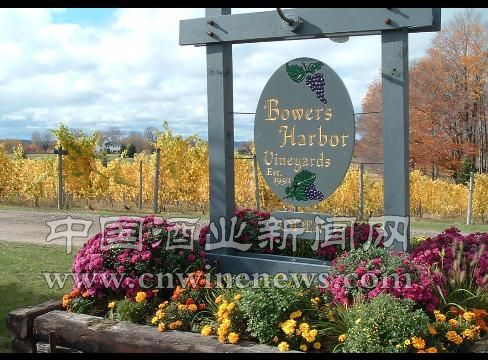
I particularly liked the 2006 Bowers Harbor Vineyard Riesling ($17) from Langely Vineyard on the Old Mission Peninsula. With 12 percent alcohol, it hit just the right mark that makes riesling both refreshing and bright. Also good was the 2007 Chateau Grand Traverse Dry Riesling from the same region ($12), with a fresh, clean, briskness that went well with the little dried hunter's sausages we nibbled on. The winery also has a six-room inn on the property overlooking Grand Traverse Bay.
A 2007 Brys Estate Vineyard & Winery Pinot Grigio ($17) was about as bland as most Italian pinot grigios, and I sniffed and sipped in vain to find much chardonnay flavor in Brys's Naked Chardonnay ($18). More impressive, if a tad too sweet, was the 2007 Forty-Five North Pinot Noir Rose ($18) from Leelanau; its 13.5 percent alcohol gave it good body, and the deep rosy color and fruit made it pretty wonderful while sitting out on the porch watching the storm clouds gathering off Lake Michigan.