Retail Sales Report: Wine Sales Still Thriving


Retailers evolve as customers change where and how they buy wine.
BEYOND THE PASSION for and craftsmanship of winemaking, sales are the most important aspect of the wine industry. Even the most finely crafted wines couldn't be made if the market for them didn't exist. With unprecedented growth of the wine category amid an uncertain economy, several seemingly contradictory trends are converging.
While the American economy is plagued by a downturn, wine sales continue to thrive--especially at the higher price points. Though consumer research indicates Americans are consolidating shopping trips in an effort to conserve gas, a larger number and variety of outlets are offering wine. The once hot casual dining category struggles as consumers are increasingly choosing lower-cost "fast casual" or higher-priced "polished casual" options.
Still, optimism abounds in the wine industry. As discussed in the May issue of Wine Business Monthly, alcohol categories tend to remain steady during times of economic distress. "The recession, or economic downturn, has impacted our category to a lesser extent than others, which is a good thing," said Danny Brager, vice president group client director, beverage alcohol team at The Nielsen Company. "We are still showing growth in wine. The growth is a little softer than in 2006 but still growing well overall. The continued growth shows that people aren't walking away from the category at all."
What consumers are doing, though, is changing where and how they buy wines because of economic conditions. According to a Nielsen Homescan survey conducted at the end of 2007, consumers indicated that they planned to reduce spending, combine errands/ trips to conserve gas, dine out less and shop more online.
"There's more one-stop shopping, so there's some pressure on places like liquor stores because consumers are going where people have choices of different products," said Brager. "They are moving to places where multiple products are located. Also, those retailers that have price appeal will have favor, especially with lower to middle income purchasers."
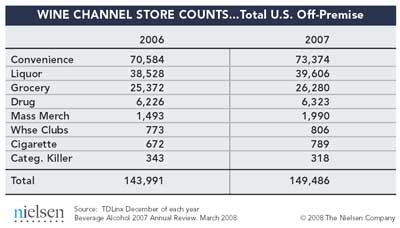
According to The Nielsen Company's TDLinx, the number of off-premise wine outlets rose 4 percent in 2007, from 143,991 in December 2006 to 149,486 in December 2007. "I think in general we're seeing a lot of growth in channel availability from a lot of different places," said Brager. "Wine is a big category in general--where wine is legal; it is close to a top 10 overall category."
Of the top 50 consumer product categories in the combined food, drug and mass merchandiser segment, wine is ranked 15th, accounting for $5.3 billion in sales. Nielsen also estimated sales to include outlets that are currently barred from wine sales and then re-ranked the top categories. In that case, wine would jump to an $8.2 billion segment, good for 11th on the list.
Retailers are adding wine to their product assortment or improving the wine sections of their stores because of the benefits they get from enticing the typical wine consumer to their store. "The demographics of the wine consumer make it a much more upscale category," said Dale Stratton, vice president strategic insights at Constellation Wines U.S. "These consumers are going to put off larger purchases, such as a new car or a European vacation, and are going to turn instead to pragmatic pleasures, self-rewards like a bottle of wine."
And consumers who buy wine are known to spend more on other items in their cart as well. "Consumers often complement the wine purchases with other [premium] goods," said Brager. "As a part of a larger basket ring, wine is pretty significant. It's a fact-based selling story. It makes perfect sense if you think about what people buy to go with wine."
Grocery stores are still the major off-premise sales channel for wine. Food stores account for over 50 percent of wine sold by both dollar sales and case volume. This channel grew by 7 percent in dollar sales and 3 percent in case volume over 2006. The number of outlets in the category has grown 4 percent in 2007, reaching 28,280 by the end of 2007.
Several sub-segments of the grocery category are rapidly adding wine to their product assortment. In particular, the number of supercenter outlets selling wine grew 10 percent, natural foods/gourmet store counts grew 24 percent and limited assortment retailers carrying wine rose 55 percent.
"The natural gourmet channel has grown, and the number of supercenters has grown because of new stores being added and new licenses being obtained to sell wine," said Brager.
Wal-Mart, for example, is beginning to add wine to their stores. Wine has become the second-largest growth category for the retail giant, up 47 percent in 2007. With consumers becoming more price-conscious, sales at value-oriented retailers, like Wal-Mart, are almost certainly going to benefit from the changing consumer shopping habits.
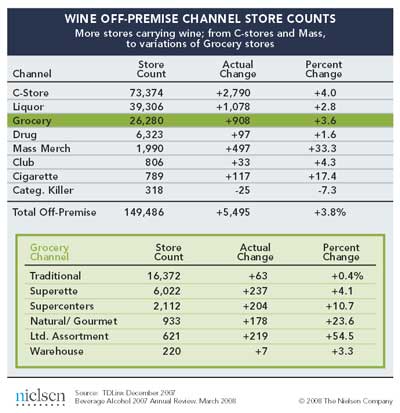
The other two largest off-premise sales channels by store count are among those that stand to lose the most during a recession. The largest channel is convenience stores, which grew 4 percent in 2007 to reach 73,374 outlets. Dollar and volume sales figures were unavailable.
Liquor stores follow, with 39,306 outlets in December 2007, a growth of 3 percent over the year before. Dollar sales in this segment grew 5 percent during 2007, while case volume rose by 3 percent.
All other tracked retail channels, such as drug stores, mass merchandisers and club stores, are selling wine in a rather limited number of locations. Drug stores are the fourth-largest wine sellers by store count at just 6,323. Mass merchandisers selling wine is another small segment at 1,990 locations. However, it is also one of the most dynamic channels in wine sales, growing by 33 percent in the last year.
In most channels, retailers need to work harder to entice customers into making the extra trip. "We're really seeing a number of accounts put an emphasis on the wine experience, if you will," said Stratton. "The points we like to use, when we're talking to retailers, revolve around environment and interaction.
"Environment is about the wine section itself and how to differentiate it from the rest of the store," continued Stratton. "A lot of retailers are putting the wine section as a bridge between fresh categories and center-store categories, so they're making the environment of that section a more pleasing place to be. On the interaction point, when we really look at it, wine can make [other] promotions in the store more adult-oriented. Putting wine with appropriate foods can help drive that consumer experience."
Brager feels the changes are due to retailers getting a better understanding of the needs and wants of their customers. "There are different types of wine consumers who are looking for different things," said Brager. "Especially when times are more difficult, it's about being more targeted and understanding of who the shopper is and having the right products to appeal to them."
There are several different methods retailers are taking to shift their focus and appeal to consumers in the wine category. Some retailers are opting to create an upscale image for their wine aisles by adding wooden shelving or different lighting schemes while other retailers are hiring wine experts to assist customers, much like a sommelier would in an on-premise environment. Where legal, many retailers are creating tasting programs and wine education classes. Some retailers are categorizing their wine sections by flavor profile instead of varietal and/or region. "The jury's out on their success, but it's certainly a different way of merchandising the wide assort of products," said Brager.
OVERALL WINE SALES UP 6 PERCENT IN FEBRUARY
Sales growth continues to remain steady, though below the rates seen through the first three quarters of 2007. It appears--at least for now--that there is no further slowdown in wine sales than what was seen in the last quarter of 2007.
Overall wine sales in the 13 weeks ending March 8, 2008 gained 6 percent over the same period in 2007. Case volume sales were rebounding slightly, rising 2 percent in The Nielsen Company-tracked supermarket channel in March figures.
The strength of sales throughout 2007 is reflected in the year-on-year data, where sales have risen 6 percent in the 52 weeks ending March 8, 2008. Case volume remained steady at 3 percent growth in March. Still, the growth rates on dollar sales still continue to outpace case sales, currently by double, indicating that higher-priced wines are driving growth even as overall wine growth is slowing down. The trend toward higher prices has sustained itself for about three years. Further, 2007 data indicated that even in the economic downturn, the highest-priced segments are showing the strongest growth.
The "big three" varietals are, for the most part, doing well. Chardonnay sales rose 4 percent in the 13 weeks ending March 8, 2008 while the varietal rose 3 percent in case volume during the same sales period. The sales growth rate is slightly better than rates seen over the last few months. Chardonnay is, by far, the top-selling varietal in The Nielsen Company-tracked marketplace, with about a 20 percent market share in sales and 19 percent share in volume.
White wines are showing strong growth, led by Pinot Grigio/Gris and Sauvignon Blanc. Pinot Grigio/Gris sales have grown 12 percent in the 13 weeks ending March 8, 2008 while case sales have increased 11 percent. Pinot Grigio/Gris is the fourth-largest varietal by dollar sales (behind the "big three"), claiming 7 percent of the market and is fifth-largest in case volume at 6 percent of the market (also behind White Zinfandel).
Sauvignon Blanc sales have similarly strong growth rates, though off a base that's about half that of Pinot Grigio/Gris. By dollar sales, Sauvignon Blanc has grown 11 percent in the 13 weeks ending in March. By case volume, the varietal grew 8 percent.
Red wine sales are also continuing to do well, led by Cabernet Sauvignon, which has increased sales volume by 8 percent in the 13 weeks ending in February. Case volume rose by 6 percent over the same time period. Though Cabernet Sauvignon represents about 15 percent of all wine sales, it accounts for 12 percent of case volume.
Merlot sales, though, continue to drop. Merlot sales dropped 2 percent in the 13 weeks ending March 8, 2008 over the same period in 2007. In terms of case volume, Merlot dropped 1 percent in the March data versus the same period in 2007. This is the third straight month Merlot sales have faltered, though by smaller rates than in the last three months.
However, for all the talk of its demise, Merlot has not suffered a drop in market share. The varietal maintains about 12 percent of the market in dollar sales and 11 percent in case volume.
Domestic wine sales gained 5 percent in the 13 weeks ending March 8, 2008 over the same period in 2007 while imports rose 6 percent over the same time period. Year-on-year, domestic wine sales grew 6 percent versus imported sales growth of 7 percent in the 52 weeks ending March 8, 2008.
In terms of case volume, domestic and imported wines both grew by 2 percent in the 13 weeks ending in March 2008 versus the same period in 2007. Year-on-year, domestic volume grew by 3 percent, but imported volume rose 4 percent. wbm