Predicting the Financial Future of Wine


Industry surveys show concern about on-premise sales and grape supplies, continuing optimism on profitability
|
Robert Smiley |

"California Wine Sales Appear Healthy," Sacramento Bee
"Softening Wine Market," Santa Rosa Press Democrat
"Wine Industry Intent on Truly Going Green," University of California, Davis press release
The author of the surveys was professor Robert Smiley of the University of California, Davis, Graduate School of Management, and the surveys were conducted by the Wine Industry Symposium Group. Smiley presented the wide-ranging results to about 250 attendees at the two-day conference.
In one of the surveys, which consisted of phone interviews with 28 wine industry CEOs from the production and distribution tiers, Smiley asked, "How has the current economic downturn affected your business?" The CEOs said that the cost of gas, electricity, supplies and transportation has risen significantly and is affecting their costs and their revenues, as consumers spend discretionary income on gas and food instead of on wine and fine dining, according to Smiley.
He added that most CEOs have seen consumers trading down to lower price- points at both on- and off-premise businesses, while restaurant sales at the casual dining level and at the very high end are suffering. "Virtually everyone talked about the on-premise business," Smiley said. "It's the business that's been hurt in this recession."
Respondents said, "With gas prices going up, dining out is one of the first areas of discretionary spending people cut back on," and, "At the higher end of the spectrum we're seeing softening in the more exclusive restaurants, the very high end. I think that is related to expense account money beginning to dry up."
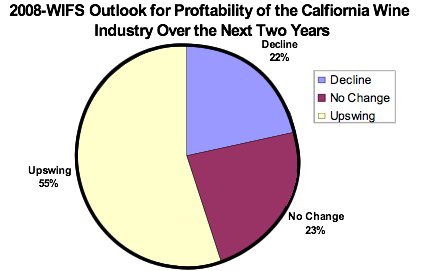
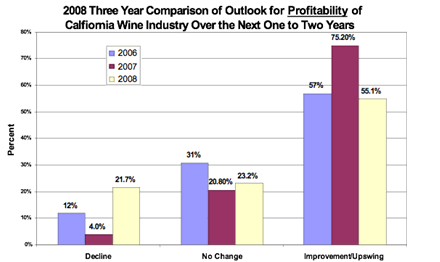
Yet, in their answers to a companion written survey on industry trends, 55% of respondents said the outlook for profitability in the California wine industry during the next one to two years was on the upswing; only 22% thought the outlook for profitability was in decline, and the rest predicted no change. While still positive, that outlook has become significantly less enthusiastic since the 2007 survey. Last year just 4% expected a decline in profitability.
The surveys were conducted in August--several weeks before the Wall Street banking crisis that saw the federal government stepping to prop up failing lending institutions.
On the prospect for increased California wine sales in 2008 vs. 2007, an impressive 73% of winery respondents to the written survey expected positive growth, and a whopping 86% expected positive growth by 2010. The top two factors for this increasing sales prospect were the acceptance of wine as an everyday beverage and its quality-for-price proposition, according to the wineries surveyed.
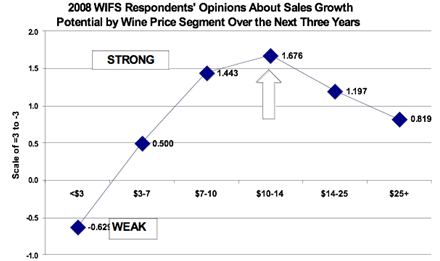
In a question about the sales potential for different price-points, the largest percentage of wineries was convinced that $11-$14 was the strongest category. Weaker expectations were recorded for the higher end, wines above $25, and the lower, wines at $7 and less.
Smiley and his graduate research assistant, winemaker Alison Crowe, also found evidence that some growers were more optimistic than in recent years. Price increases for their grapes were cited by 43% of growers as a reason for optimism, and 27% said having more contracts encouraged them.
Growers indicated that all five premium red wine varieties may be in undersupply. Sixty-four percent said Pinot Noir was in shortage; 41% said the same for Cabernet Sauvignon, 37% for Merlot and 30% for red Zinfandel. Even the doghouse variety, Syrah, had 11% of respondents saying it was in undersupply.
Both wineries and vineyards revealed increased attention to their efforts to be more environmentally sensitive. A significant 16.7% of the vineyard survey respondents said they farmed at least some of their acreage organically, while 3.4% of them said they farmed at least some of their acreage Biodynamically. More dramatically, 80% of growers said they farmed some of their acreage sustainably.
Seventy-five percent of wineries said that their customer base was interested in sustainably farmed wine; 26% interested in organically grown wine, and a surprising 38% believed their customers are interested in organically grown and made wine.