Take the train to Halifax to explore charming Nova Scotia


|
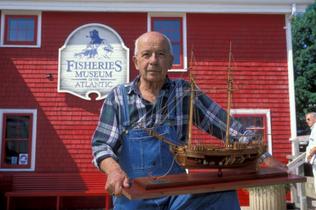
Learn about seafood at the Fisheries Museum of the Atlantic in Lunenburg. |
You can get there by car, boat or plane, but gliding on the rails to Halifax, Nova Scotia, you have the time to sit back and appreciate the Kodak moments: lush forest, rolling hills, a couple dusty mills and gorgeous rivers.
Halifax is one of the easternmost port cities in North America and VIA Rail Canada's Ocean train travels there from Montreal every day but Tuesday, a 772-mile overnight journey through Canada's Maritimes region that's truly
captivating.
The train offers the option of sleepers, complete with comfortable, duvet-covered bed, bathroom with shower and access to the train's dining room a few cars away. If you book the top-category Easterly sleeper-class your lesson in local culture begins immediately with an onboard "learning coordinator" lecturing on topics including history and how lobsters are caught. Easterly passengers also enjoy wine tastings and access to the rail's signature dome viewing car - with 360-degree views.
Leaving in the early evening, by early morning, as the fog burned off, we train
passengers crossed time zones from Eastern to Atlantic and were mesmerized by
the glistening Bay of Chaleur. Shortly thereafter we were in the heart of Nova
Scotia, winding along the carved-out hills on the outskirts of Halifax. As you
enter the city, you can catch a glimpse at one of the cemeteries where some
victims of the Titanic are buried - three ships from Nova Scotia were involved
in the task of recovering bodies from the disaster.
The train disembarks in downtown Halifax, and from the station you can easily
walk to almost any downtown hotel. The city is easy to explore, a compact place
with a college-town ambiance (thanks to the University of King's College,
Dalhousie University and other schools.)
Founded in 1749 by Gov. Edward Cornwallis, Halifax grew up around the
star-shaped Halifax Citadel, a huge stone fort - the present structure was
completed in 1856 - that's the biggest remnant of the British Empire's hold on
Canada. The site was designated a national landmark in 1951. Kilt-wearing
historical re-enactors offer guided tours. And every day at noon, they fire off
a cannon that today points to downtown office buildings.
A short walk away is the active waterfront and Pier 21, Canada's version of
Ellis Island, first stop for about 1 million immigrants, mostly from Ireland,
Scotland, Germany, France and Italy. Pier 21 features a museum, an eye-popping
multimedia show and a research center you can use to find Canadian ancestors.
The museum is the centerpiece of a renaissance around Halifax Harbour, which has
undergone a series of major cleanups: New luxury condos are being built and a
boardwalk makes it easy to walk along the water. Along the boardwalk is the
Maritime Museum of the Atlantic, featuring a collection of artifacts from the
province's rich marine history - including Titanic information.
Near the waterfront, a must-do stop on a Saturday is the Halifax Farmer's Market
(7 a.m. to 1 p.m.; open Saturdays year-round). Vibrant and crowded, it is housed
in the historic Keith's Brewing Co. building at 1496 Lower Water St., next to
the Courtyard Marriott. You'll find here a dizzying array of the finest in local
produce - fresh vegetables, fruit, bread, meats and cheeses.
While the city impresses, it is in the outskirts where you'll gain an
appreciation for Nova Scotia's local charm. Picturesque towns dot the province,
from the craggy granite boulders of Peggy's Cove to the vineyards of Wolfville,
and many options are within an hour's drive from Halifax.
Rent a car and drive to Lunenburg, a historic fishing village listed as a UNESCO
World Heritage Site. The town hasn't changed much at all since it was founded as
a British colonial settlement in 1753. Colorful pastel-painted shops, homes and
other buildings surround the harbor and it's easy to get lost in the beauty. The
other draw to Lunenburg is the Bluenose II, a replica of the celebrated 1921
Canadian racing and fishing vessel. For $35 from June through September you can
take a two-hour cruise on the schooner. You may even spot seals flopping in the
water.
Those hungry for seafood knowledge should stop by the Fisheries Museum of the
Atlantic, an aquarium and museum right next to the Bluenose II pier. Here you
can check out what halibut, salmon and lobster look like when they're not being
served on a plate. And then dine on fresh seafood at the museum's The Old Fish
Factory, with a great view of the harbor to boot.
If you go
Getting there: VIA Rail Canada offers departures from Montreal to Halifax on its
Ocean train (www.viarail.ca) leaving Montreal's Central Train Station, six times
a week (every day but Tuesday) at 6 p.m. and arriving in Halifax about 21 hours
later. The trip takes you through the provinces of Quebec, New Brunswick and
Nova Scotia. Regular seats from $222 each way; Easterly Sleeper-class from $426,
available mid-June to mid-October.
Staying there: In Halifax, the Courtyard Marriott offers rooms with views of
Halifax Harbour (rates from $143 to $229; 902-428-1900; www.marriott.com). In
Lunenburg, the Lunenburg Arms Hotel (rates from $129; 902-640-4040;
www.eden.travel) overlooks Lunenburg Harbour. In Wolfville, the Blomidon Inn
(rates range from $99 for a small room to $269 for a cottage; 800-565-2291;
www.theblomidon.net), is a quaint bed and breakfast in the former mansion of a
sea captain.
Eating there: For some of the freshest fish you'll ever eat and a delicious
salad bar, try 5 Fishermen (902-422-4421; www.fivefishermen.com) at 1740 Argyle
St. in Halifax. McKelvie's, housed in a former fire station at 1680 Lower Water
St., features delicious seafood and pasta. In Lunenberg, try Fleur De Sel
(902-640-2121; www.fleurdesel.net), a French restaurant that features some of
the most creative dishes from one of the region's most celebrated chefs, Martin
Ruiz Salvador.
The next Napa Valley?
Wolfville and the Annapolis Valley serve up fascinating Acadian history
(detailed at the Grand Pre National Historic Site; www.pc.gc.ca) and miles of
blueberry fields and apple orchards. But increasingly attracting attention are
the vineyards.
Nova Scotia's wines may be the best-kept secret in the wine world.
Grapes for wine have actually been grown here since the 1600s - in the Annapolis
Valley and other regions. But only recently are the vintners beginning to claim
bragging rights.
"We're going to be the next Napa Valley," said Cacilia Stutz-Spirig, the
daughter-in-law of Hanspeter Stutz, the founder of Grand Pre Wines in bucolic
Grand Pre, one of nine wine producers in Nova Scotia.
While the short growing season means the vineyards can't grow traditional grape
varieties such as Chardonnay or merlot, don't discount the wines here. Grand Pre
produces a light-bodied seyval blanc, a Vintner's Reserve Foch and a Vintner's
Reserve Castel that have won gold in the All-Canadian Wine Championships, and
ice wines that have also received acclaim (the vineyard's hard cider, Stutz, is
also a treat).
At the Benjamin Bridge winery in Wolfville, winemaker Jean-Benoit Deslauriers, a
Canadian with experience working at wineries in California and Chile, is in
charge of a huge project that will introduce a large variety of champagne-like
sparkling wines sometime in 2011. "It's a very ambitious project," he said.
From now until Oct. 26, the third annual Nova Scotia Wine Festival features wine
tours and special menus at select restaurants. Find more at www.winesofnovascotia.ca.