Whirlwind tour of Shanghai


There is so much to see and do in China’s third largest city but even a fleeting visit, writes TAN BEE HONG, can be a journey of discovery... if you know where to go
|
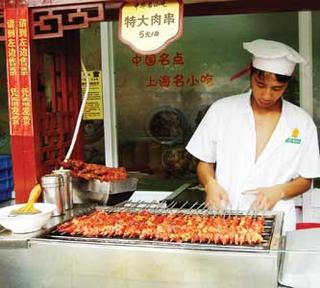
Satay, Shanghai-style. |
|
View of Oriental Pearl TV Tower, the tallest building in Asia and third tallest in the world. |
|
The two sides of Shanghai. |


After all, Shanghai, spread over 6,218 sq km with an extended metropolitan area, is the third largest city in China.
But even a fleeting visit is not without its moments. The blend of eastern and western cultures is more obvious here than anywhere else, yet these two contrasting facets of the city are distinctly apart.
Shanghai began as a fishing village in the 11th Century, but by the mid-18th Century it had become an important area for growing cotton and by the 1800s it was the largest city in China.
Architectural Wonders
Landmarks such as The Bund, carry the legacy of foreign invasion without apologies and you may be forgiven if, for a minute, you wonder where you are as not a single facade is of Chinese design.
The historical buildings on this embankment facing the Huangpu riverfront once belonged to banks and trading companies from France, Russia, Britain, Germany, The Netherlands and Belgium. Today, they continue to be an important financial hub.
Though I am told the nightlights at The Bund are truly spectacular, with all the buildings lighted up, I didn’t get an opportunity to see this.
But even a day tour (if the polluted skies clear up a bit) offers a sight that would leave architecture students weak in the knees as one seldom finds so many building styles in one place — from Gothic and Romanesque to Renaissance, Neo-Classical and Art Deco.
Even modern structures, including modern apartment blocks, exhibit a need to link with the past as evident in the use of Baroque elements like griffins, angels and the like.
Incidentally, the Shanghainese appear singularly-minded when it comes to the tops of buildings. They can’t leave them alone. Look upwards and you’d find them capped with complicated domes, crowns, mini pyramids and more - and often in gleaming gold too.
Across the river in Pudong, modern structures stand tall, including the Oriental Pearl TV Tower, the tallest building in Asia and the third tallest in the world.
Temples & Gardens
Most tourists head for Chenghuang Miao in Fangbang Zhong Lu, which is also where the Old Town Bazaar is. The temple is dedicated to the town deity.
My group was dropped off at Yuyuan Garden instead, in the centre of the Old City, not too far from The Bund. With a total area of nearly 20,000 sq m, it comprises both an inner and outer gardens, built in the Ming Dynasty classical style.
The garden was believed to be built over 400 years ago in 1559, during the Ming Dynasty as the private garden of Pan Yunduan. There are rock and tree garden areas, ponds, dragon-lined walls and numerous doorways and zigzagging bridges separating the various garden areas and pavilions.
The exquisite layout, beautiful scenery and architecture have made Yuyuan Garden one of the must-see spots in Shanghai.
The surrounding bazaar area is like a market place and tourists can find plenty of souvenirs and handicrafts from keychains and musical instruments to clothing. There’s even a Starbucks coffee outlet there.
As at most places in Shanghai, bargaining is the order of the day and if you sharpen your skills, you’d easily knock 50 per cent off the asking price.
But it’s not just shopping here. You can jostle your way around the outer garden and admire the various statues, buildings and lotus ponds. Then stop for tea in a traditional tea house overlooking the lake or buy fish food to feed the carp in the ponds.
But whatever you pick for a souvenir, please don’t buy bubble keychains with tiny live fish trapped inside. These are totally gross and are the epitome of man’s insensitivity towards animals.
Dining & Wining
In the evenings, head for Xin Tian Di, an urban happening spot in the middle of the city. Here, on the outside, you’d find facades of cafes, restaurants, galleries and boutiques built in the 1800s Shikumen architectural style of old Shanghai. But step into any of the shops and you’d be amazed at the transformation that captures the pulsating beat of any modern city.
Dining here is a treat and you’d find cuisine from Japan, France, America, Brazil, Germany and Italy. The American chain, Lawry’s The Prime Rib, for instance, is crowded almost every night with customers who come in for the prime cuts of roast beef. Not to worry, even those who steer clear of beef can find a wide range of seafood dishes from salmon to lobster tails.
For a taste of local Shanghai cuisine, however, there is a choice of street food or top Shanghai restaurants like Shanghai Old Restaurant, De Xing Restaurant, Meilongzheng Restaurant and Shanghai Uncle.
For a touch of nostalgia, go to Fu 1039 Yu Yuan Road. The restaurant is one of the city’s best-kept secrets. Housed in a building that was the home of a former State Minister, the entrance is through a nondescript doorway that opens up to three storeys of private dining rooms.
Wooden stairways, chic French furniture, old-fashioned restrooms, faded portraits and fireplaces all spin a tale of Shanghai’s heydays, invoking the romantic ambience of the 1930s.
The food is classic Shanghainese and one starts with some 20-40 appetisers to nibble on from chicken in wine to miso cod and lotus root stuffed with glutinous rice.
Go easy as there’s an amazing range of delicious main dishes to come and then, just in case you are still hungry, finish off with noodles and xiao loong bao (dumplings).
Shopping Paradise
Shanghai is a paradise for shoppers, whatever your budget. Popular destinations include the bustling shopping centres along Nanjing Road, Huaihai Road, North Sichuan Road, Xujiahui Shopping Center, Yuyuan Shopping City and Jiali Sleepless City.
Nanjing and Huaihai are where you can find top-designer brands from all over the world. You can spend an entire day here, trawling the shops from its junction at The Bund to the other end or take detours to browse charming small boutiques and shoe shops along side roads.
Those with a more limited budget can head straight for the Qi Pu Lu wholesale markets. These can either be a shopper’s idea of heaven or a nightmare come true.
Whichever, you’d find plenty of character in the streets and in the three or four buildings housing small shops stocked to brim with all kinds of clothing, bags, shoes and accessories.
A lot of the stuff is junk but clever shoppers will be able to find great bargains in factory rejects. I picked up a lovely lined silk Chinese top for only RMB30 (under RM15) and a dress (going at RMB200 in Nanjing Road) for RMB60.
Bargaining is the order of the day here! Don’t be embarrassed to offer shopowners half the asking price. You would also probably find persistent touts at your heels but tell them firmly “No!” and they will give up — after half an hour or so. Go early though as the place shuts down after 6pm.
There’s also the Xiangyang Road market, famous for its range of fake designer wear. Here, you can buy Chanel, Gucci, Polo, Louis Vuitton and Rolex watches at a fraction of the original price but please remember these are just FAKES!