Robert Mondavi Institute Opens


|
Wielding giant scissors used to cut the ribbons for the grand opening of the Robert Mondavi Institute for Wine and Food Science at UC Davis are, from left, Clare Hasler, executive director of the institute; Robert Grey, University of California interim provost; Neal Van Alfen, dean of UC Davis' College of Agricultural and Environmental Sciences; and UC Davis Chancellor Larry Vanderhoef. |
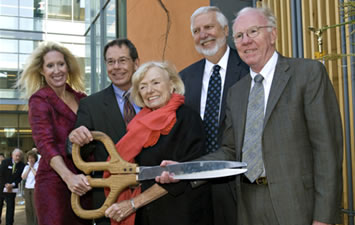
On Oct. 10 a group of lawmakers, faculty and donors gathered at the newly constructed Robert Mondavi Institute (RMI) to celebrate the grand opening of the site, and hold a groundbreaking ceremony for the Teaching and Research Winery and the Anheuser-Busch Brewing and Food Science Laboratory.
Speaking to the hundreds of donors who had gathered for the event, University of California, Davis, chancellor Larry N. Vanderhoef said that opening the doors to RMI was akin to opening the doors to the world. UC Davis has long been considered home for one of the top food and wine research programs, and now it has facilities to match, Vanderhoef said.
In spite of the school's lofty reputation, students and faculty have been conducting experiments in sub-par conditions for years. "As we like to say, 'Our winery was one Louis Pasteur would feel very comfortable in,'" joked Neal K. Van Alfen, dean of the College of Agricultural and Environmental Sciences.
Vanderhoef and Van Alfen participated in the ribbon-cutting ceremony Friday at RMI, joined by Clare Hasler, executive director of the institute, UC interim provost Robert Grey and Margrit Mondavi, widow of the late Robert Mondavi, for whom the school is named.
"On a scale of one to 10, today is 20," Mondavi told the crowd. "I am only sorry that the love of my life, Robert, isn't here."
Margrit Mondavi shared the story of how her late husband conceived the idea for helping to better the circumstances of the UC Davis viticulture and enology department. Robert often consulted the faculty of UC Davis for ideas about how his wine could be improved, Margrit said, and after one visit he came away saying, "I'm going to get the vintners together. Somebody's gotta do something," about the facilities. But years went by, and nothing changed. It was then that Mondavi took matters into his own hands and met with the school to see how he could help. The move eventually led to Robert and Margrit Mondavi gifting the school with $25 million to help construct a state-of-the art research institute.
|
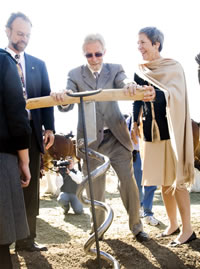
A giant corkscrew was used to break ground on the second phase of construction at the Robert Mondavi Institute for Wine and Food Science. Helping to ceremonially break ground were, from left, Andrew Waterhouse, chair of the Department of Viticulture and Enology; Robert Mondavi's children Tim Mondavi and Marcia Mondavi Borger. |
Environmental consciousness was a key point in designing the new buildings. The floors, which appear to be concrete, are in fact made from fly ash, a residue that is generally captured from the chimneys of coal plants. Cabinets in the labs are made of pressed wheat straw, and all of the wood used in construction of the building came from sustainable sources. The laboratories are outfitted with glass panels that prevent infrared radiation from entering, and keep the temperature steady. And the buildings encircle a courtyard, which is planted with a citrus grove, an olive grove and the "good life garden"--ever-changing plots of herbs and fruits.
Following the grand opening ceremonies and ribbon-cutting, the large crowd turned its attention to the site that in coming years will house a teaching winery, a brewery and a food-processing plant for milk and tomatoes. To break ground on the site, Dr. Andrew Waterhouse, chair of the department of viticulture and enology, turned a giant corkscrew into the ground with the help of Tim Mondavi and Marcia Mondavi Borger, children of Robert Mondavi. Representatives from the Food Science Technology program dug in with a giant fork, and a representative from Anheuser-Busch and UC Davis faculty turned the soil using a huge bottle opener.
"It's only the beginning," Margrit Mondavi said. "We are ready to go."