Dr. Frank Fast Tracks a Riesling Clone


Cooperation among New York, USDA and Cornell clears Germany's N90 clone in two years
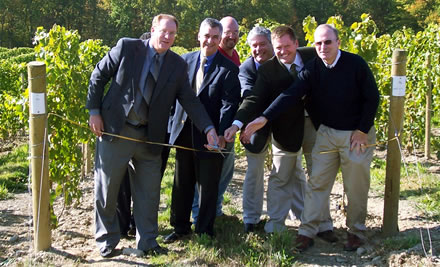
After cutting bureaucratic red tape to streamline the approval process for clone N90 Riesling, those who cooperated in the process enjoyed the ribbon-cutting ceremony at Dr. Frank's Vinifera Wine Cellars on Oct. 9. From left to right: Frederick Frank, President, Dr. Frank's Vinifera Wine Cellars; Alan Green, APHIS, PPQ; Eric Volz, vineyard manager, Dr. Frank's Vinifera Wine Cellars; Marc Fuchs, Cornell University; Patrick Hooker, NYS Department of Agriculture and Markets (Commissioner of Agriculture); Tom Burr, Cornell University.
Hammondsport, N.Y. -- Dr. Frank's Vinifera Wine Cellars celebrated the official release of the Riesling clone N90 on Oct. 9, culminating in an unusually rapid deployment of an imported grapevine valued for its winter hardiness and aromatics.
Why would Vinifera Wine Cellars, already widely known for world-class Riesling wines, want to find a new Riesling clone when its existing vineyards were already producing excellent grapes and wine? Moreover, how did the winery bring all the relevant authorities together to get the vines out of quarantine for potential viruses and other diseases just 28 months after importation?
Since clone 90 came from Germany's Neustadt Research Station, Frank contacted Matthias Zink, formerly his vineyard manager at Chateau Frank, and now the nursery manager and in charge of the grafting operation at the Neustadt station. Zink told him that clone 90 was now clone N90, and that Frank should buy rooted vines grafted on Neustadt's SO4 clone 202 rootstock from the station's certified virus-free mother block.
Cornell University's Geneva Experiment Station was in the process of applying for reinstatement of its Grape Virus Indexing and Certification Program after the lapse of a decade, and Dr. Marc Fuchs, assistant professor in the Department of Plant Pathology, would soon be named as the program's director. When Frank talked with Fuchs, he found out that Fuchs had visited the Neustadt station and was aware of the certified mother block. Since exceptions to quarantine standards had to be approved by both the USDA's Animal and Plant Health Inspection Service (APHIS) and by New York state, Frank presented his case to both authorities.
The agencies reviewed the information, and APHIS asked Fuchs to go to the Neustadt station to verify its testing procedures. During a business trip to Europe in 2005, he collected dormant cuttings from N90 and SO4 clone 202, brought them back to Geneva, tested them, and reported to APHIS and the New York State Department of Agriculture and Markets that they were virus free.
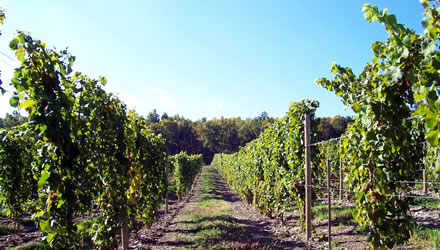
Certified virus-free, the clone N90 Riesling vines in the experimental vineyard appear to be thriving.
APHIS and New York state had to agree on the required standards. The vines were to be planted in a field at least 400 yards away from any other vineyard, and the entire field had to be fenced and locked. In addition, the field could not be owned by Vinifera Wine Cellars, and a leasing agreement had to be established with the Geneva station so that it would have control of the plot. Twice per year, the vines were to be inspected by Fuchs.
The vines that were shipped from Germany and planted at Vinifera Wine Cellars were grafted and rooted year-old vines that had been certified at the Neustadt Research Station to be virus and pathogen free, and free of crown gall. Normally, a limited number of dormant cuttings are brought into the United States and subjected to established quarantine procedures, but in this case, a unique pilot introduction allowed the 1,500 grafted N90 vines to be imported and quarantined for a two-year period. It took the cooperation of the USDA-APHIS-PPQ, the New York State Department of Agriculture and Markets, and personnel at the Geneva Experiment Station to make the pilot introduction reality.
Of the 1,500 vines imported from Germany in June, 2006, 1,445 were planted in late July of that year. Fuchs made his last test in 2008, and on Oct. 6, Dr. Thomas J. Burr, director of the Geneva station, requested the release of the vines. The request was granted by both APHIS and New York State one day later.
According to Fred Frank, Willy Frank's son and now the winery's president, the N90 vines have the advantages of higher quality wine potential with enhanced aromatics; more disease res istance due to looser clusters and greater winter hardiness. The release of the vines from quarantine will allow the winery to propagate them and make them available to other vineyards.
Fuchs told Wines & Vines that the bottom line for him is that this was a success story. "It was a success because it was a coordinated effort by state government, federal government, a research station and a visionary grower. All of them had to have the same dedication to make this happen."
This was underscored at the celebration, when those cutting the ribbon at the vineyard site included high ranking officials from organizations that made it possible: Alan S. Green, executive director of the Plant Health Programs at APHIS, Patrick Hooker, commissioner of the New York State Department of Agriculture and Markets, and Burr, director of the Geneva station.
Joining them were Fred Frank, representing his late father; Marc Fuchs, and vineyard manager Eric Volz.
Fred Frank first tasted wine from clone 90 in 1982-1983 when he was a student at Geisenheim University in Germany and sampled various Riesling clones in the microvinification lab. Clone 90, the predominant clone in the older German vineyards, was his favorite, and he passed along his enthusiasm to Willy. Vinifera Wine Cellars was then owned by Willy's father, Dr. Konstantin Frank, and clone 90 had to wait.
Later when he became familiar with 20-years of research Robert Pool was conducting on clone 90 at Loomis Farm in Geneva, Fred Frank was convinced that the wine quality, disease resistance, winter hardiness and loose clusters of clone 90 would be the same for N90.
He will begin propagating N90 this winter, and a year later he expects to make N90 available to other growers.
Vinifera Wine Cellars has a new vineyard site on Seneca Lake in Hector, N.Y. This site, in what is called the Finger Lakes "banana belt," has milder winter temperatures as well as good, well-drained soils. No wine has yet been made from clone N90, although a Riesling reserve wine has been made from old vines, the majority of which were clone 90.