Spanish Cooper Sells Chinese Oak


Tonelería Magreñán introduces barrels from Mongolian forest
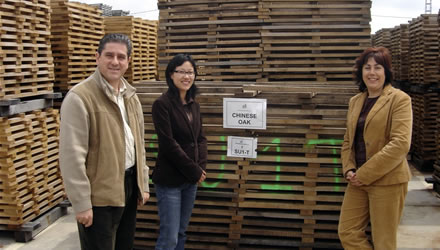
Pictured in the photo are brother and sister partners Antonio Magreñán and Teresa Magreñán, along with the local Chinese translator in Spain.
Rohnert Park, Calif. -- Seasoned winemakers who once turned up their noses at oak grown outside the famous forests of France have grown to accept, and even sing the praises of, oak from the Americas, Russia, Hungary and Romania. Now, Tonelería Magreñán, a cooperage from La Rioja, Spain, has partnered with a supplier in China to introduce barrels made from Quercus mongolicus, or Chinese oak, and more than two dozen European wineries already have jumped on the bandwagon.
Antonio Magreñán, who runs the family cooperage business with his sister, Teresa, is an avid traveler. He first became interested in Quercus mongolicus upon learning of a forest in Mongolia that is about twice the size of Spain. Magreñán was looking to offer something different to his customers, so he bought about 40,000 barrels worth of standing trees in 2005, cured the oak and aged it for 36 months in the yard of his property in La Rioja.
Last year, Tonelería Magreñán began production on the Chinese oak barrels, which currently are in use in Spain, Italy and even at Chateau Malescot St. Exupery, a 400-year-old winery in the Margaux appellation of Bordeaux. In North America, the Winemaker's Loft in Prosser, Wash., currently is experimenting with the barrels.
"We believe we're the first ones to use Quercus mongolicus in cooperage," said Craig Thornbury, who represents Tonelería Magreñán in the United States. He said that wines aged in Chinese oak barrels have been described as smoky, low in tannins and having exotic notes in the nose, as well as a creamy mouthfeel. The oak itself has a toasty, almost bacony quality, some users say.
Among the list of winemakers taking the plunge is Miguel Torres, whom many thought to be foolish when he started using stainless steel tanks in Chile in the 1970s. Now, of course, the practice is commonplace, and Torres is experimenting yet again by aging his white wine in Quercus mongolicus.
The Chinese oak barrels are similar in price to many French oak barrels, Thornbury said, and they create flavors that haven't been made before.
"It depends on the style of wine that you want to make. It depends on the grapes, and where they come from. The only way to find out is to try some barrels with your wine," Thornbury suggested to Wines & Vines readers. "Basically, it's to be different and to distinguish your wines from someone else's."