Biologist Creates Herbicide-Resistant Grape


Improved Chancellor withstands agent commonly used in Midwest
|
Robert Skirvin |
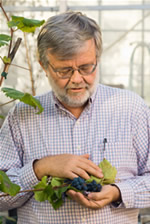
"2-4D drifts really, really badly. Even if you are careful, it can drift for a mile or three miles; and if it gets hot, it'll revolatize, and then it moves again," said Robert Skirvin, the plant biologist behind the discovery. "The power companies use 2-4D to kill weeds along power lines and railroads, so there is still a lot of it used."
The biologist at the College of Agriculture, Consumer and Environmental Sciences at the University of Illinois got the idea for a 2-4D-resistant grape upon reading an article about a USDA scientist who found a material to break down 2-4D in soil. Skirvin tried placing different markers within the cells of the Chancellor variety, which is used to make wine at several wineries in Southern Illinois. There the hilly landscape isn't conducive to row crop planting, and thus 2-4D isn't as much of a problem. Eventually, the biologist found a cellular combination that, when inoculated with the resistant bacteria, led to a 2-4D-resistant grapevine.
Transgenic plants can't be placed in the field without USDA approval, so Improved Chancellor is isolated in a greenhouse. The lab already has collected offspring seedlings that show resistance to 2-4D, but is having trouble getting them to germinate.
Skirvin doesn't yet know why the vine doesn't react to the 2-4D, and what it does with the herbicide it comes in contact with. "Sometimes when organisms take in a poison, they actually make a little cellular enclosion, so we don't know how it's breaking it down," he said.
At the start of the 20th century, Skirvin said, about 100 counties in Illinois were making wine--in fact, when the World's Fair was held in Chicago in 1893, wines from across the state were showcased at a special exhibit. The biologist is hopeful that the creation of an herbicide-resistant grape could help restore the state's wine industry to its former prolific place in U.S. winemaking.