Washington Researchers Launch Winery


Small-lot facility designed to replicate experiments for most accurate results
|
WSU enologists James Harbertson and Kerry Ringer designed the new research winery. Photo by Brian Clark, CAHNRS Marketing and News Services. |
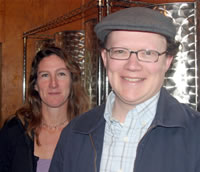
Dr. Kerry Ringer, a WSU assistant professor and extension food scientist, told Wines & Vines that this week the winery has been processing Chardonnay from the rootstock project directed by WSU's Dr. Markus Keller. Keller studies scion/rootstock interactions. Ringer said that next week the winery will be crushing red winegrapes, possibly Merlot.
Small lots
Ringer and Dr. James Harbertson spent about six months designing the new winery. It's equipped with 73 stainless steel fermentation tanks, which have capacities of 26 to 260 gallons and temperature controls. "I was fermenting in garbage cans when I first got here, so for me this is a considerable step forward," Harbertson said. "Last year we had a senator come to visit, and they were watching me punchdown in a garbage can." The team is working with Chateau Ste. Michelle, where the WSU researchers are performing different irrigation treatments on Cabernet Sauvignon to gauge the effects of irrigation on grape and wine quality.
"They're doing the Cabernet Sauvignon at their place, but we're doing our own studies here. Basically we've relied on our industry partners to make the wine for us until now," Ringer said. "Right now they're making the wine for us, but next year we hope to make the wine in- house in our 80-gallon fermenters."
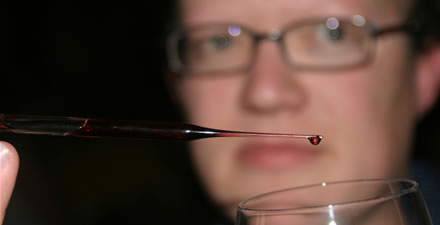
Dr. James Harbertson uses a pipette to extract juice to analyze.
Researchers already have taken samples from the grapes that have come in, and the first batches of wine will probably be ready in about a month, she said. The staff in Prosser will wait until fermentation is complete to begin experiments with the wine.
Syrah will be one of the winegrapes studied at the winery, as will Riesling. "Riesling is a pretty big contender in Washington state," Ringer said. Sensory and aroma studies are among other factors the researchers will be investigating.
Over and over
Ringer added that because the experiments are being done for research purposes, treatments are replicated between three and five times to mimic what happens in the field and eliminate outside variables. Sometimes viticulture techniques create a discernable effect in grapes, but once those grapes are made into wine, the effect goes away, Ringer said. She also hopes to do some experiments with cross-flow filtration and flavor compounds.
"I think we're going to be able to help the Washington winemakers quite a bit," Ringer said. "A lot of people might think that a technique is working, but without doing the replicates, it's hard to say if it's working or not."