Leafroll Viruses Spread in Finger Lakes


Insects may be important factor; Brix reduction and pH increase documented
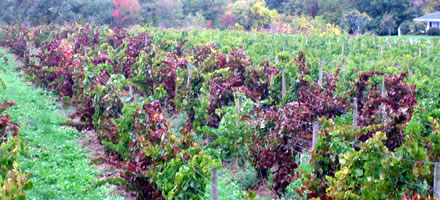
In this Cabernet Franc vineyard, red leaves on some vines indicate the presence of leafroll virus.
Geneva, N.Y. -- The presence of grapevine leafroll viruses in California vineyards is well known, but the extent that vineyards in other parts of the country may be affected is only beginning to be determined. Cornell University's Cooperative Extension recently released the results of a survey that began in 2006 designed to gather data about the presence of leafroll viruses in the Finger Lakes region of New York.
The New York survey looked at 95 vineyard blocks in 25 different vineyards throughout the Finger Lakes region. Up to 20 leaf samples were collected from each vineyard to find the percentage of positive samples and to map the location within the vineyard of any infected vines. A total of more than 1,000 leaf samples were tested in Marc Fuchs' laboratory at the New York State Agricultural Experiment Station in Geneva for the presence of three grapevine leafroll associated viruses: GLRaV-1, GLRaV-2 and GLRaV-3.
|
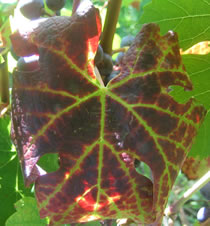
A leaf from a red varietal shows symptoms of leafroll virus -- red leaf with green veins. |
The impetus for the survey came from a Lemberger vineyard with symptoms of leafroll viruses on most of the vines. Researchers made a special effort to collect samples in Lemberger vineyards where leafroll viruses were expected to be found, but then found it in blocks of different varieties within the same vineyard.
Further testing on the initial vineyard revealed that two of the grapevine leafroll associated viruses, GLRaV-2 and GLRaV-3, were present on that site. In addition, nearby blocks also had GLRaV-1 present, the first time this form of leafroll was reported in New York.
While all leafroll viruses are spread through infected budwood cuttings and graft unions, mealybugs and soft scale insects have been identified as vectors that can spread leafroll viruses to clean vines. Consequently, the researchers in New York also looked for grape mealybugs and soft scale insects. Samples of these possible vectors were collected at 31 blocks in 25 vineyards. Some of the same vineyards used in the leaf sample survey were included, but not all of them. Six sites were free of soft scales or mealybugs. While 25 sites (81%) had either soft scales or mealybugs, 22 of those blocks had very low numbers.
|
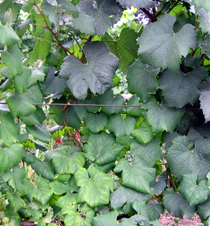
White varietals display different symptoms of leafroll virus -- leaf curling and yellowing. |
Because leafroll viruses delay grape maturity, lower yield and affect the quality of the wine produced from those grapes, the researchers in New York also conducted pre-harvest sampling of grape berries from 14 vineyards with vines that were easily identified as clean or positive for leafroll symptoms.
In one Cabernet Franc vineyard, two of 14 rows showed strong presence of leafroll virus, while 12 rows appeared to be clean. At this site, weekly samples were taken for five weeks before harvest. The results showed that Brix was lower in the leafroll vines by 2° throughout the five week period, and that juice pH was higher and titratable acidity was lower. Samples taken near harvest at the other sites also exhibited similar fruit chemistry. Brix measurements were 1° to 3° lower in grapes from leafroll-affected vines than in grapes from clean vines, and juice pH was generally higher. However, readings for titratable acidity and berry weight were inconsistent.
Once a grapevine is infected with a leafroll virus, it cannot be cured. Consequently, it is important to prevent infection initially and to keep the viruses from spreading. The New York researchers suggest five steps to help manage this problem:
Plant certified vines. Use planting material derived from certified virus-tested stock for new vineyards and replants.
Recognize the symptoms of leafroll, which become visible in vineyards in mid- to late August. Red varieties have characteristic red leaves with green veins; in white varieties, the symptoms are rolled leaves and general yellowing.
Mark and replace infected vines when possible to limit further spread in the vineyard.
Do not spray insecticides for mealybugs. These insects are rare in vineyards and don't directly impact vine performance. The use of insecticides in other regions has not limited the spread of leafroll viruses.
Harvest selectively. The most visible leaf symptoms occur in red vinifera grapes, which makes it possible to harvest around those infected vines to improve wine quality and reduce green, unripe flavors.
According to Martinson, vineyard managers in New York have known for years that leafroll viruses were present in certain vineyards, especially in blocks of older Pinot Noir vines, but they believed that the problem would not spread. Now that insect vectors for the viruses have been identified and the effect on fruit quality has been demonstrated, grapegrowers can't afford to ignore this problem.
The economic impac t of leafroll viruses in New York is amplified by the fact that growers are facing a second replacement of grapevines. Many growers lost vines in the freeze during the winter in 2004, and many of the replacement vines that were ordered were not clean vines but came with leafroll viruses. Martinson notes, "This means growers are facing an enormous economic loss, since they went without a crop after the 2004 freeze and now have to plant again."
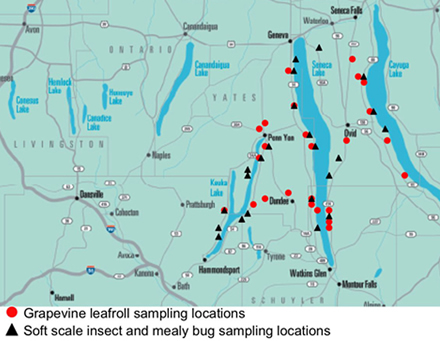
In this The map pinpoints locations of vineyards surveyed in the Finger Lakes for leafrool virus.