Fueled by passionate entrepreneurs, Clackamas County's wine industry is exploding


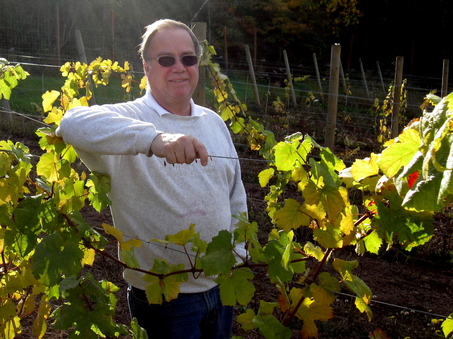
PEGGY SHEKELL/SPECIAL TO THE OREGONIAN
Don Carter, a retired Mentor Graphics engineer, is taking his longtime passion for wine´making public by launching his own line of commercial wines. He hopes to sell his Villa Mariposa Vineyards pinot noir and pinot gris at area grocery stores, wine shops and restaurants.
For many people, each passing year means another step closer to the grave.
Don Carter couldn't disagree more -- and it's all because of wine.
"Most people are frustrated that time goes by so fast," said Carter, a former Mentor Graphics engineer and entrepreneur, who plans to take his passion public next year by launching his own commercial line of wine. "With winemakers, it's just the opposite. The minute this year's wine goes into the barrel, we can't wait for next year to roll around."
With new vineyards springing up on Petes Mountain, in the Ladd Hill area west of Wilsonville and along Southwest Rosemont Road near West Linn, Carter is emblematic of Clackamas County's viticultural emergence.
And while many Oregonians correctly identify Yamhill County as the epicenter of the state's $1 billion wine industry, Clackamas County is making some noise of its own as a producer of increasing amounts of delectable and salable wine.
The number of commercial vineyards in the county has doubled in the past few years, from 22 in 2002 to 44 in 2007, according to state agricultural statistics.
Carter, with his distinctive Villa Mariposa Vineyards label, whose colorful butterfly was created by his 87-year-old father and partner-in-wine, Thurl Carter, is helping lead the charge.
"There's an explosion taking place in Clackamas County right now," said Darrel Roby, founder of Ribera Vineyards in West Linn. "A lot of people have no idea how big it is."
Pressing concerns
Carter's journey from home winemaker to fledgling professional came in a roundabout way.
In the mid-1980s, he was logging "incredible hours" at Mentor Graphics, where he rose to managing director and co-authored seminal textbooks on the emerging field of concurrent engineering.
"We needed a change of venue, you might say," Carter said, laughing. "So a group of us got together and decided to start making wine."
Along the way, he learned from two of the best.
After initially pitching in on crushing, pressing and bottling duties for Mentor Graphics compatriot Jim Hillman, Carter and others conferred with Rex Hill Winery founder Paul Hart.
Hart taught the group what he called "the art of winemaking," largely avoiding the craft's myriad and complex scientific aspects.
It was then that Harry Peterson-Nedry, another former Mentor Graphics employee who established Chehalem Vineyards in Newberg, arranged for Carter and others to meet David Lett, regarded by most as the father of Oregon's modern wine industry.
That Lett openly shared his secrets with a cadre of well-financed and very bright potential rivals surprised no one.
"Oregon is very much a collaborative state and always has been," Peterson-Nedry said. "Once you have that gift given to you, you pass it on."
Lett, who died last month at age 69, tacked enough science onto his seminars to make Carter think twice about his new path.
"I didn't think I'd ever make it because it seemed too hard," he said. "It was like being given thousands of bricks and being told to make a house out of them."
Enter the countess
In 1991, Carter and his wife, Carla, jumped at the company's offer to transfer them to Mentor Graphics' office in Paris.
On weekends, the couple drove south to France's famed Burgundy region. They ventured widely and grew to love the various expressions of Burgundy's signature red grape, pinot noir. It's the same grape that's put Oregon on the world's wine map.
Weekend after weekend, they ended up at the same place -- Domaine Comtesse de Loisy, named for its owner, one of the last countesses of France.
Carter became enamored of the octogenarian de Loisy's hands-off winemaking style. She inoculated freshly crushed grapes with native yeasts, rarely fiddled with the vines' crop loads and never added sulfites to her finished product.
"She did very little to change what Mother Nature gave us," Carter said of the countess, who dressed regally for dinners, but worked seamlessly alongside field hands during the day.
One weekend, everything changed. When Carter showed up, the countess stunned him by saying he could never again taste her sumptuous wines or even buy them.
"I was devastated," he recalled. "All I could say was, 'Why? What did I do wrong?'"
"You must work here from now on," the countess replied, a sly smile spreading across her face. "It's time to help me out."
From then on, he spent his weekends learning how to prune vines, how to tie them to fruiting wires, how to make wine the way she made wine.
"It was from that experience," Carter said, "that I knew eventually I wanted to have my own winery."
The dream is now within sight.
Carter is awaiting state approval of his wastewater-handling permit. Once that's in hand, he should have little trouble gaining the other permits he needs to start a commercial winery next year on his property along Southwest Rosemont Road near West Linn.
For now, he plans to continue buying grapes from several other vineyards. By next fall's harvest, however, Carter expects to start using pinot noir and pinot gris grapes from the 3.5-acre Mariposa Vineyard behind his residence.
He loved Burgundy's soils so much that he's tried matching them on his property.
"The soils here were good to begin with, but they were probably better for blackberries than vines," he said. "So I added 38,500 pounds of amendments to basically replicate what I loved in France."
Scott Burns, a Portland State University geology professor who analyzes soils for vineyard sites around Oregon, said Carter's addition of tons of potassium and dolomite will help approximate Burgundy's limestone-based soils.
"The climates of Oregon and Burgundy are very similar, but our soils lack their limestone," Burns said. "I can't wait to see what he comes up with."
The butterfly effect
Each of Carter's finished bottles will carry labels graced by butterflies, with yellow, orange and blue butterflies denoting pinot noir, pinot gris and merlot.
There's a deeply personal reason for that.
Originally, he was going to name his vineyard for a small creek that flows near his property. His mother, Virginia, changed that plan by reminding him that when his brother, Thurl Jr., was killed in Vietnam in 1968, orange monarch butterflies had filled the air near the family's home.
"I'd like to be remembered as a butterfly, too," she said. "A blue coastal butterfly."
When his mother died, Carter spotted a blue coastal butterfly perched on a flower outside the funeral home. And the day he climbed aboard his tractor to break ground on his own vineyard, an orange monarch flitted on the steering wheel.
"It's very simple," Carter said. "This is just the way it's supposed to be."
Like much of Oregon's mom-and-pop wine industry, Carter plans to remain small, producing anywhere from 750 to 1,000 cases of wine annually.
He is quick to acknowledge that Clackamas County, when it comes to viticultural reputation, isn't the Red Hills of Dundee or the rolling hillside vineyards of Carlton.
"But what I'm about is the same thing the rest of Oregon's winemakers are about," Carter said, "and that's passion. You give this area a few more years, and I think you'll be amazed at the quality of wine coming out of here."