China to the rescue as champagne bubble bursts


With the West nursing a financial hangover, champagne producers are looking to China, India and Russia for salvation
This time last year, with the crucial Christmas champagne market in full swing, France's producers were raising a glass to the British consumers whose seemingly unquenchable thirst for bubbly was propelling the industry to record sales. With demand continuing to outstrip supply, the prospects looked so good for another bumper year that the boss of one famous house compared champagne to crude oil, then touching new price peaks on world markets. "It's only natural in this situation that there tends to be a bit of arrogance," observed another Champenois bigwig.
But as plummeting oil prices since then have demonstrated, commercial hubris on this scale rarely goes unpunished, and champagne - which historically has proved a fairly accurate barometer of economic conditions - never stood a chance of escaping the impact of the fast-deepening world recession.
Sales in the UK, which account for around one in four of all the 150 million bottles exported, have been sliding for the past nine months: figures for October were 18 per cent down on 2007 and in key markets like the US and Germany, year-on-year sales have also fallen sharply. "You could say that the profession is feeling rather tense right now," a spokeswoman for the champagne industry trade association told The First Post.
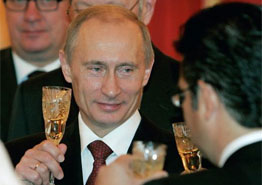
Former Russian president Vladimir Putin quaffs champagne with ambassadors at the Kremlin
With more affluent British consumers increasingly "migrating" from the more expensive retail outlets, the supermarkets are busily pushing champagne at deeply discounted prices. One high street chain has virtually halved the ticket on an award-winning brand to just £10 a bottle - an affront to the stuffier Champenois who regard mass sales of cheap fizz as the thin edge of the wedge.
Just about the only seasonal cheer for the industry is the spectacular growth (albeit from a modest base) of markets in Russia, China and, somewhat improbably, India. This year, the Russians, or more accurately the country's luxury-addicted oligarchs for whom the local fizz is simply infra dig, swilled down over a million bottles for the first time: despite the economic turmoil now prevailing, sales are still looking good.
Are French producers diverting supplies from the UK to emerging markets?
The enthusiasm of the Chinese for conspicuous spending on drink - sometimes manifested in the appearance of Johnny Walker Black Label on the breakfast table - shows little sign of abating, especially in Hong Kong. As for India's newly moneyed class, prices of up to £80 for a bottle have not noticeably hampered sales: "You can't be without a a good brand in the fridge when friends come round," one Indian observed to a British visitor.
Among some British wine retailers, there is a suspicion that the French producers are cutting back supplies to the UK in order to maximise revenues from these lucrative emerging markets. The industry association insists it would be ridiculous and counter-productive to "starve" Britain, its best customer. But one upmarket retailer in London told The First Post, on condition of anonymity, that the makers of a pink bubbly which sells particularly well in the run-up to Christmas have threatened to blacklist any outlet that dares to offer it at a discount even though it's selling at one-and-a-half times last year's price.