Washington, D.C., Suburb OKs Winery


Paradise Springs overcomes zoning hurdles to be first in Fairfax County
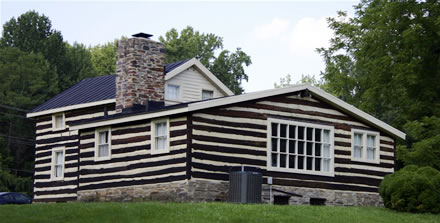
Paradise Springs' winery tasting room will be housed in this 18th century log cabin.
Clifton, Va. -- Virginia currently has 139 wineries, but the start of No. 140 this fall hit a major obstacle. The proposed Paradise Springs Winery property in Clifton is zoned "residential-conservation," a category that allows agricultural uses, but according to local Fairfax County zoning officials, it was not properly zoned to operate a farm winery.
The deputy zoning administrator, Lorrie Kirst, said that because the owners, Jane Wiles and her son Kirk, intended to manufacture wine and buy some of their grapes, the winery could operate only on land zoned for industrial use. It did not matter that at the state level farm wineries are identified as agricultural entities.
Then, on Dec. 4, the Washington Post picked up the story and, for the Wiles, the most important readers were the Fairfax County Board of Supervisors. According to Kirk, the supervisors were not aware that the zoning administrators were blocking the approval of Fairfax County's first winery. At the next supervisors' meeting on Dec. 8, the supervisors wrote and passed emergency legislation to allow farm wineries to be established and operate in the county, clearing the way for the Wiles to move forward with their proposed operation.
Fairfax County is immediately to the west of Washington, D.C., and mostly developed into suburban communities. There are few large parcels still available, and the Wiles' farm, west of Clifton and across from Hemlock Overlook Regional Park, represents significant open space in the county.
Until its own grapes begin bearing, Paradise Springs is making wines from purchased grapes.
About 20 years ago, Jane Wiles had a conversation with her aunt about what should be done with the 111-acre farm the aunt owned. The land had been in the family since its purchase as an original land grant from Lord Fairfax in the 1700s. The two concluded that perhaps part of the farm should be planted with grapes and a winery established. The aunt then put the land into agricultural zoning.
Two years ago, Jane inherited 35 acres of that farm and began to work toward realizing that 20-year-old vision. Her son, Kirk, who had been a business major at the University of Miami, joined his mother in the project. The two named the winery Paradise Springs after a local mineral spring where water was bottled and sold in 1910.
Kirk Wiles prepared a business plan, started to learn how to grow grapes and make wine, and this past spring, the Wiles planted 2 acres of Cabernet Franc. In the next year or so, they plan to put in another 2 acres of Viognier and in the future want to plant vineyards on adjacent land.
Their plans call for the winery's tasting room to be located in a log cabin built in the 1700s and renovated by a protégé of Frank Lloyd Wright in the 1950s. The log cabin's stone cellar will be used for private tastings and special winery dinners. The Wiles have drawn up plans for a new winery building to include a state-of-the-art production area and a barrel room, which will allow them to produce up to 5,000 cases.
According to Kirk Wiles, "As soon as we receive our official zoning notification, we can break ground and get started." In the meantime, the Wiles are working with their consultant, Chris Pearmund, and plan to purchase grapes to make wine until their vines mature in another two to three years. They hope to open the winery as soon as next summer.
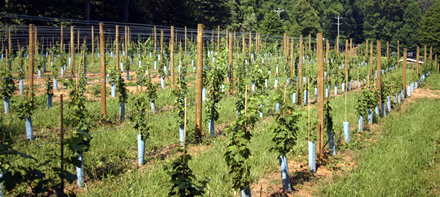
The Wiles planted their first 2 acres of Cabernet Franc at Paradise Springs in spring 2008.
When Paradise Springs Winery opens, it will fulfill the dreams of Kirk and Jane Wiles, while completing the vision of the town's founder in the 19th century. "In 1868, Harrison G. Otis founded the town of Clifton. While passing through the area on the railroad, he heard the squealing of hogs eating wild grapes. He thought that if the grapes were sweet enough for hogs, that they would be good enough to make wine. So he returned to the area, founded the town--and planted grapes with the aspiration to make great wine." Kirk Wiles says, "We hope to make his dream as well as ours come true."