Culture czar


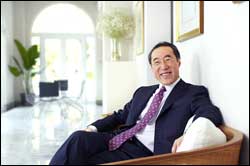 Henry Tang's white-pillared colonial residence sits nestled on The Peak. The high ceilings are pristine white, with elegant chandeliers; the walls are dove gray, white again or warm yellow. A long conservatory runs the length of the place. Windows arch, one after the other, unfettered by curtains or blinds, and afternoon sun streams across the small terrace into the room dotted with assorted furniture of varying styles.
You'd have to be familiar with, or at least peer quite carefully at, four framed prints that turn out to be feint etchings from Picasso's Vollard suites.
A large still-life has been divided. The two sections hang on opposite walls facing each other.
Towards the back of the room are two black, traditional-looking, Chinese-style cases, and behind us are two large glass vases brimming with used wine corks. (They are collected from past dinner parties. The sheer number suggests a love of good company).
We are meeting Tang after the politician has faced a tough few weeks of scrutiny. Outcries over taxi price rises sounded loud and then came what many commented was a delayed response in sending planes to stranded tourists in Bangkok after Thai anti-government activists took the airport there.
But as he strides through the circular hallway into the room, he is wearing that wide, trademark grin, and looks refreshed. Slightly flush, he is trim and smart as ever in a navy-blue suit with purple tie.
Just an hour before, the chief secretary had been
hosting a lunch where he selected a 1997 burgundy - an excellent midday choice, he says, because it matches food well and isn't heavy.
Bottles of empty vintage Petrus and Lafite Rothschild lining Tang's shelves would be enough to make most collectors green but, together with the amassed corks, they stand as testament to the fact that the chief secretary prefers to drink his wine, rather than shore it up for investment.
Buying to invest, he jests, would be far too much temptation anyways. "You could do some serious damage to your investment." That philosophy has served him well, given the current financial climate in which wine, like many other collectors' markets, is suffering in the downturn.
Perhaps his long-standing career in government - during which he has ridden out the Asian financial crisis, SARS and two avian flu outbreaks - or his entrepreneurial edge (in 1989, Tang collected the Young Industrialist Award of Hong Kong from the Federation of Hong Kong Industries) guides his swift, simple response for Hong Kong's businessmen in the current economic flux.
"Believe in yourself," he says. "In the history of Hong Kong, we have overcome many, many challenges but we have emerged from every single one of them stronger than before."
Tang's father, Tang Hsiang Chien, was born in Shanghai and moved to Hong Kong in 1950 making his name in textiles, a path his son followed. Both have strong ties with the Chinese government.
 Tang says that, following China's 30 years of spectacular growth, Hong Kong is better positioned than ever before to rebound, thanks to our close links to the mainland.
"Look around us - we are part of China. Look at how China has developed in the past 30 years, how the Chinese leadership in this financial tsunami have held steadfast to their core beliefs and core values."
With a smile he adds: "I think they have coped quite well compared to what's happening around us."
What's happening around us in Asia is also a major concern in terms of maintaining Hong Kong's competitive edge.
With Singapore, Shanghai, Shenzhen and, increasingly, Taipei threatening to dwarf the city, one of Tang's other loves - art - is planned to become our newest crowd-drawing icon.
The 40-acre West Kowloon Cultural Centre is scheduled to become one of the world's largest art hubs.
But the project has been dogged by criticism since its inception. As recently announced chairman of the project's committee, Tang is in charge of defending the hub, as well as orchestrating the final use of space. Both are well underway.
Top on Tang's to-do list is uncovering a much-anticipated master layout. Despite his vision, the job is proving a hard task. He wants, among other things, a usable space that integrates with its surroundings, rather than "a few iconic buildings scattered."
He wants to create stroll paths that border the harbor. He wants available space for spontaneous events. He wants to create an arts center that other cities emulate.
The problem revolves around people flow, and in such mammoth space Tang admits: "I'm not sure whether it can be done."
The topic lends itself to charges that such a wealth of space devoted to the arts is a waste, not just of space, but of money (HK$21.6 billion is allocated) but Tang is intent on promoting the attraction as a business opportunity.
Behind performers or artists, he says, are other working staff - backstage hands, management, marketers - and the project offers plentiful job opportunities.
"You might not be a talented opera singer, but you can become a great producer, a great writer, manager or agent - they make a lot more money than singing."
It has been suggested that, in Hong Kong, the arts have neither been taught nor encouraged. The practice is set to change from the next school year as 5 percent of the secondary school curriculum will be devoted to an "arts and culture" strand.
Soon primary school students will study art alongside math and Chinese, and in the future arts management courses could be implemented at university level.
Tang also wants to foster parental encouragement and is having to stand by that proposal himself.
His own daughter (he has three daughters and one son) is studying fine arts in New York, and he admits that supporting her subject choice is difficult when the success rate in the art world is limited. "I actually welcome people's scrutiny and people's interest in the project," he says.
But he has no comment to make on how long his involvement with the West Kowloon project will last. He was selected by the chief executive, he says, and that contract will last for a further two years. He can't foresee what will happen beyond.
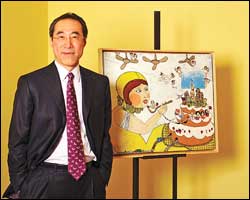
On an easel in the corner of Tang's sitting room is a painting called Happy City-Blue Skies-Good Government by Hong Kong artist Carrie Chau.
It features government figures and lawmakers including Anson Chan and "Long Hair" Leung Kwok-hung atop a layered cream cake.
A fantastical figure in bright spectacles, having swiped a spoonful, is posed to eat Tang's cream-covered caricature.
"I was in it, so I bought it," Tang shrugs.
These are edited highlights of an article that first appeared in The PEAK Hong Kong