Grape Expectations


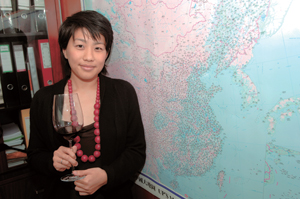 The idea of founding a French-style winery in northern China, complete with a classical-style chateau, sounds fanciful, particularly when the investor’s stated ambition was to make the nation’s first truly world-class wine.
But Grace Vineyard (怡园酒庄), now in its sixth year of operation, has proved the skeptics wrong, winning rave reviews for its selection of highly drinkable wines, even earning a place on the wine list of the prestigious Peninsula in Hong Kong, regularly voted the world’s best hotel.
The driving force behind Grace’s phenomenal success is Judy Leissner, the young, dynamic, US-educated daughter of Hong Kong entrepreneur Chan Chun Kueng, who funded the USD 6 million start-up. The entrepreneur was convinced that the Yellow River region of China had similar terroir to the famed Bordeaux region of France, the elusive combination of soil, climate and irrigation that is conducive to the production of quality wine.
Chan had developed a taste for French wine on numerous business visits to the nation, and enlisted the help of expert friends to cast an eye over potential sites in China. They finally agreed on a plot near the distinctly unglamorous city of Taiyuan in Shanxi Province, in a region largely known for its coal production, where work began on planting imported vines, constructing a production plant and cellars, and building a faux-Bordeaux chateau.
STEEP LEARNING CURVE
The task of running the new vineyard project was given to daughter Judy, then in her mid-20s. It meant a steep learning curve for Leissner, whose only previous working experience was as a Goldman Sachs merchant banker; she had little knowledge of wine, or expertise in selling or marketing such a niche product.
The early years saw plenty of hiccups, as Leissner readily admits. “When we started, we had no experience of retail or marketing, as our family business was in utilities. At first, we let staff in China do design and packaging but people thought it looked like a soy sauce bottle – the packaging was not very good. We got questions like ‘why is it so sweet?’ That was a bitter experience for us.”
But the company improved its product and design, and was helped by positive wine-critic reviews, including approving noises from wine guru Jancis Robinson, and media interest in the novel project.
The company also had a stroke of luck: Shanghai-based Alberto Fernandez of Spanish wine giant Torres was impressed by a tasting of Grace wines and suggested a distribution deal, allowing the various vintages to gain a high profile in restaurants, bars and stores.
“We are small and very different to existing Chinese wineries,” says Leissner. “We produce a million bottles a year compared to the 100 million bottles of the major producers such as Great Wall, Changyu and so on. We are still brand-building, that is why we go to the five-star hotels and should-be-seen restaurants. We don’t go for volume.”
THE OLD TO THE NEW
The Grace range includes cabernet sauvignon, cabernet franc, cabernet merlot, chardonnay and chenin blanc, with a new muscat wine to be produced in partnership with Torres. The original French wine-maker has been replaced by Australian Ken Murchison, meaning future vintages are likely to have more New World influences.
The existence of such a winery, funded by a private Chinese individual, says a lot about the changes in the nation during the past 30 years. When owner Chan left China for Hong Kong in the mid-1970s after completing university in Taiyuan, he could hardly have imagined that his return, almost three decades later, would be as a vineyard-owning entrepreneur.
The boss now has the satisfaction of seeing his Chairman’s Reserve, a merlot, cabernet sauvignon and cabernet franc blend that retails for RMB 400 (USD 58), as the wine of choice at some of the most prestigious banquets in China. The other two flagship wines are Tasya’s Reserve, made of a single variety that sells for RMB 190 (USD 28), and Deep Blue, a merlot cabernet franc and cabernet sauvingon blend, which is dedicated to Leissner and priced at RMB 288 (USD 42).
Grace Vineyards produces everyday wines, known as the Vineyard Series, sold throughout China in high-end supermarkets and wine stores for under RMB 100 (USD 15) and online, via torreschina.com, which lists the RMB 68 (USD 10) cabernet sauvignon as its current bestseller.
Grace also undertakes batch production and special packaging of wines for other organizations, including the Peninsula hotel in Hong Kong. “That was one of our biggest successes and we were very excited about it,” says Leissner. “The Peninsula look for quality and did a blind tasting with experts. We do a lot of personal service for them blending different types for them and printing labels up to their quality. As a hotel they want new ideas – a Chinese wine is something different.”
She adds that the family nature of the firm helps Grace to stand out from other Chinese wines. “What distinguishes us from other wineries is quality: we put the chairman’s name on it and my daughter’s name on it,” she says. “Our barrels are first-class quality.”
CHINESE OENOPHILES
Naturally enough, the local provincial government is hugely enthusiastic about having a glamorous international player in their backyard, insisting that Grace vintages are served at all local banquets and that the company’s wines accompany trade missions at home and abroad.
That is part of a much broader interest in wine in China that has seen consumption increase rapidly in the past few years and the emergence of urban oenophiles with sophisticated palates.
“It is my very firm belief that wine is here to stay in China,” says Leissner, now 31. “If you look at statistics, it is increasing every year. It will not be sudden, it will be gradual. You don’t need to teach people how to enjoy life: when they have money, then they will learn how to do it very quickly.
“They said Chinese don’t like strong wine because they don’t like tannins, but if you look at tea, it has very strong tannins. It is a matter of habit and exposure. When I started drinking wine, I didn’t like the taste but you slowly get used to it and then you start to miss it.”
ADDING COLOR
For Leissner, the project that was originally a fun and challenging diversion from her role as managing director of parent company Everbest Century Holdings (恒发世纪控股) has metamorphosed into a job that occupies 70% of her time.
Expansion is on the cards, with more vineyards planned in Shanxi, Shaanxi and Ningxia provinces, along with a USD 10 million winery close to the ancient capital of Xi’an that is due to open in 2010.
It means the Grace president spends a lot of time zipping around China from her Hong Kong home base. On visits to the vineyard, the extended Leissner family, including her German husband and two small daughters, often tag along.
“I like to take the kids to the vineyard, it means they now know that [grapes] come from vines, not the fridge,” says Leissner. “The business is a lot of fun, very different to Everbest, which is power plants and waste water and property. I go to restaurants as part of the job, and people now recognize me from interviews I have done on TV. It has added a lot of color to our lives.”