Cold times for icewine


Paul-Andre Bosc recollects an old joke told by vintners when talking about wine and the economy. "Business doesn't go down in the booze industry, because when times are good, people drink to celebrate, and when times are bad, people drink to forget."
Mr. Bosc's family has been growing wine for five generations, starting in France. His father founded Chateau des Charmes Winery in the Niagara, Ont., wine region in 1978, and soon after it was one of the first Canadian wineries to produce icewine.
Since then, the country's icewine industry has grown to nearly $12-million a year in exports, according to Agriculture Canada.
"With icewine, Canada created a new niche in the luxury beverage-alcohol sector," says Mr. Bosc, who is also chairman of the Canadian Vintners Association. "It's very rare that new products enter that market niche. French Champagne has been around for a very long time. Canadian icewine is a very new player on that scene."
But demand for icewine, which many Canadian wineries export or sell through retail outlets at their vineyards, is fizzling as people move away from luxury alcohol in the downturn. That's a sore point for vintners, because this year's harvest might be the best in years.
"Winter came early this year, and it's been unrelenting," says Daniel Speck, one of three brothers who founded and now run Henry of Pel-ham Family Estate Winery in St. Catharines, Ont. "This is a perfect icewine vintage from the growing season."
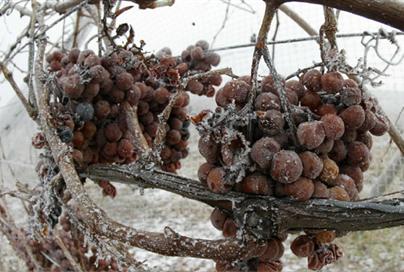
icewine production is a risky venture, wholly dependent on the weather. Thousands of dollars of grapes need to be left on the vine after the growing season. Vintners then spend months waiting for winter. According to Vintners Quality Alliance (VQA) standards, temperatures must dip to a freezing -8C before the grapes can be harvested. Wine pressed from grapes picked in higher temperatures is forbidden from being called icewine -- it must be labelled dessert wine instead.
If a deep freeze doesn't come, the crop fails and revenue evaporates -- icewine represents up to 20% of revenue for some wineries.
"We really depend on winter," Mr. Speck says.
This year's abundant harvest arrives just as Canada's largest market for the sweet drink is drying up. The United States is one of the main destinations for Canadian icewine and drops in exports were seen even before the U. S. economy shrivelled. In 2006, exports to the United States sat comfortably at just over $5-million. That comprised nearly half of all icewine that left Canada. In 2007, the number plunged dramatically to $1.8-million.
"Sales are down 20%," says John Neufeld of Palatine Hills Estate Winery. "We're finding that people are looking for better prices. Everyone wants it cheaper than last year -- they want breaks."
David Orange, president of Wine Emporium in Brooklyn, N. Y., which imports high-end wines, says sales of luxury wines have been down by about 35% since the U. S. Thanksgiving weekend. The holidays are typically the importer's busiest season. "We had some big wine-store chains that, instead of ordering 10 cases over the holidays, they ordered five. They're still saying that people love it, but wines that sell for over $40 are usually the first to go."
Mr. Neufeld, who's been in the wine industry for more than 30 years, bypasses importers and sells directly to clients, primarily in northeastern states such as New York and Pennsylvania. He also finds those customers are turning to other, cheaper wines. A bottle of Canadian icewine runs upwards of $60.
Mr. Bosc says the potential evaporation of icewine exports to the United States is a double whammy to the tenuous industry. The market not only relies on exports, but also thrives on tourism to local wineries. Many wineries depend on what is known as "farm gate sales," which is wine sold directly to customers at the winery, for a substantial portion of revenue.
"We have beautiful Rieslings and Chardonnays, but it's not the main reason people come here," says Mr. Bosc. "People come to wineries here for what we do best, what we're known for. And that's icewine. So, if tourism is down, by extension, icewine sales are down."
Tourism numbers to Canadian wineries have fluctuated widely in recent years. After 9/11, tourists from Japan and Europe slowed to a trickle. The year 2003 was even worse -- the SARS outbreak scared off many Japanese visitors, a significant source of wine tourists to Canada.
Asia has always been a lucrative market for icewine. Since the decline of sales in the United States, the Eastern Asian market -- South Korea, China and Japan -- has challenged Canada's southern neighbour as the main hub of demand. Vintners are hoping that Asians' insatiable thirst for Canadian icewine continues, though some are finding even that well has a bottom.
"The growth in Asia has slowed," says Greg Berti of Pellar Estate Wineries, which owns vineyards in Niagara and the Okanagan Valley in British Columbia. Mr. Berti points out, however, that some Asian markets, such as Hong Kong and Malaysia, continue to see healthy growth. "That will make up for any decline we see in places like Japan."