Economic climate not grape growers' top fear


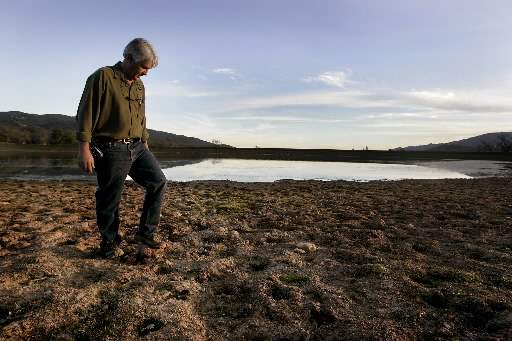
Photos by KENT PORTER / The Press Democrat What should be mud in a Kunde Vineyards reservoir is instead dry dirt. Growers are increasingly alarmed at the lack of precipitation this year.
Sonoma County grape growers are worried about how the weak economic climate will hurt their businesses, but it's the unusually dry climate that has them downright terrified.
More than 400 vineyard owners and managers from around Sonoma County gathered for the annual Dollars & Sense conference in Santa Rosa on Tuesday, an event that highlighted how the recession is affecting the wine and grape industry.
But the record warmth and worsening drought have farmers more worried about whether it will rain in the next few weeks than whether wineries will want to buy their grapes in the fall.
"We really need rain now," said Ryan Decker, a viticulturalist for Rodney Strong Vineyards in Windsor. "It's definitely one of our foremost concerns."
The lack of rain and temperatures in the 70s and even 80s could trigger the vines to awaken early, leaving them vulnerable to frost damage, Decker said.
Vineyard managers normally fight frosts by spraying water on the vines, but this year most vineyards' reservoirs are tapped out, leaving then nearly defenseless.
"It's potentially pretty horrific," said Peter Haywood, who farms about 90 acres of grapes, mostly zinfandel, in the Sonoma Valley.
Most of his vineyards are on fast-draining hillsides, so he's completely dependent on his reservoirs for both frost protection and irrigation during the year. But this year Haywood's ponds are nearly dry, after receiving only about 6 inches of rain this winter.
"In my 33 years of farming our vineyards, there has never been a Jan. 20 where our reservoirs have not been full and overflowing," Haywood said.
If he doesn't get some serious rain soon -- several inches worth, at a minimum -- he'll have to start drawing water from wells on his property, an expensive and risky proposition. With so little rainfall, Haywood said he has little faith that the aquifer has been replenished enough to keep his wells from running dry.
"How long will they last? Who knows?" Haywood said.
Up the road in Kenwood, the largest holding pond at Kunde Vineyards is at a fraction of its capacity, perhaps 20 acre-feet in a reservoir that typically holds 165 acre-feet this time of year, said vineyard manager Steve Thomas.
If push comes to shove, the winery can tap its well, but it doesn't like the idea of using an already scarce resource that way.
"We hate to rely on the wells," Thomas said.
Luckily for Kunde, it has more than 100 acres of dry-farmed vines, some over 100 years old. These vines have deeper roots than most, and are more drought-tolerant than younger ones that are dependent on irrigation, Thomas said.
To tip the scales further in the vines' favor, Kunde will probably plow under the cover crops in some vineyards to keep them from competing with the vines for what limited water is in the soil, Thomas said.
One business the drought is directly hurting is nurseries. Many growers are worried about having enough water to irrigate new vineyards or replace old or damaged vines, said Eckhard Kaesekamp, owner of Lake County Grapevine.
His business is down about 20 percent, partially from drought concerns, but also because growers can't get financing in the tight lending environment, Kaesekamp said.
Chris Bowen, vineyard manager of Robert Hunter Winery in the Sonoma Valley, said he's not going to buy any new vines until he sees some rain.
"I'm seriously considering not ordering anything because I'm just not sure that we're going to have the water to be able to keep those vines alive, let alone thrive," Bowen said.
Climate researcher Greg Jones of Southern Oregon University told growers he didn't see much hope for them on the horizon. The Pacific Ocean is in a La Niña trend that creates cooler ocean surface temperatures along the West Coast, resulting in unusually dry weather in California. He expects these conditions to persist for at least the next two years.
"He certainly wasn't offering much hope for this year in the short term," Bowen said.
As if that weren't enough bad news, grape broker Glen Proctor outlined several troubling economic trends. Consumers are buying less expensive wine and eating out less, while wineries are hesitant to sign many new long-term grape contracts, said Proctor, a partner in grape broker Ciatti Co.
But he also offered reasons for optimism. He noted that prices paid for Sonoma County chardonnay have increased substantially between 2006 and 2008, from $800 to $2,200 per ton to $1,700 to $3,400 per ton.
"The good news is wine consumption is still growing," he said.