Old-vine zin


Ravenswood Winery's Joel Peterson preserves a part of Sonoma's heritage -- one vineyard at a time
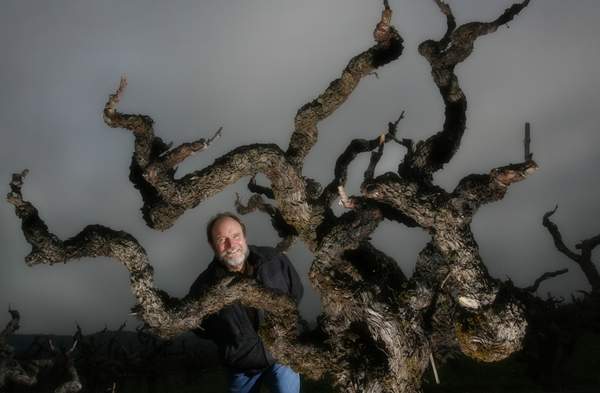
JOHN BURGESS/ PD Joel Peterson, the general manager and winemaker at Ravenswood Winery, peers through the "Medusa Head" of 130-year-old zinfandel vines from the Bedrock Vineyard near Glen Ellen.
It was about 1976 when beginning winemaker Joel Peterson cast his lot with zinfandel, figuring he'd both eke out a small living through the varietal and, circumventing what wine maestro Robert Mondavi and others were doing nearby with cabernet sauvignon and chardonnay, stand out from the rest.
"I asked myself, what is it about California that's special?" he recalled. "What can I do other people aren't? Zinfandel was the clear answer. I knew it had the possibility of producing world-class wines, but no one to speak of was doing it."
Long thought of as California's native and historic grape, zinfandel's genetic heritage has since been traced back to Croatia as well as linked with primitivo, a grape common to southern Italy. California's long, dry growing season suits the grape to a tee. Intolerant of humidity, zin is susceptible to mildew and mold, which is likely why it was planted here in the first place and why it endured.
Peterson's once-small winery those 30-some years ago was of course Ravenswood, which has since provided the winemaker with more than just a small living and, in no small part due to his own maniacal dedication, become one of California's biggest, baddest names in zinfandel.
Peterson became particularly interested in what we've come to call old-vine zinfandel, wine from grapevine plantings that go back to the late 1800s/early 1900s -- well before Prohibition. He remembers when he was starting out there wasn't much interest in these older plantings, that much of the old zin grapes were going plainly into jug wines.
"The price per ton was under $300 and they were not particularly revered as vines," he said. "Everybody wanted to do the new stuff which was cabernet and chardonnay primarily."
A lot of old-vine zinfandel was taken out and replanted. It was, ironically, white zinfandel, the lucratively popular phenomenon, that inadvertently helped keep acreage of heritage zin in the ground.
And then winemakers like Peterson, Joe Swan, Paul Draper of Ridge and others came along.
"We began looking at these vines as being an interesting historical source of grapes that had been planted because they were right for the environment," Peterson said. "We began looking at things not so much in a commercial way but in the way that the French might look at things -- which grapes were right for a particular locale and how did they get there."
There was buried treasure to be found. Tramping around with Joe Swan, Peterson stumbled upon Old Hill Vineyard in Sonoma Valley. It had been planted by William Hill in 1862 to what Hill had called "Iberian" varieties, the majority of which was zinfandel, the rest a diverse smattering of "mixed blacks" as they're known, including such things as, in this case, syrah and grenache.
The single-vineyard designated Ravenswood Old Hill Zinfandel indeed has a Rhone-like intensity, with hints of blackberry and black pepper amidst mint and smoke.
"There are only so many areas that have these 80-, 90-, 100-year old vines," said Geoff Kruth, master sommelier at the Farmhouse Inn and Restaurant in Forestville. "Old-vine zinfandel is a unique part of Sonoma County's real cultural heritage. The wines tend to have more character, more intensity of flavor."
Bedrock Vineyard was another cultural treasure. A stone's throw from Old Hill off Madrone Road, it was planted originally in 1861 and then replanted by George Hearst (William Randolph's father) in 1888. Peterson now owns it with his son, Morgan, who uses the 152-acre field blend of grapes growing there -- zinfandel, alicante bouschet, mourvedre and carignane to name a few -- to make wine for his own Bedrock Wine Co.
Peterson, a detailed student of history, reckons that Hearst was probably among the first in California to have access to rootstock given his ties to the University of California and its agricultural department, and that he would have replanted the vineyard after the grapevine pest phylloxera hit the area in the 1870s.
"The charm of an old vine is its pretty consistent in what it produces, it's very attached to its place," Peterson said. "They tend to be lower in production and more in balance than they would otherwise be, so you get smaller-berried, smaller-clustered, more flavorful grapes."
The 12 Sonoma Valley acres of zinfandel and petite sirah at Barricia Vineyard, another of Ravenswood's key grape sources, stand on land traded in the 1840s by General Mariano Vallejo to his children's music teacher in exchange for piano lessons. Six acres of the zinfandel there date back to 1892.
Further afield in Alexander Valley sits Big River, a rare, 100-percent zinfandel vineyard originally planted in 1893. Since 1997, it's been owned by Scott and Lynn Adams, who also run Bella Vineyards and Wine Caves on West Dry Creek Road. Bella's Big River Ranch Zinfandel (Bella and Ravenswood split the grapes) is the winery's flagship wine.
In the Russian River Valley is Belloni, the majority of its zinfandel planted more than 90 years ago, the rest mixed blacks: carignane, petite sirah and alicante bouschet. Planted in a cooler climate, the mixture of grapes here complement each other in typically important ways: the carignane providing the core zinfandel grapes with more acidity and raspberry flavors; the petite sirah adding peppery notes and tannin structure; the alicante bouschet a nice way to give the wine soft, plush, round qualities, with wisps of blueberry and darker color, too.
The Teldeschi Vineyard in Dry Creek Valley is another important vineyard to Peterson, its oldest vines planted between 1913 and 1919. Back in the late 1970s Peterson showed up at Frank Teldeschi's house to see if he could source some grapes. Joe Swan had previously been buying grapes from Frank's brother Mike next door.
After spending the afternoon drinking Frank's homemade wine, Peterson was given four tons of grapes to work with that first year. He now gets the entire vineyard, including some carignane and petite sirah.
It is thanks to winemakers like Peterson and growers from Adams to Teldeschi that these old vineyards continue to thrive; the price of the wines the grapes go into can support their survival. But there's always pressure to plant them over to more lucrative grapes. These days the lure of planting pinot noir is big, particularly in places like the Russian River Valley.
Kruth is among those who would also like to see more formal protection for these historic vines.
"We don't really do anything to protect them," he said. "We protect old buildings. It's an issue of cultural heritage."
And such is the blessing and the curse of zinfandel that it is not really grown elsewhere in the world. That it is considered such a part of California's heritage, so much of that within Sonoma, Peterson figures, bodes well for its future.
"The wines we revere in the world are wines of places, grapes selected for that place," he said. "When zin came out of Prohibition and was made into jug wine, we took away its royalty. But the blessing is its uniqueness is still with us. We can reclaim the past."