Knights Valley residents opposing new Jackson winery


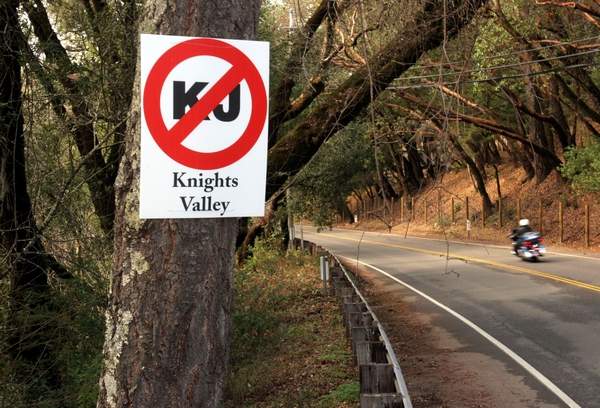
MARK ARONOFF/The Press Democrat Signs indicating opposition to the Kendall-Jackson expansion are affixed along Highway 128 approaching the Kendall-Jackson site in Knights Valley about 6 miles north of Calistoga. This sign is near Bidwell Creek.
A boutique winery proposed on the slopes of Mount St. Helena is generating an outsized share of controversy.
By winery standards, it’s relatively small - 5,000 cases of planned production and a tasting room estimated to average 35 vehicle trips daily.
But the man behind it is Jess Jackson, one of the country’s richest men and one of Sonoma County’s best-known winemakers.
And it’s proposed in the heart of Knights Valley, where residents zealously guard their privacy and the land’s agricultural heritage.
“It’s real estate development in the guise of agriculture,” said Jean Marie Zukowski, an opponent who has 20 acres of grapes and walnuts down the road from Jackson’s property off Highway 128, where the winery is planned.
“It is a preserve. It’s called the Knights Valley Agricultural Preserve,” she said.
The winery application by Jackson and his wife Barbara Banke is scheduled to be considered at 2:10 p.m. Tuesday by the Sonoma County Board of Supervisors.
County planners are recommending approval of the project, while acknowledging most neighbors believe the public tasting room and the special events activities would bring unwanted commercial and tourist activity.
Lenny Stein, president of Jackson Family Enterprises, said county supervisors are “very responsible public representatives” and the project has gone through extensive consideration.
“We have been extremely responsive to the input we got at the various commission hearings and design review, as well as from the community,” he said. “There can be no doubt this project has and will receive a full hearing in front of the decision makers. And we welcome it.”
He said the winery is very much in keeping with the rural nature and rich history of Knights Valley.
“It’s a project we’re very proud of,” he said.
The only winery now in Knights Valley is Peter Michael, owned by a wealthy British businessman Sir Peter Michael, who made his fortune in electronics and established the winery in the late 1980s. It can produce up to 30,000 cases of ultra-premium wine, with tasting by appointment only.
Zukowski and many of her neighbors fear the “Pelton House Winery” proposed by Jackson on the 1,200 acres he owns in Knights Valley will be the first of many more to come.
She and fellow opponents say Jackson can grow his grapes and even have a winery, but they object to the public tasting room and the four special events he wants to hold per year with up to 200 guests.
However, some neighbors are comfortable with Jackson’s plans, such as Gloria Ball, who changed her mind after initially opposing the project.
She likes the plan for restoration of a 19th Century stone building that lost its second floor to a fire more than 50 years ago. It would be used for winery offices.
“I’m grateful we have someone with enough money and motivation to maintain the building and bring it back to what it looked like,” she said.
But Craig Enyart, an opponent, said the area has changed little from an 1873 landscape painting made of the valley. And that makes it even more worthy of preservation in his opinion.
“People drive through Knight’s Valley and say it’s totally pristine, so refreshing. You see some cattle and vines and that’s it,” he said. “It’s a wonderful, scenic corridor that connects Napa and Sonoma counties, that’s virtually been left intact.”
Located between Calistoga and Healdsburg along Highway 128, many of the properties in Knights Valley are large, like the holding that Jackson, a retired land use attorney, vintner and race horse owner, bought in 1996.
Critics say the project should require a comprehensive environmental impact report. The winery would total 22,700 square feet, including offices, restrooms and kitchen.
They note the proposed 12,000-square-foot production facility would be more than a half-mile from the tasting room and would be between two creeks that flow to the Russian River.
There are sedimentation issues, they say, that could impact coho and steelhead salmon in the creek, along with other wildlife.
The project has been subject to hearings in front of the county Landmarks Commission because of the historic building on the property and has been subject to design review.
Supervisors will decide whether to grant a use permit for the winery and will consider a lot line adjustment that alters the size of two of Jackson’s parcels.
Opponents complain Jackson is being given a property tax credit under the Williamson Act for keeping his land in agriculture, even though it will become a new commercial use.
But county planners said wineries are considered “agricultural processing facilities” and not commercial or industrial land use.
In a report, county Planner Traci Tesconi noted many other wineries in adjacent areas, such as Dry Creek and Alexander valleys, have public tasting rooms and special events for tourists.
“The county has found that tasting room and special events are a compatible use for agricultural land under Williamson Act contracts,” she said.
They serve as a “selling tool” to ensure ongoing wine sales in the county and promote the long-term success of agriculture, she said.