Washington Growers Hear from Henick-Kling


New director of viticulture and enology seeks co-operation from industry and academia
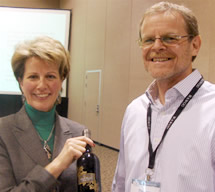 WAWGG executive director Vicky Scharlau presented incoming WSU viticulture and enology program director Thomas Henick-Kling a bottle of Walter Clore Columbia Crest Private Reserve 2005, reminding him that he follows a trail blazed by the late Walter Clore, hailed as the father of the state's wine industry.
Kennewick, Wash. -- Setting goals and priorities for the financial success of the Washington State wine industry is a key aim of Dr. Thomas Henick-Kling as he steps into his role as director of viticulture and enology at Washington State University this spring. Growers expressed their happiness that he'll be based in Richland, in the heart of the state's most productive winegrowing area.
Choosing the annual Washington Association of Wine Grape Growers convention in Kennewick on Feb. 4 to address growers for the first time since his appointment, Henick-Kling praised the adaptability of the Washington state wine industry. Its openness to new ideas excites him, but he was also clear about the need to establish priorities that will allow the sector to thrive.
WSU has been a leader in research, and Washington growers have done a good job at innovating to meet the business challenges they face, but Henick-Kling said the two groups must work in concert in order to ensure the ongoing health of the industry. He sees his role as that of a communicator discussing opportunities and ideas that researchers can pursue.
"It's about putting these pieces together and finding these ideas," he said. "For this industry to continue to be successful, it has to invest heavily in research and education."
The research infrastructure and ongoing investment in education in most of the world's major wine producing regions is proof of the benefits that support of research and education can provide industry, Henick-Kling said.
Australia, where Henick-Kling served as director of the National Wine & Grape Industry Centre at Charles Sturt University in New South Wales from 2007 until taking up his position at WSU, collects levies from growers to support research initiatives.
Rejecting compromise in favor of clear strategies, Henick-Kling said the right strategies will strengthen the industry's ability to distinguish itself on the world stage. "We have to make wines that are identifiably Washington state," he said.
Henick-Kling pledged his support of lobbying efforts, which have already been given a boost by WAWGG's hiring of Jean Leonard, also executive director of the Washington Wine Institute. Leonard will represent the interests of both organizations in lobbying government.
With many wondering what the attitude of President Barack Obama's administration will be with respect to agriculture, Henick-Kling assured Washington growers that they have at least one ally in the firm of former New York Senator Hillary Clinton, now the country's top diplomat. "She's a fantastic promoter of agriculture," said Henick-Kling, who met Clinton during his 20-year career at Cornell University.
WAWGG executive director Vicky Scharlau responded to Henick-Kling's comments by noting that growers had raised more than $1-million towards an endowment of his position at WSU. Washington has long needed someone of Henick-Kling's stature, Scharlau said She expressed her hope that Henick-Kling will follow in the steps of the late Walter Clore, hailed as the father of the Washington state wine industry when he died in 2003.
Scharlau told WAWGG's business meeting on Feb. 5 that coordinating research and business goals is key if WAWGG hopes to fulfill its aim to "triple the economic impact and improve the profitability of the Washington grape and wine industry by 2020."
Ideally, the priorities of researchers at WSU and the goals growers review during the association's business meetings should reflect each other.
"Hopefully, in the future, this meeting will become much more tactical," Scharlau said.