It's wine before its time


A sure sign of spring is the arrival of barrel-tasting season
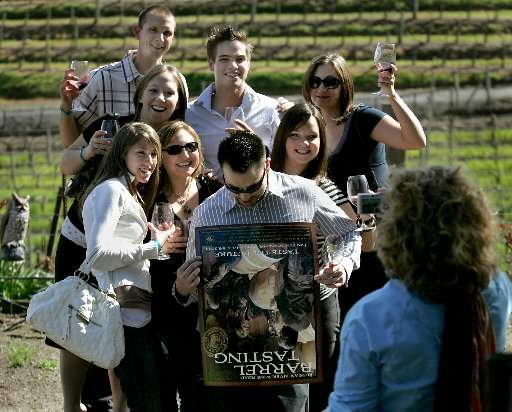
KENT PORTER Visitors capture the moments in a photograph at a barrel tasting at A. Rafanelli Winery.
The harbingers of spring are everywhere, in fields of yellow mustard, in baskets of asparagus at farmers markets, in the sweet aromas of warm grass carried on a breeze.
It is spring in our wineries, too, where the newest wines are waking up after their winter slumber.
As fermentation concludes in early winter, wines are put to bed in the barrels that will shape them. For the following few months, these wines are all but untouched, as winemakers do nothing more than stir them and top them up — replace what has evaporated so that the barrels remain full — every few weeks.
Come spring, winemakers begin to taste and taste again, dipping their long glass wine thieves into every single barrel.
“Tasting is important to be sure nothing is going wrong,” Jon Phillips of Inspiration Vineyards and Winery in Santa Rosa explains, “and to see if malolactic fermentation is progressing correctly.”
Phillips begins tasting shortly after the first of the year, looking for evidence of oxidation, bacterial contamination and volatile acidity, which imparts a vinegarlike taste to a wine. He also looks for more subtle qualities, the influences of the various barrels used to create a finished wine.
“The type of barrel is one of the only ways a vintner can influence the taste of a wine after fermentation,” he says, adding that certain barrels are compatible with certain varietals and not others.
“I would never ever put pinot noir in American oak,” he says, “because (the oak) would step all over the wine. But American oak is great with zinfandel, though I use some European oak, too.”
Many decisions must be made at this time. If a winemaker doesn’t like a particular barrel of wine, it may be sold on the bulk market. Is it time to blend — combine all the barrels of a certain lot — or should the wines age separately a bit longer? A particularly fine barrel of wine might be bottled separately instead of going into a blend.
In early spring, wines go through their first racking, a process that removes the sediment that settles out following fermentation. When a wine is racked, it is gently removed from its barrel, leaving the sediment behind. The barrel is thoroughly cleaned and the wine returned to it or, in some cases, to a different barrel, where it will continue to evolve.
Why is barrel tasting so exciting, you might wonder, especially to anyone with more than a passing interest in winemaking?
“Wine is alive,” François Cordesse, winemaker at Matanzas Creek Winery in Bennett Valley, offers as an explanation. “In barrel, it’s still a child; in bottle, an adult.”
Although wine changes dramatically during its first two years in wood, Cordesse says, the process is by no means over when it is bottled.
“The wine is pulled out of barrel when he is still a teenager,” he says, and it will reach maturity in the glass.
Jon Phillips adds additional perspective. “Customers see a mystique in the art of winemaking,” Phillips says, “and tasting from the barrel gives them an opportunity to have an experience with the winemaker, with the process. They tend to ask a lot of questions and they have a lot of fun, too.”
Although most of this activity — the careful tasting of the new wines, the management of the barrels, the making of blends — takes place out of the public eye, there are opportunities for wine lovers to get up close to the process.
The biggest opportunity to taste new wines is during the annual barrel tasting hosted in early March by Russian River Wine Road. Scores of wineries in the Alexander, Russian River and Dry Creek Valleys participate each year.
Barrel tasting is a big party, the first of the season, and one both locals and visitors return to year after year after year. But it is not necessarily the best opportunity for a thoughtful exploration of the process, which involves more than simply sampling the wines from a barrel instead of a bottle.
For the most informative experience, you want to visit a winery when it is not so busy, either by dropping by at a typically slow time — a weekday morning, for example — or by making an appointment and indicating, when you do so, that you would like to taste wines in the barrel if possible.
François Cordesse likes to offer a bit of advice, too. Hold your hands around the bowl of your glass to warm the wine a bit, so that its bouquet will emerge. And please, always spit the wine, he urges, which is closed and young and not ready for prime time.
A bit of a warning is in order, too. Not all winemakers welcome visitors into the cellar to taste from the barrel. Merry Edwards, now of Merry Edwards Wines, but three decades ago inaugural winemaker at Matanzas Creek Winery, doesn’t even like to let her shareholders sample her young wines.
“Most consumers do not understand wines in the barrel,” she says, “which can be misrepresentative.”
“For example, pinot noir,” she says of the varietal for which she is best known, “is typically very big in the spring, a characteristic that will resolve as the wine continues to age.”
Think of it this way: Wine from the barrel is a snapshot of a moment in time, a taste that is as fleeting, or nearly so, as spring itself.