Why are Alsace wines so underrated?


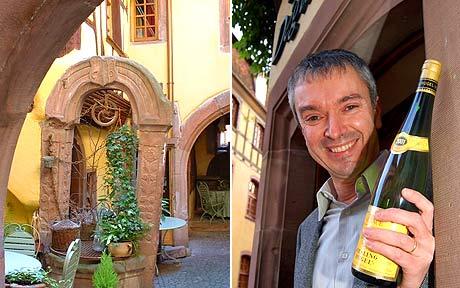
I can't understand why the wines of Alsace are so underrated in the UK, nor why so few British tourists visit this fascinating region.
It's easy to get to, and easy on the eye, too, with rolling hills and absurdly picturesque medieval towns and villages such as Colmar, Obernai, Ribeauvillé and Riquewihr, all cobbled streets and half-timbered houses. Best of all, though, it's an epicurean playground, with more Michelin-starred restaurants than anywhere else in France. And, as any gourmet or – in my case – choucroute-loving greedy-guts will tell you, the wines are about as food-friendly as can be, matching almost every conceivable food. They are refreshingly varied, too.
Related Articles
Country churches: A very English journeyI have just waddled out of one-star Le Rendez-Vous de Chasse in Colmar after a shirt-popping, belt-straining, nosebag of a feast. I've already lost count of the number of courses I scoffed but do recall washing them down happily with a Champagne-method sparkler, a brace of dry whites (muscat then Riesling), a red (pinot noir), a dessert wine (late-picked gewürztraminer) and an icing-on-the-cake digestif (eau de vie de framboise), not one of which was produced more than 10km from my table. Even my foolishly untouched mineral water was local.
"For some reason, as a rule the British just pass us by," shrugs Etienne Hugel, the 12th generation to work in his family winery. "They go to Paris, the Loire and the south of France but not here, unless they're on their way to visit their banker or to go skiing. It's a shame because they'd be sure of a warm welcome."
It's true, the welcome in Alsace is always effusive. From top names to local one-man-banders, almost all the wine producers have tasting rooms open to the public, seven days a week (see box, right). Visitors who drop by unannounced are greeted with delight, ushered in and given glasses of whatever is open (with no obligation to buy), often in the company of the winemaker himself. If you knock on the door of some fancy-dan château in Bordeaux with an inquiring thirst you'll often be sent packing.
The Alsatians are a bit chippy, you see. The wines don't sell as well as they should, even in France - ''What do the peasants in Paris know about wine?'' exclaims one winemaker - and they struggle for recognition. As a result they are desperate to get their wines down you.
I need no encouragement and allow Hugel to waft countless wines under my nose. Standouts are the sumptuously sweet and spicy late-picked gewürztraminer and the I‑can't-believe-it's-not-burgundy, pinot noir Hugel Jubilee.
It's a great start to my three days in the region. Basing myself in Colmar, I intersperse tasting wine with gentle sightseeing and serious grazing. Highlights are a visit to the Musée Bartholdi, dedicated to the creator of the Statue of Liberty, and a lunch of pig's trotters and veal vol au vents at L'Ami Fritz in Ottrott.
I taste some sublime Rieslings with my old friend, Jean Trimbach, who manages to convince me that fine white wine is a far better accompaniment to cheese than red.
"It's the fault of us bloody French," he says. "Somehow we persuaded the world that red wine goes with cheese. But it doesn't, except perhaps old burgundy. The tannins of the wine fight with the acids of the cheese. Far better to have a first rate Riesling or silky smooth pinot gris."
At biodynamic Josmeyer, one of my new favourite producers, I sample some fascinating flowery and aromatic white blends, a comparative rarity in this land of single varietals. At Robert Blanck, a small-scale organic producer, who sadly doesn't export to the UK, I enjoy old-vine pinot gris.
One gets great purity of fruit here. Oak barrels are used, but they are invariably old oak barrels which don't impose their personality on the wine the way they do in bordeaux or burgundy.
The years 2007 and 2008 were both fine vintages in Alsace and, not only are the wines great with grub, they are approachable, easy to enjoy and reassuringly easy to understand (they're labelled and marketed by their grape variety). The bottles might look a bit Germanic and might not be so credit-crunch friendly, but they're a fascinating alternative to Bordeaux, Burgundy and the Loire.
Alsace is a bewitching place and if you don't know it already, now is the perfect time to introduce yourself to the region and its equally disarming wines.