Kimmel Vineyard and Orchard: Nebraska wine country


After talking to many owners of Omaha restaurants, I noticed a repetitive theme among them all: many area restaurants go out of their way to buy fresh produce from local vendors. (Chalk it up to the trend of decreasing carbon footprints or just plain ol’ state pride.) As well, many restaurants enjoy featuring Nebraskan wines on their wine lists. This got me thinking. What makes Nebraskan vendors and wineries so great?
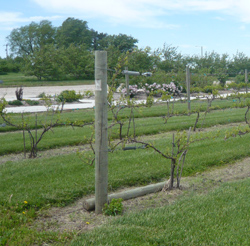
Nebraska wines are made from specially bred grapes.
When I think of the term “wine country,” rolling fields of grapes in California or somewhere overseas come to mind – not Nebraska. Likewise, when the average person thinks of Nebraska, he or she usually thinks of fields of corn or soybeans – not fields of grapes.
So I ventured off to Kimmel Orchard and Vineyard in Nebraska City, Neb. Known for both their plethora of fresh produce and locally-made wines, it seemed like a “two birds with one stone” scenario. Thinking I was in for a brief wine tasting and maybe a chat with an orchard employee, I didn’t expect to have such an educational journey. I returned home with a newfound respect for Nebraskan wines, and for the science behind them.
“Nine years ago, there was one [vineyard] in Nebraska,” says Vaughn Hammond, Extension Technologist for the University of Nebraska-Lincoln Extension office housed at the Kimmel Education and Research Center. “Now we are up to 23 or so [wineries] with two or three more coming on board this year. There are around 600 acres devoted to grape growth in Nebraska – that’s around 30,000 plants.”
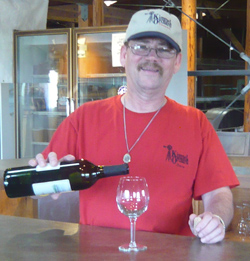
Steve Harris pours a sample of a Kimmel wine.
The Kimmel Education and Research Center, where Hammond works, is on the grounds of the historic Kimmel Orchard and Vineyard, and the famous Apple Barn storefront. This is appropriate as Richard and Laurine Kimmel, founders of the orchard and vineyard, first turned to the University of Nebraska’s Extension department in 1925, when they requested the help of Agent Ernie Hoppert to help with the layout of their orchard. Hoppert became a trusted companion of the couple and an advisor for years to come.
Now the research center echoes the Kimmel’s passion for research, collaboration, and education as the UNL Extension office uses it to “extend the University of Nebraska-Lincoln campus into the heart of Southeast Nebraska where it supports economic development [in order to] create new economic opportunities and develop the entrepreneurial and leadership skills of individuals, organizations and communities,” says the Center’s brochure.
These “economic opportunities” include “Being ‘Green’ for Good” workshops, sustainable and organic agriculture classes, and a bi-annual winemaking school for those looking to start a commercial winery in the region. In the past, the winemaking school has been a hit, attracting representatives from a 13-state area. Why, you might ask? Because Hammond and others associated with the UNL Extension office happen to know a lot about cool climate viticulture.
Unlike states like California that enjoy relatively warm weather year round, Nebraska experiences four extreme seasons. Due to this, Nebraska wasn’t an ideal place to make wine - until recently, when science was added to the mix. A dash of genius, a lot of patience, and the ingenuity to try lots of different mixtures – and voila! Grape varietals were born that were custom made to survive the Midwest’s diverse climate.
Says Hammond, “Many people come to Kimmel Orchard and request a Chardonnay or some other wine made from a well known grape. Well, we simply don’t have that in Nebraska. Since we are cool climate viticulture, many people aren’t familiar with the grapes we use for wines. Most people don’t recognize the names of grapes like Chambourcin or DeChaunac. They’re grapes that have been bred to thrive despite the various climate conditions and our shorter growing season. Most of the Midwest states grow these same varieties.”
Though these custom-bred grapes have unfamiliar names, they produce wines that taste better that many internationally-known wines. Steve Harris, Retail Manager at Kimmel Orchard, agrees. “People don’t realize that Nebraska grows some of the best grapes in the world.”
In charge of holding bi-weekly wine tastings at Nebraska City’s beautiful Lied Lodge and daily at the Apple Barn, where Kimmel Orchard and Vineyard products are sold, he says many first timers are stunned that the delicious wines they are sampling was grown and made in Nebraska.
“They’re always really surprised at how good our wines taste,” says Harris. “You’d be surprised at how many of our repeat customers are from out of state. We get orders from Denver, and California, and all over.”
So maybe its more than just state pride. The use of science has created a way for Nebraskans to start their own wineries with specially-engineered grapes, and for restaurateurs to serve delicious locally-made wines year round.