Longmen Grottoes


The Longmen Grottoes, an apotheosis of the art of stone carvings in ancient China, are regarded as one of the three greatest grottoes in China, together with the Yungang Grottoes in Datong and Thousand-Buddha Caves in Dunhuang.
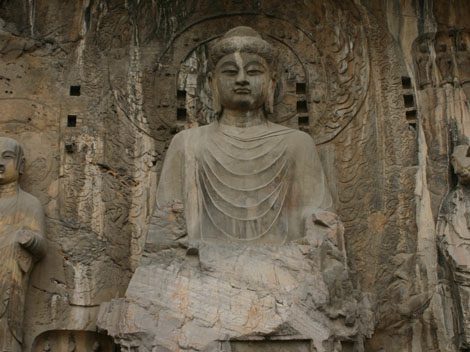
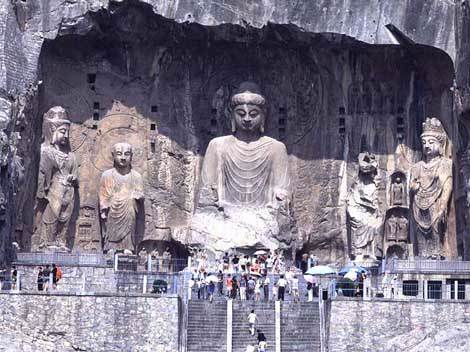
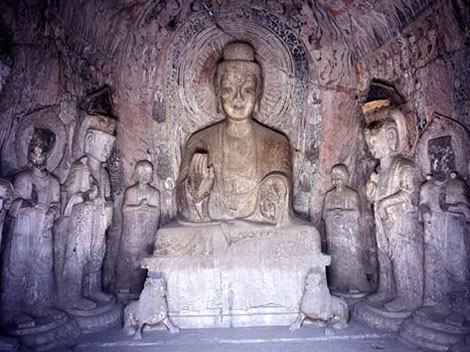
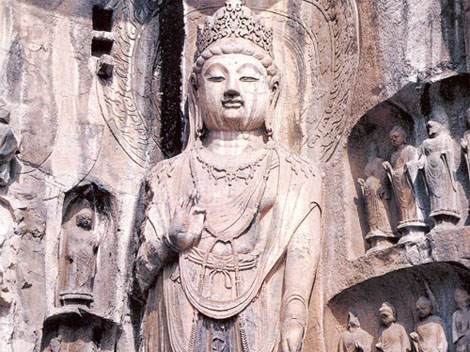
The Longmen Grottoes are located 12 kilometers south to downtown Luoyang, Henan Province on the cliffs along the banks of the Yi River. With a total length of 1 km from south to north, they were first chiseled out during the Northern Wei Dynasty (386-534) and mended now and then for as long as over 400 years, which, until now boast a history of over 1500 years. Currently, the total number of existing grottoes is more than 1300, with 100,000 plus Buddha figures, among which the largest is as high as 17.14 meters, while the smallest measures merely 2 centimeters. They are but a complete embodiment of the artistic accomplishments of the ancient working people in China. Among the grottoes, the Middle Binyang Cave, Fengxian Temple and Guyang Cave are the most representative ones. Except for various exquisite sculptures, Longmen Grottoes also preserve a large quantity of historical materials in terms of religion, fine arts, calligraphy, music, garments, medicine, architecture and Sino-foreign transportation, etc. Therefore, they are also a large museum of stone carving art.
Large in scale, the Longmen Grottoes feature exquisitely-carved sculptures of rich contents and subjects, thus are reputed as one of the greatest classical artistic treasure houses in the world. With their own systematic and unique language of sculpture art, they reveal all of the rules and principles of the artistic creation. On the other hand, the abundant substantial historical materials kept inside also reflect in different aspects the evolution of various fields, including the ancient politics, economy, religion and culture. In Nov. 2000, Longmen Grottoes were listed into the World Heritage List by the UNESCO.