Kublai Khan


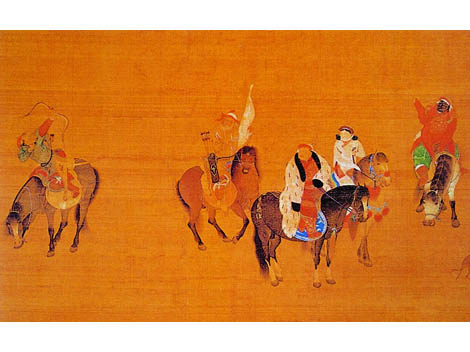
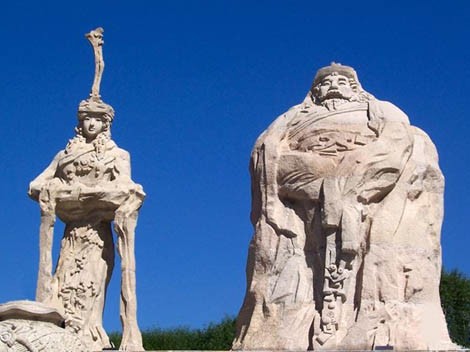
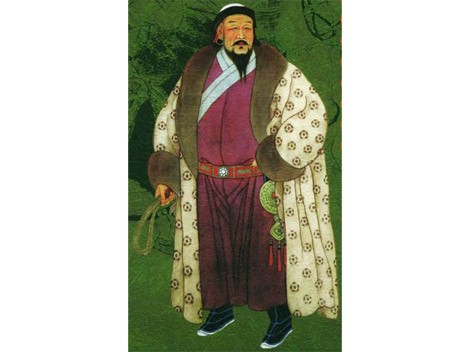
Kublai Khan (1215-1294) is the founder of the Yuan Dynasty. He is a grandson of the God's favored person Genghis Khan and is called "Yuan Dynasty Shih Tsu Hu Pi Lieh" by later generations. After defeating his younger brother Alibuge who intended to grab the crown in 1264, Kublai Khan took the throne, with "Zhiyuan" as the reign title. Afterwards, he moved the capital to Yanjing (the current Beijing) and renamed it "Dadu". In 1271, Kublai Khan set "Yuan" as the official name of the nation and then confirmed Dadu as the capital in 1272. After destroying the Southern Song Dynasty in 1279, Kublai Khan accomplished great unification around the whole country and founded the Yuan Dynasty.
Through adopting legal systems of the Han ethnic group during his reign, Kublai Khan established political systems, radicated politics of centralized state power, resumed normal ruling orders, and also, created the system of administrative province. In addition, he implemented some measures beneficial to the production of agriculture and handicraft industry. They include the establishment of Ministry of Agriculture, cultivation of fields, reclamation of wasteland, construction of irrigation works, and restriction on enslaving loyal subjects. Furthermore, he intensified management on border areas, built roads connecting China and foreign countries, and also, consolidated and developed a multi-ethnic country. Most importantly, Kublai Khan was eager in studying Han culture. He was modest in learning Confucian administrative doctrines from lots of scholars such as Seng Haiyun (Song Yinjian), Seng Zicong (Liu Bingzhong), Wang E, Yuan Haowen, Zhang Dehui, Zhang Wenqian and Dou Mo. Meanwhile, he adopted policies of the Han ethnic group and successively appointed Han people and Confucian scholars to govern Xingzhou.
It is in the Yuan Dynasty that the over three-century-long splitting status of China after the Tang Dynasty was ended and a new great unification in the history was achieved. It is also in the dynasty that the border areas were exploited, that effective administrative jurisdiction on Xinjiang, Tibet and other places was implemented, that Tibet was included in China’s territory for the first time, and also, that the scale of Chinese territory was primarily settled. Furthermore, economic and cultural exchanges among all ethnic groups in China were promoted in the Yuan Dynasty, which made tremendous contribution to ethnic integration.