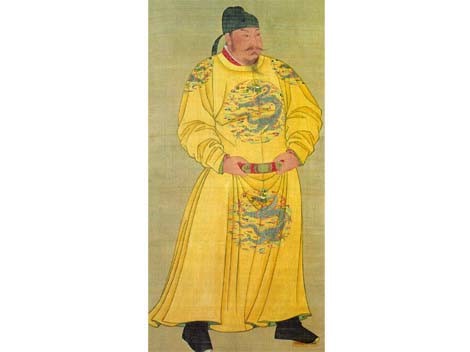
Emperor Taizong of the Tang Dynasty


With the personal name Li Shiming, Emperor Taizong of the Tang Dynasty lived between 599 and 649 AD. He was the second emperor of the dynasty, also one of the emperors with great achievements in Chinese history. During his reign, the country was prosperous and the people were at peace, with booming economy and strong military might. As the title of his reign was called “Zhenguan”, his ruling period was called “Zhenguan Reigning Period”.
In 626 AD, Li Shiming, the then Duke of Qin, killed crown prince Li Jiancheng and Duke of Qi Li Yuanji at Xuanwu Gate, the northern city gate of Chang’an. The incident was historically called “the Mutiny of Xuanwu Gate”. Shortly afterwards, Li Shiming ascended the throne.
When he was in power, Li Shiming adopted new military, taxation and land systems and actively promoted the imperial examination system for talent recruiting. The Tang Dynasty enjoyed unprecedented prosperity. At that time, the economy was booming, the society was stable, the government was clean and the people were healthy and wealthy. The prosperity laid a foundation for the ensuing Kaiyuan Flourishing Age.
Emperor Taizong was very modest and willing to accept the remonstrating suggestions put forward by officials. He attached great importance to the legal system by setting an example of obeying the law. He also paid special attention to developing ethnic relations. In 641 AD, he married Princess Wencheng off to Songtsam Gambo of ancient Tibet. The two ethnic groups therefore enjoyed friendly ties. All these measures laid a solid foundation for the prosperous development of the Tang Dynasty.
Emperor Taizong of the Tang Dynasty was considered as the paragon of ancient Chinese emperors. His words and deeds were documented in books like Zhenguan Zhengyao (Notes of Political Governance of Zhenguan), serving as a textbook for rulers of later ages and causing great impact on Chinese politics and culture.