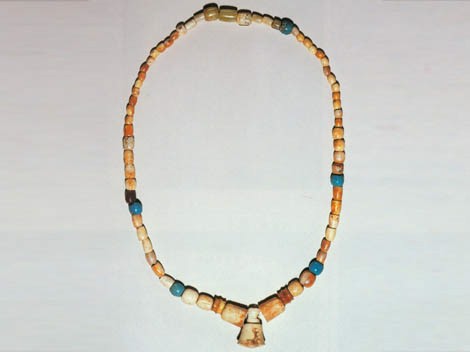
Jade Pendant


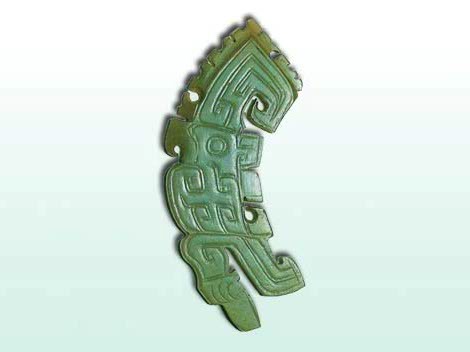
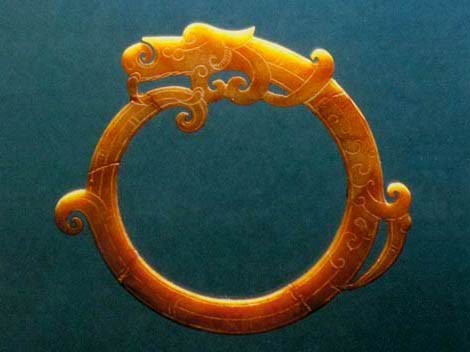
The practice of wearing jade pendant can be traced back to the time immemorial in China. In the early period of the Neolithic period appeared the decorative tiger-shaped jade, jade beads and jade assembly, and so on. Since the raw jade was not sufficient in the early times and difficult to carve, jade ware was exclusive to the dignitaries, thus becoming the symbol of power and wealth.
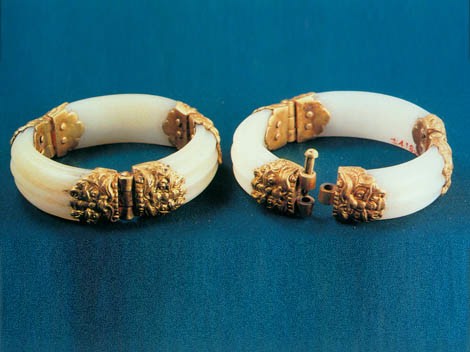
Until the Song Dynasty, all kinds of jade pendants appeared as a result of the unprecedented development of the handicraft and commerce. The jade pendants bore structurally complex designs with rich gradation and perfect unity of form and spirit, which can be regarded as having strong flavour of paintings. The Ming and Qing Dynasties witnessed the prosperity of jade culture, during which period wearing jade pedants was in a vogue among the general public. The dignitaries would wear jade ornament on the hat brim, jade pedants and hangers around the girdle, and jade buckles on the shoes – jade wares almost all over the body. And the ordinary people would usually wear jade bracelet, jade rings, and jade ear rings.
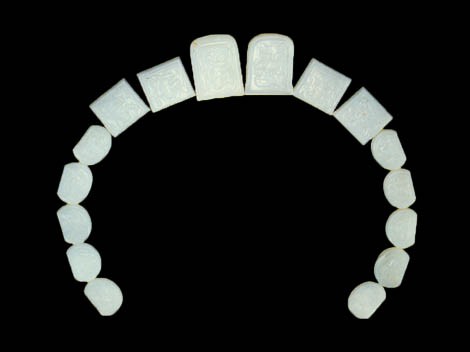
The raw materials for jade pedants are mainly celadonish jade, white jade and yellow jade, among which the suet white jade produced at Hetian, in present-day Xinjiang Uygar Autonomous Region, was the most precious. As for the yellow jade, it was not cheap, anyhow. Emerald was introduced to China in the early Qing Dynasty. It was usually used for producing small articles such as ring face and ear rings due to its small size.