Hemudu Culture


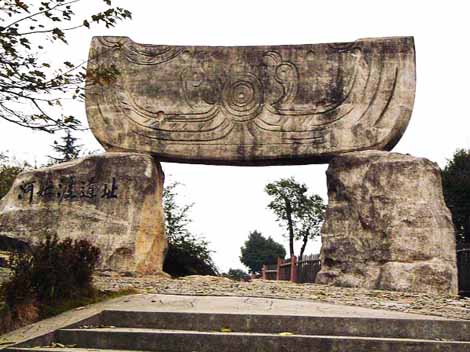
Hemudu Relics, a neolithic cultural site located in the lower reaches of Yangtze Valley, got its name after that of Hemudu Town in Yuyao city of Zhejiang Province where the site was initially discovered. Hemudu Culture has been verified to range from 5000 B.C. to 3300 B.C.
Living utensils of Hemudu Culture mainly consist of pottery vessels, with a few wooden wares as supplementary. Stone tools are mostly ground artifacts but with little delicacy. In contrast, the making of bone wares reaches certain height. Some are even carved with exquisite patterns to be featured in both practicability and aesthetics. In agriculture, rice was planted to facilitate the possibility of storing up surplus grain, which led to the discrepancy between the rich and poor. Thus a new phase of civilization development unfolded itself. Besides, the primitive spinning wheels, bone needles and ceramics engraved with cloth lines have been unearthed, which reflect the progress of weaving skills in that period. Decorative objects made of jade and fluorite materials are in great variety and with refined craftsmanship, representing the level of neolithic culture. The red-lacquered bowl uncovered here, with a history of 7,000 plus years, is the earliest lacquer ware in China.
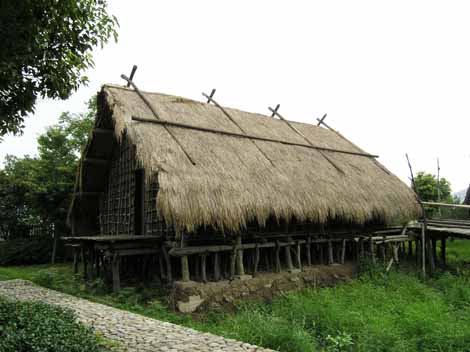
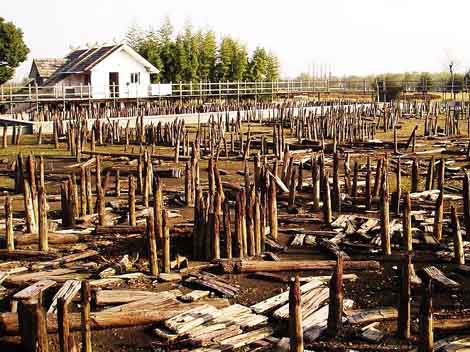
The inhabited areas in the age of Hemudu Culture were in the form of all-sized villages. Plenty of house foundations have been found at the relics, which deliver the message that the architecture at that time was mainly in stilt style. It is one of the important architectural forms in the south of the Yangtze River since the neolithic age and is enormously different from the half-crypt houses in north China in the same period. Up to date, Hemudu boasts the earliest stilt houses ever.
Hemudu Culture, not similar to Yangshao Culture of the Yellow River Valley, represents the civilization of Yangtze Valley in south China as another major thread going through the development of ancient Chinese culture. The discovery of Hemudu Relics has proved the fact that Neolithic culture situated in lower reaches of Yangtze River also serves as a principal origin of Chinese civilization.