Singapore: Consorzio Vino Chianti Classico at the 2009 World Gourmet Summit


Singapore's 2009 World Gourmet Summit (WGS) went out on a bit of limb this year with its wine events. True, there were still a few safe bets featuring winemakers that were sure to pull in the crowds including Michael Sillaci of Opus One and Didier Cuvelier of Chateau Leoville-Poyferre. But there were also a number very brave wine affairs introducing wines that are not so blindly worshipped, such as those of Priorat, Parker Coonawarra, Yering Station and Robert Weil. But perhaps WGS's most precarious position on its nonconformist cordon this vintage was to feature two full days of events focused around one of the world's most historic and finest quality wine consortiums representing a region that is often snubbed here in Singapore: Consorzio Vino Chianti Classico.
Founded in 1924 by just 33 growers, today's Consorzio Vino Chianti Classico is one of the world's best established producer consortiums. There are currently 566 members farming 7200 hectares of vines devoted to Chianti Classico wines giving a total annual production of around 260,000 hl. (A further 2000 hectares of land within this region is committed to making IGT wines, many referred to as "Super Tuscans".)
In Asia, Japan is a significant market for Chianti Classico; it's the sixth largest export market accounting for 6% of the region's total sales. But while demand is growing in Singapore, the Consorzio has a long, long way to go here to catch up with the popularity of Bordeaux and its New World reared counterparts or even that of Chianti Classico's precocious younger siblings – the Super Tuscan cult labels.
The Consorzio's events and hosts were adeptly organised by WGS' well-connected wine consultant, Dr NK Yong. Four visiting guests were brought over especially for the occasion: Giovanni Manetti of Fontodi, Paolo de Marchi of Isole e Olena, Marco Pallanti of Castello di Ama and independent consultant and wine critic, Daniel Thomases.
The WGS events kicked off on Sunday, 26th April with a Wine Fair at The Saint Regis Hotel featuring more than twenty different stands each showcasing a different winery, including top names like Ruffino, Castello di Ama, Fonterutoli and Felsina. Manning their stands were Giovanni Manetti of Fontodi and Paolo de Marchi of Isole e Olena, offering attendees the rare opportunity to meet these great winemakers and have their questions answered. Nearly all the wines shown were available to purchase on the day via local distributors making this both a fun and practical opportunity for locally based winos.
The Wine Fair was directly followed by a Chianti Classico Symposium chaired by Giovanni Manetti (Fontodi), Marco Pallanti (Castello di Ama), Paolo di Marchi (Isole e Olena), Daniel Thomases and moderated by Dr NK Yong. Attended by around 80 guests, this educational tasting and tutorial provided a chance to learn about the region in-depth, touching on key quality issues such as the percentage of Sangiovese used in blends, altitude of vineyards and soil types. Twelve superlative Chianti Classico wines from the excellent 2004 vintage were shown to illustrate the points raised.
The next day WGS hosted a press lunch at the St. Regis' Yan Ting restaurant, giving us journalists a few more wines to taste and an opportunity to present questions to the visiting guests. I threw out a broad, open-ended question about the relative differences and quality levels of recent vintages in Chianti Classico. Daniel Thomases began the discussion by giving a run-down of his take on vintages since 2000:
2001 – Cool, late in the season but generally very good.
2002 – Rains at harvest, terrible.
2003 – Difficult because of the heat.
2004 – Very usual and traditional year. Long growing season, excellent quality and good maturity.
2005 – "Interesting" vintage. Some rain.
2006 – Beautiful year.
2007 – Good but more selective vintage.
2008 – Good year but a bit of rain leading to difficult ripening.
"But", Thomases stipulated at the end, "Chianti Classico is a large region with a lot of variation."
Paolo di Marchi interjected here, "2008 was a good vintage."
Giovanni Manetti agreed, "The main problem was the small crop."
I then asked about favourite vintages of the 1990s, sparking Manetti to announce, "Everyone is always saying that 1997 was the vintage of the century but for me 1999 was better. The wines show greater typicity."
"1993 is a very under-rated vintage," added di Marchi. "1993 is one of those vintages that showed itself after a few years in bottle."
"I have a sneaky love for 1995 wines from Chianti Classico and Montalcino," Thomases confided. "One of the coolest vintages of the 1990s, saved in September / October. Nice long, slow ripening."
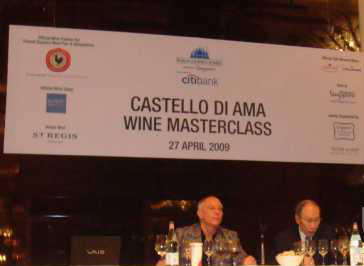
That afternoon WGS hosted a Castello di Ama Masterclass showcasing eight samplings, including some rare older vintages of this top producer's wines. The estate's director and winemaker, Marco Pallanti, gave fascinating insight into the estate's terroir and techniques. Also moderating were Daniel Thomases and Dr NK Yong injecting their perspectives and considerable experience into the proceedings.
The grand finale of the two days was a gala dinner pairing a selection of Chianti Classico wines with the cuisine of iconic three Michelin starred Chef Heinz Beck, flown from his restaurant La Pergola in Italy for WGS. Seven wonderfully inventive though intrinsically Mediterranean courses were paired with nine wines including four incredible IGTs: 2005 Flaccianello della Pieve, Fontodi; 2005 Castello di Brolio Casaferro; 2005 Siepi, Castello di Fonterutoli and 2001 L'Apparita, Castello di Ama.
All tolled, apart from furthering my own passion for the undervalued wines of Chianti Classico, the events gave me the opportunity to taste more than fifty stellar wines from this multifaceted region, with the tasting notes posted below. IGT wines are listed separately at the very end.