Swan District


Overview
The historic Swan District region is unique for its location and wines. Straddling the banks of one of the state's treasures, the Swan River, and adjacent to the booming, bustling Perth metropolitan area, the Swan District can be reached in only 30 minutes from the CBD.
The Big Picture
The first vines at Olive Farm were planted in 1829 by Thomas Waters, and the following year he dug out the wine cellar that is incorporated in the present winery of the same name. For almost 150 years it was the only significant wine-producing region in Western Australia and is today also home to the state's largest winery, Houghton. It is an actively multicultural area, with the descendants of early Yugoslav, Italian and English migrants continuing the region's winemaking traditions.
Like most of the Australian wine industry, the Swan District's only subregion, Swan Valley, produced fortified wines for much of the first 100 years, slowly turning to table wines as market demand for such styles increased. Pioneers in the development of table wines include the legendary Jack Mann at Houghton in the 1930s and 1940s and John Kosovich at John Kosovich Wines in the 1960s and 1970s.
The region is a flat alluvial plain flanked by the Darling Range and watered by the Swan River and its tributaries. The Gingin and Moondah Brook areas are set on gentle slopes in the north of the region.
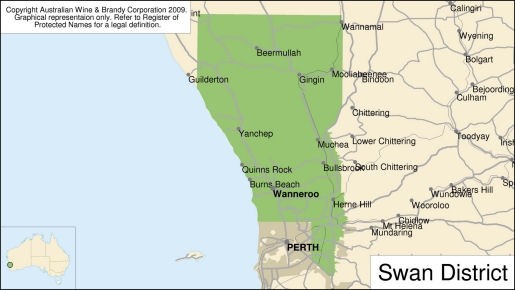
Swan District Wine Region
Climate
The Swan District proper has a warm to hot Mediterranean climate. It is very dry during ripening and harvest, with most rainfall (167mm or 6.5 inches) occurring during winter and spring. It has an extremely high mean January temperature of 24.15°C (75.5°F), a low relative humidity of 44% and a high 1791 total sunshine hours during the growing season. The district is relieved from the heat by the famous Fremantle Doctor ─ the south-westerly sea breeze. Verdelho, Chardonnay, Chenin Blanc, Shiraz and Cabernet Sauvignon excel in the warm, dry growing conditions.
The Gingin/Moondah Brook area is somewhat cooler and, although still at the very warm end of the climatic spectrum, it has consistently demonstrated a surprising capacity to produce full flavoured, full bodied white whites, particularly with Chenin Blanc, Verdelho and Chardonnay.
Soil
The soils of the Swan District are typically young alluvial soils; very deep, with excellent moisture retention capacity. Soil types vary widely, from deep draining sand over limestone along the coastal strip around Wanneroo to well drained gravelly loam along the fringes of the Darling Scarp, deep rich red loam around the Swan River and grey sand over clay in the Herne Hill flats of the Swan Valley subregion. On the lower slopes of the Darling Range is the highly suited gravelly sand to gravelly sandy loam overlying brown clay.
Wines
Chenin Blanc: This is one of the principal varieties in the Swan District. In this climate the wine produced has a certain luscious richness, which responds well to bottle age, producing a full-flavoured white of almost voluptuous dimensions.
Chardonnay: The plantings are increasing and one or two producers have produced some very good, buttery, peachy wines from this grape, which comes from a measure of barrel ferment.
Verdelho: This traditional variety was appreciated well before it came into vogue in the eastern states during the 1980s. Many wineries produce a varietal wine from Verdelho and are usually content to allow the rich honeyed, honeysuckle flavours free reign without introducing new oak.
Shiraz: The Swan District is sharing in the surge of Shiraz plantings, a variety which has shown its ability to produce quality wine in virtually all climatic conditions.
Blended White Wines: One of Australia's largest selling and eternally popular white wine wines is from this area; Houghton White Burgundy. Sold under other names in export markets, it is the result of the coalescence of three principal white varieties. Despite its modest price and very large volume, this blend has the capacity to age magnificently for five to ten years.