Perth Hills


Overview
The Perth Hills wine region extends along the Darling Scarp – just east of the state capital Perth, from Chittering in the North to Serpentine in the south. Most producers are reached in an hour or less from the Perth CBD.
The Big Picture
Viticulture has been practised intermittently in the picturesque Perth Hills amidst the Darling Ranges for over a century, but on a generally tiny scale. The first vineyard was planted in Darlington in the 1880s, followed by a second in Glen Forrest in 1896. While Despeissis was able to report in 1902 that grapes grown in the Mundaring-Chidlow area ripened two to three weeks later than in the Swan Valley, the earliest of the present day wineries in the region date back to the mid1970s.
For a long time very few of the region's wineries crushed more than 50 tonnes. However, Western Range Wines has now established a vineyard of 100 hectares (40.47 acres) in the Chittering Valley and a much greater regional production is anticipated. The region is very different to the Swan District and is only 22 kilometres from Perth, making it easily accessible to day trippers.
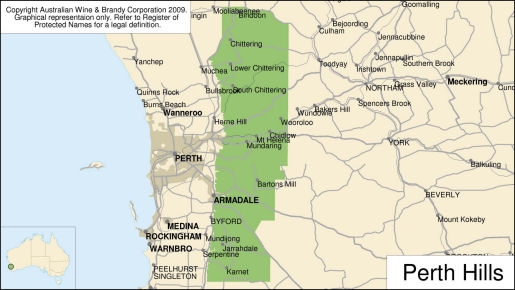
Perth Hills Wine Region
Climate
As expected, the climate varies significantly with altitude, but also with the orientation of the maze of valleys that criss-cross the Perth Hills. The tempering influences which reduce the heat summation and delay ripening for 10 to 21 days (compared to the Swan Valley) are the altitude (generally between 150 and 400 metres), the free air flow and exposure to afternoon sea breezes.
The annual rainfall of 900 to 1200 mm (35 to 47 inches), depending on altitude, is strongly winter-spring dominant and, given adequate dam and thus irrigation sites, the climate poses no problems for the vigneron. Overall, Dr John Gladstones likens it to that of the Douro Valley in Portugal, which is perhaps why it should be more suited to dessert wines and fuller bodied reds than to lighter bodied table wines.
Rivulets and often dry creek beds, ridges, hills and valleys criss-cross the region in every direction, offering an almost unlimited choice of aspect and slope, but those cut off from the sea breeze influence tend to be warmer rather than cooler.
Soil
The valley slopes have ironstone and gravel sandy loams as well as gravelly loams which overlay clay, similar in type to much of south-west Australia, and were once covered with marri forests. They are well suited to viticulture, being of moderate fertility and producing moderate yields.
Wines
Chardonnay: The ubiquitous Chardonnay does not disappoint and the best white wines from the Perth Hills region have been made from this variety. One would expect the style to be generous, and it usually is, but some are quite tight.
Cabernet Sauvignon and Merlot: These are frequently blended, sometimes released as straight varietal wines, and produced by the majority of the wineries in the region. The wines are reliable and pleasant; full flavoured, with chocolatey, earthy and berry flavours.
Shiraz: The winemakers of the Perth Hills share with their colleagues in many other Australian wine regions an enthusiasm for Shiraz which here, as in other warmer regions, is generously fruit driven.
Vital Statistics
| Map Coordinates | 31° 59'S |
|---|---|
| Altitude | 150-400 m (492-1312 feet) |
| Heat degree days, Oct-Apr | 1770 (cut off at 19ºC (66.2ºF) but otherwise not adjusted) |
| Growing season rainfall, Oct-Apr | 220-250 mm (8.6-9.4 inches) |
| Mean January temperature | 23.3°C (74°F) |
| Relative humidity, Oct-Apr, 9 am | Average 61% |
| Harvest | Late Feb - Apr |