Peel


Overview
Just 40 minutes' drive south of Perth, Peel is an emerging wine region with its 200 hectares of wine grapes grown over a considerable area. Some are mature plantings, while others have become part of the wine industry over the past few years.
The Big Picture
Peel lies between the Swan District and Perth Hills to the north and Geographe to the south.
The European settlement of Peel dates back to 1829 when a visionary named Thomas Peel brought three ships of migrants from England for the Peel Settlement Scheme. In 1846 the first lead, silver and zinc mine was opened in West Australia. Although short-lived, it presaged the large-scale mineral sands, gold and bauxite mining and the processing operations that commenced during the 1970s.
The first vines were planted in 1857. However it was not until the 1970s that more significant developments have taken place in what has been a rapidly expanding area for numerous lifestyle activities. The first commercial vineyard was established with a planting of Shiraz by Will Nairn at the Peel Estate in 1974. While most other varieties have also now been established, Shiraz remains the flagship variety for the region.
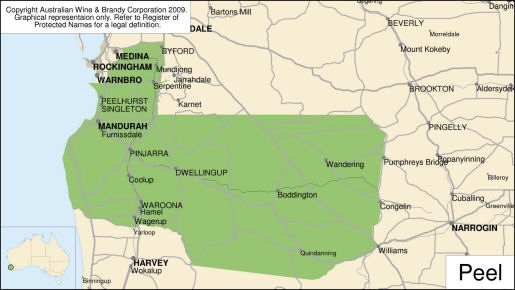
Peel Wine Region
Climate
The coastal region has a Mediterranean climate with cool, wet winters and hot dry summers. The sea breezes moderate extremes; inland and at higher altitudes land breezes are stronger, rainfall higher and temperatures slightly lower.
The region’s massive expanses of water, as well as the Indian Ocean to the west, ensure a consistent supply of cooling summer sea breezes to maintain cool temperatures for optimum grape ripening.
Soil
The eastern extension of the Peel region, incorporating the Darling plateau around Boddington/Wandering/Mount Saddleback, includes very old granite and gravel soils. These are totally different to the limestone sands and fluvial sediments of the coastal area, which have significant ground-water reserves three to 15 metres (49 feet) below the surface.
Wines
Chenin Blanc: This was the first white grape to be planted in Peel. The wine is produced with or without oak and gains character and depth with short to medium-term cellaring.
Chardonnay: Planted in most of the localities throughout the region, this wine attests to the versatility of the variety. Character notes range from melon and stonefruit to rich and buttery.
Cabernet Sauvignon: Planted in many parts and producing a medium-bodied wine, Cabernet is slightly firmer when grown inland at higher elelvations.
Shiraz: Not only the longest established in the region, the Shiraz is arguably the most successful variety, particularly around the Peel Estate. Overall, the style is medium-bodied with sweet, fine, ripe tannins.
Vital Statistics
| Map Coordinates | 32°31'S |
|---|---|
| Altitude | 5-290 m (16-951 feet) |
| Heat degree days, Oct-Apr | 2300-2350 (cut off at 19ºC (66.2ºF) but otherwise not adjusted) |
| Growing season rainfall, Oct-Apr | 160-280 mm (6.2-11 inches) |
| Mean January temperature | 22-23°C (72-73°F) |
| Relative humidity, Oct-Apr, 3 pm | Average 49% |
| Harvest | Mid Feb - Mid Mar |