Geographe


Overview
Formally established as a wine region in 1999, Geographe extends through the shires of Harvey, Collie, Dardanup, Donnybrook, Capel and eastern Busselton, and produces wine grapes with full fruit flavours ensuring exciting wines. Tastings are available at 11 facilities in the Donnybrook area, nine in Harvey, eight in the Dardanup-Ferguson Valley and three south of Bunbury.
The Big Picture
Geographe is a compact region unified by its warm to hot and mostly maritime-influenced climate. More than 1,200 hectares are under vine, some 10% of Western Australia’s vineyards, underwriting the region as a major contributor to premium wine production.
The Harvey River meanders through the northern boundary on its way to the coast. Bunbury, 140 kilometres (87 miles) south of Perth, is the region's commercial centre, with Busselton at its south-western corner. The region is watered by several rivers, chiefly the Capel, Ferguson, Collie and Brunswick rivers which, during their descent from the Darling Ranges in the east over millions of years, have created fertile valleys on their way to the coast.
Overall, this is an area of considerable beauty with a varied topography that results in an impressive landscape. The magnificence of the gum trees, ranging from the tuart forests of the coastal sands of the same name through to marri and karri eucalyptus further inland, is internationally renowned and combines with the spectacular native shrubs and flowers to make this region unique.
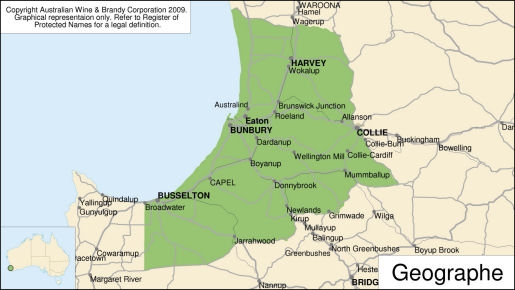
Geographe Wine Region
Climate
In this region, what might in other more Continental areas be considered excessively warm temperatures are modified by the prevailing south-west sea breezes coming off the Indian Ocean. Summers are dry but rainfall is generous during winter and relative humidity is quite high.
While there are as yet no officially recognised subregions, there are three quite distinct areas. The first is the true coastal sector, stretching from Bunbury in the north to Busselton in the south, and with the lush, peaceful Capel River and the town of Capel at its centre. Wholly maritime-influenced by the warm Indian Ocean, its climate is similar to that of the northern part of the Margaret River, although the soil types vary considerably.
The Donnybrook area is next and has a distinctly different climate, as it is cut off from the maritime influence of the Indian Ocean by the intervention of the Darling and Whicher Ranges. The net result is a Continental climate, which Dr John Gladstones describes as closely resembling that of Bendigo and Rutherglen in Victoria, with considerable diurnal temperature fluctuations.
The third area is the valley of the Ferguson River where early success with Sauvignon Blanc, Shiraz, Merlot and Cabernet Sauvignon has led to a rapid expansion in plantings. The largest venture is Willow Bridge Estate, with a 100-hectare vineyard and a 2,000-tonne capacity winery.
Soil
The coastal tuart sands have limestone as their parent material and overlie limestone. A permanent water table at a depth of between three and 15 metres (10 to 49 feet) is a further aid to viticulture. However, low natural fertility and ready leaching of nutrients mean that care has to be taken to achieve the best results. The soils of the traditional farming and orchard land at Donnybrook are richer, being either gravelly sandy loams or heavier soils derived from the gneissic country rock in the valleys.
Wines
Chardonnay: Chardonnay is propagated everywhere in the region, producing wines which reflect the varying site climate and, of course, the hand of the winemaker. The cooler sites produce wines with intense grapefruit characters, while the warmer sites veer through melon to butter and cashew. All develop well in bottle over the medium term.
Semillon: It comes as no surprise to find that Sauvignon Blanc and Semillon tie as the second most widely planted varieties in this region, a tribute to the popularity of the crisp white which is a pleasing product of their union. It produces a tangy wine with grassy herbal overtones; a light touch of oak is an optional extra.
Cabernet Sauvignon: Cabernet Sauvignon, whether blended with Merlot or not, tends to be finer and more elegant than that of either the Margaret River or the Mount Barker regions, with lingering, soft fine-grained tannins. However, the spread of plantings inland from the coast will result in more diverse styles, particularly when the newer vineyards reach maturity.
Shiraz: The Shiraz is the most important grape, usually presented as a varietal wine but also used in complex multi-blends. The weight and extract varies substantially, from the more robust to softer and perhaps more elegant styles, but each with a core of cherry and mint fruit.
Vital Statistics
| Map Coordinates | 33° 18'S |
|---|---|
| Altitude | 5-70 m (16 - 230 feet) |
| Heat degree days, Oct-Apr | 1700 (cut off at 19º C but otherwise not adjusted) |
| Growing season rainfall, Oct-Apr | 185-220 mm (7.3-8.6 inches) |
| Mean January temperature | 22°C (71.6°F) |
| Relative humidity, Oct-Apr, 3 pm | Average 60% |
| Harvest | Early Feb - Mid Mar |