Margaret River


Overview
Located approximately three hours' drive south of Perth, the vibrant Margaret River region enjoys a growing reputation as one of the most popular destinations in Australia thanks to its exceptional range of restaurants, accommodation and tourist activities.
After a much-publicised birth in the early 1970s prompted, in part, by Professor Harold Olmo's research but, more importantly, that of Dr John Gladstones in 1965, the region briefly lost its momentum in the late 1980s before emphatically regaining it in the 1990s.
The Big Picture
The Margaret River area includes the rolling hills of the Leeuwin-Naturaliste Ridge, extending 90 km north-south between Cape Naturaliste and Cape Leeuwin, and is bounded to the west by the Indian Ocean.
Initially regarded as a producer of powerful yet elegant Cabernet Sauvignon, the region has also forged a great reputation for its white wines, notably Chardonnay and Semillon Sauvignon Blanc blends. However, it is capable of producing all the classic varietal wines.
In the last 20 years, plantings have increased tenfold and wine producer numbers have increased six times to more than 120. Between them they crush more than 35,000 tonnes.
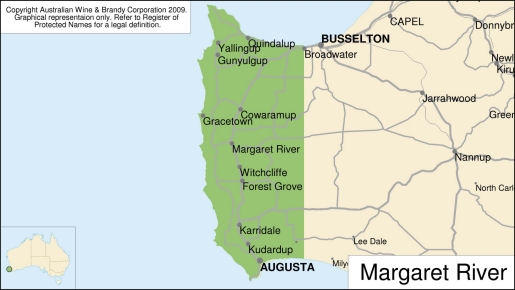
Margaret River Wine Region
Climate
Margaret River's climate is strongly maritime-influenced, as might be expected in a region surrounded by the ocean on three sides. With a mean annual temperature range of only 7.6°C (45.68°F), it also has, for good measure, the most marked Mediterranean climate in terms of rainfall, with less than 25% of its annual rain falling between October and April. The low diurnal and seasonal temperature range means an unusually even accumulation of warmth. While spring frosts are very rare and highly localised, lack of winter dormancy and salty winds during spring can cause problems that are unique to this region.
Soil
The varied landscape is given character by the abundance of small creeks and gentle valleys, as well as the profusion of native trees, shrubs and flowers. In physical terms, a degree of protection from winds blowing in from the ocean is the most important factor. The principal soil type is that of the ridge which runs from Cape Naturaliste to Cape Leeuwin; it is predominantly gravelly or gritty sandy loam that has formed directly from the underlying granite and gneissic rock. The soils are highly permeable when moist but moisture is quickly shed from sloping sites.
Wines
Chardonnay: One of the pioneers of Chardonnay in the region, the Leeuwin Estate Art Series is, by the reckoning of many, one of Australia's greatest examples of the variety. But Leeuwin is by no means the only producer of outstanding Chardonnay, which seems to acquire an extra dimension that stems from, and is unique to, the Margaret River region. It is more concentrated, more complex, more viscous and more tangy, yet does not cloy nor become heavy. The voluptuous fruit lends itself to the full range of winemaking techniques and the region's winemakers do not shirk from using them.
Sauvignon Blanc and Semillon: The permutations of these two varieties – used either as single varietals or as blends with one or other component dominant, or supplemented by Chenin Blanc to produce a regional specialty often called Classic Dry White – seem endless. But in most vintages the region welds the two varieties together in a way which no other area does: the Semillon (and even Chenin Blanc) acquires a pleasantly herbal grassy cut which imperceptibly shades into Sauvignon Blanc. Intensity and elegance similarly coalesce in wines that are seldom less than distinguished.
Cabernet Sauvignon: Wines from the aristocratic red grape Cabernet Sauvignon were the first to win acclaim in Margaret River for their consistently high quality. This is the wine upon which Margaret River's reputation was founded and in no small measure upon which it rests today. Virtually every winery produces a Cabernet although Merlot is an increasingly common blend component. The style has evolved over the decades, with a cross-hatch of winemaker and viticulturist inputs giving rise to a number of distinctive and stylish interpretations of Cabernet and Merlot. The common threads are physiologically ripe grapes that provide a sweet core to all the wines, which are never leafy or herbal, and often with slightly earthy or gravelly tannins. These latter characteristics are very much a product of the local terroir, which needs to be controlled but provides complexity, authority and structure.
Vital Statistics
| Map coordinates | 33°57'S |
|---|---|
| Altitude | 40 m (131 feet) |
| Heat degree days, Oct-Apr | 1690 (cut off at 19°C (66.2°F) but otherwise not adjusted) |
| Growing season rainfall, Oct-Apr | 200 mm (7.9inches) |
| Mean January temperature | 20.4°C (68.7°F) |
| Relative humidity, Oct-Apr, 3 pm | Average 59% |
| Harvest | End Feb - Mid Apr |